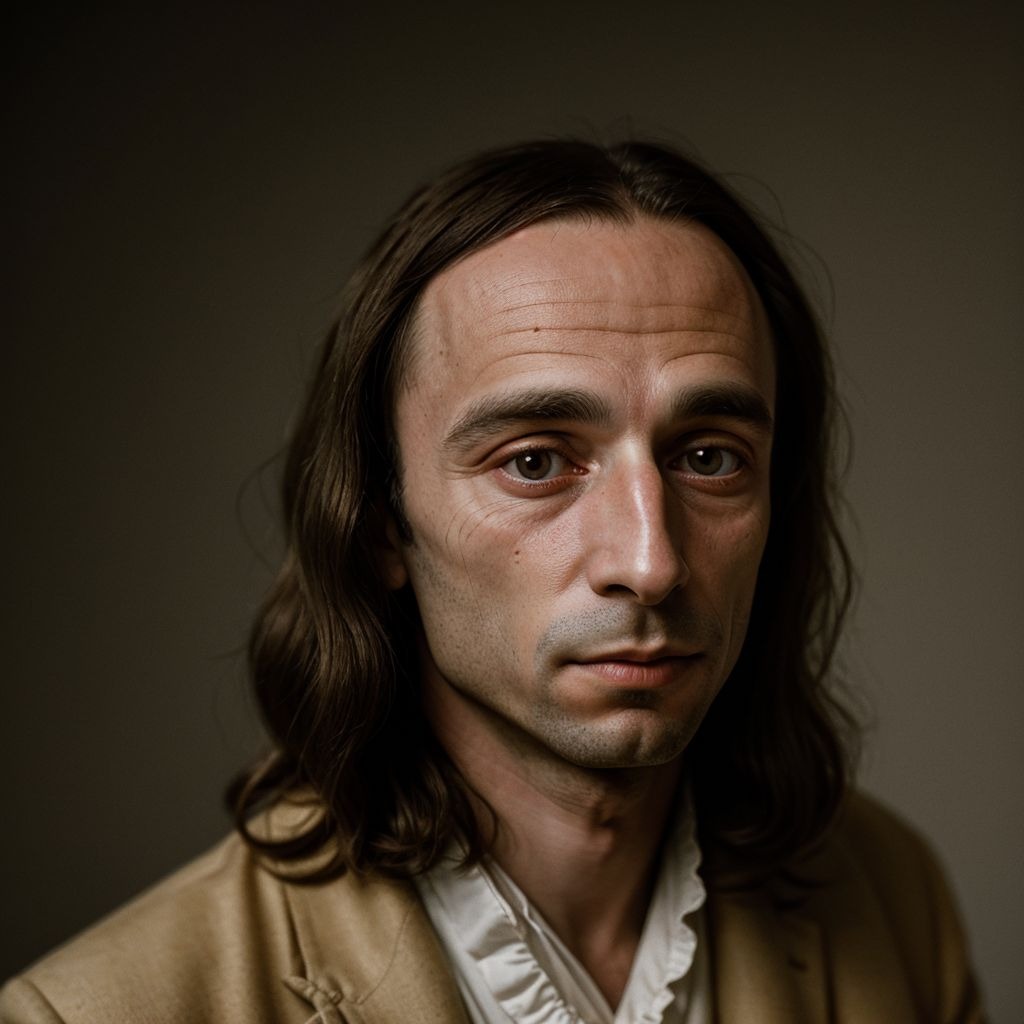
Blaise Pascal. I’ve always been fascinated by him, but not in the way you’d expect. It’s not his mathematical genius or his contributions to science that draw me in – although those are impressive, don’t get me wrong. What really resonates with me is the complexity of his personality.
I think about how he was both a rational thinker and a deeply spiritual person. His famous wager, where he argues that it’s safer to believe in God than not, feels like a reflection of my own inner turmoil. As someone who’s struggled with faith and doubt, I find myself relating to Pascal’s ambivalence. He wasn’t afraid to acknowledge the uncertainty that comes with questioning everything.
But what really gets me is how Pascal was also incredibly anxious and melancholic. His writings on the subject are some of the most poignant I’ve ever read – a mix of philosophical musings and personal confessions. It’s like he’s sharing his innermost fears and insecurities, making it impossible to separate the man from his work.
I remember reading about how Pascal’s health issues led him to take long periods of rest and contemplation. He’d retreat to his chambers, away from the world, and write some of his most profound thoughts on paper. It’s as if he was trying to outrun his own demons – the anxiety, the self-doubt, the existential crises.
I’ve had my share of anxiety attacks, too. The feeling of being lost in a sea of uncertainty, unable to grasp what lies ahead or find any semblance of control. Pascal’s struggles with these same emotions are both comforting and terrifying at the same time. It’s like I’m not alone in this messy, confusing world.
But here’s where things get complicated: Pascal’s writings on anxiety often feel… tidy. Like he’s somehow contained it within the lines of his text. His logic and reason seem to provide a sense of resolution – even if it’s just temporary. Meanwhile, my own anxiety tends to be more chaotic, less rational. It’s like two different languages speaking past each other.
I wonder: does Pascal’s writing represent a kind of intellectual escapism? A way for him to temporarily outrun his fears and doubts? Or is it something more profound – a genuine attempt to understand and make sense of the world?
As I ponder this, I’m reminded of my own writing habits. I use words as a way to think through problems, to untangle the knots in my mind. It’s not always easy, but it helps me process the messiness of life. Maybe that’s what Pascal was doing too – using his writing as a form of emotional excavation.
But even with all this introspection, I’m left with more questions than answers. What is it about Pascal’s anxiety that feels so… relatable? Is it because he’s articulating emotions I’ve never put into words? Or is it something deeper, a shared human experience that transcends time and circumstance?
I suppose what draws me to Pascal is the recognition that even someone as intellectually gifted as he was struggled with similar fears and doubts. It’s a humbling reminder that our greatest strengths can also be our biggest weaknesses – and that sometimes, it’s okay not to have all the answers.
As I put down my pen (or rather, close this laptop), I’m left with more questions than ever. But maybe that’s the point. Maybe Pascal’s writing is less about providing solutions and more about embracing the uncertainty that comes with being human.
I find myself returning to Pascal’s concept of the “misery” of human existence – a phrase that he uses to describe our inherent desire for happiness and fulfillment, but also our tendency to sabotage it through our own flaws and weaknesses. As someone who has struggled with self-doubt and anxiety, I see this as a profoundly relatable idea.
Pascal writes about how we are all “carried along by the stream of our passions” – how we are swept up in our desires, emotions, and whims, without ever truly being in control. It’s a notion that resonates deeply with me, especially during times when I feel overwhelmed by my own thoughts and feelings.
But what struck me most is Pascal’s acknowledgment of his own complicity in this misery. He recognizes that he is not immune to the same flaws and weaknesses that afflict everyone else – that even the greatest minds can be trapped by their own ego, pride, or irrational fears. This self-awareness, I think, is a testament to his remarkable honesty as a writer.
I’m reminded of my own writing struggles when I feel like I’ve lost control over my thoughts and emotions. It’s as if I’m drowning in a sea of words, unable to make sense of anything. But Pascal’s words offer me a lifeline – a reminder that even in the midst of chaos, there is always a way forward.
I wonder: how does Pascal’s concept of misery relate to his idea of the “vacuum” of human existence? He writes about how we are all searching for meaning and purpose in life, but often find ourselves empty-handed. Is this sense of emptiness what he means by the “misery” of being human?
As I continue to ponder these questions, I start to see parallels between Pascal’s ideas and my own experiences with creativity. When I’m struggling to write, it feels like a vacuum has opened up inside me – a void that threatens to consume everything in its path. But when I finally manage to put words on paper, there is a sense of satisfaction, of fulfillment, that fills the space.
Pascal’s writing may not provide easy answers or solutions to our problems, but it offers something more profound: a recognition of the human condition – all its complexities, contradictions, and messy uncertainties. And in this, I find a strange kind of comfort.
As I delve deeper into Pascal’s ideas, I’m struck by the way he weaves together disparate threads of thought and emotion. His writing is like a rich tapestry, intricate and multifaceted. It’s as if he’s trying to capture the very essence of human experience – all its joys and sorrows, triumphs and failures.
I find myself drawn to his concept of “infinite regret.” He writes about how we are all haunted by our past mistakes, regrets that can’t be undone or forgotten. I know this feeling all too well. There have been times when I’ve replayed conversations in my head for hours, wondering what I could have done differently. Pascal’s words offer me a strange kind of solace – the recognition that I’m not alone in my own regret.
But here’s the thing: Pascal doesn’t just leave us with regret; he offers a way out. He suggests that by acknowledging our mistakes and shortcomings, we can begin to let go of them. It’s like he’s saying, “Yes, you messed up, but you’re not defined by it.” This is incredibly liberating – especially for someone who’s struggled with self-criticism.
As I reflect on Pascal’s ideas about regret, I’m reminded of my own writing struggles. When I’m stuck, I often find myself trapped in a cycle of self-doubt and criticism. “This is terrible,” I tell myself. “I’ll never be able to write something good.” But what if I’m wrong? What if Pascal’s right – that by acknowledging my mistakes and limitations, I can begin to break free?
It’s funny; the more I read about Pascal, the more I realize how little I know about him. Despite his intellectual brilliance, he was a deeply human being – flawed, vulnerable, and uncertain. This realization both comforts and unsettles me. It’s comforting because it makes me feel less alone in my own struggles. But it’s unsettling because it reminds me that even the greatest minds are still searching for answers.
As I close this laptop (again), I’m left with more questions than ever. What is it about Pascal’s writing that speaks to me on such a deep level? Is it his intellectual curiosity, or is it something more profound – a sense of shared human experience? And what does it mean for me, as someone who struggles with anxiety and self-doubt, to be drawn to this complex and multifaceted person?
I suppose the answers will have to wait. For now, I’m content to continue exploring Pascal’s ideas – to see where they lead me, both intellectually and emotionally. And who knows? Maybe someday, I’ll stumble upon a new insight or perspective that will change everything.
As I continue to delve into Pascal’s world, I find myself fascinated by his concept of the “geometrical” nature of human thought. He writes about how our minds are prone to categorization and compartmentalization – how we tend to reduce complex ideas and emotions to neat little boxes that can be easily understood and analyzed.
I see this tendency in my own writing, where I often try to break down complex feelings into manageable pieces, hoping to make sense of the chaos within me. But Pascal’s words suggest that this approach may not always be sufficient – that sometimes, we need to acknowledge the messy, illogical nature of human experience.
This resonates with me on a deep level, as someone who has struggled with anxiety and self-doubt. There are times when I feel like I’m drowning in a sea of uncertainty, unable to make sense of my own thoughts and emotions. But Pascal’s writings offer me a glimmer of hope – the possibility that even in the midst of chaos, there may be a way forward.
I think about how Pascal often used his writing as a form of self-exorcism – a way to purge himself of his doubts and fears. This idea both intrigues and intimidates me. On one hand, I admire Pascal’s willingness to confront his own vulnerabilities; on the other hand, I worry that such honesty may be too much for my own fragile ego.
As I ponder this, I realize that Pascal’s writing is not just about intellectual curiosity – it’s also a deeply personal and emotional journey. He writes about his struggles with faith and doubt, his anxiety and melancholy, in a way that feels both intimate and universal. This makes me wonder: can I do the same? Can I find the courage to be as honest and vulnerable in my own writing?
The more I read Pascal’s words, the more I feel like I’m being pulled into a world of contradictions – a world where reason and emotion coexist in a delicate balance. It’s a world that is both beautiful and terrifying, full of paradoxes and uncertainties.
As someone who has always struggled with the idea of control, this concept resonates deeply with me. Pascal writes about how we are all subject to the whims of fate – how our lives are shaped by forces beyond our understanding or control. This can be a scary thought, especially when faced with uncertainty or adversity. But at the same time, it’s also incredibly liberating.
I think about how Pascal often used his writing as a way to surrender to this lack of control – to acknowledge that sometimes, we just have to let go and trust in the unknown. This is something I’ve been trying to learn myself – to recognize when I need to release my grip on things and trust in the flow of life.
As I continue to explore Pascal’s ideas, I’m struck by the way he weaves together seemingly disparate threads of thought and emotion. His writing is like a rich tapestry, intricate and multifaceted. And yet, despite its complexity, it feels strangely familiar – as if I’ve been here before, even if only in my own thoughts and feelings.
I wonder: what does this say about the human experience? Is it possible that we’re all connected by some deeper thread of understanding – a thread that transcends our individual struggles and triumphs? And what role does writing play in this process – is it a way to tap into this shared humanity, or simply a means of expressing our own unique perspectives?
As I close this laptop (again), I’m left with more questions than ever. But for now, I’m content to continue exploring Pascal’s ideas – to see where they lead me, both intellectually and emotionally. And who knows? Maybe someday, I’ll stumble upon a new insight or perspective that will change everything.