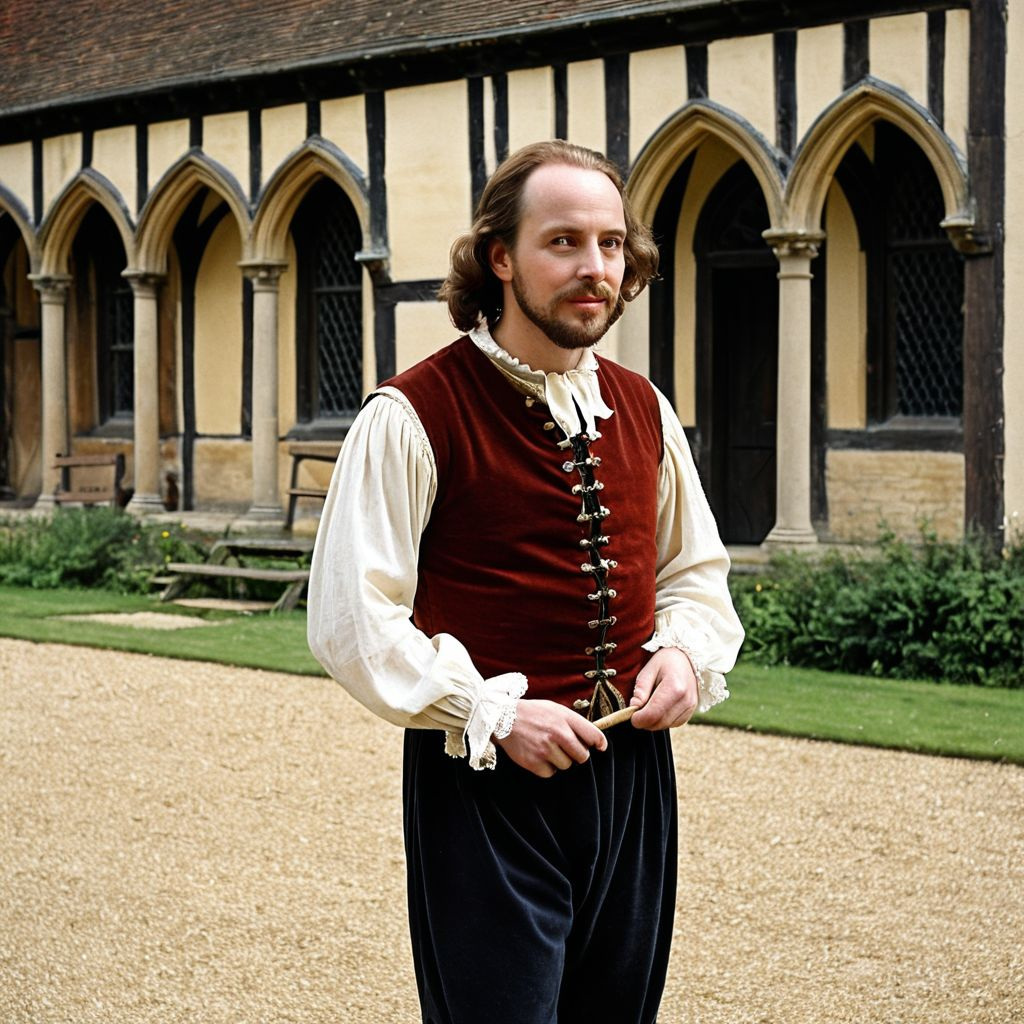
I wonder if anyone thought to mark this day, four and a half centuries ago, when a child named William Shakespeare was born into a modest house in Stratford-upon-Avon. England at the time was uneasy, still absorbing the aftershocks of religious upheaval and political uncertainty. For most families, a birth was not a moment of ceremony so much as calculation—another life folded into an already fragile balance of labor, cost, and hope.
Stratford was not an obvious beginning for someone whose words would one day travel the world. It was a market town shaped by routine and restraint, by the rhythm of trade and the quiet pressure of survival. I imagine the early textures of that life not as destiny, but as environment: the sound of carts on packed earth, the river moving steadily past its banks, the intimacy of a household where work and family were inseparable. His parents, John and Mary Shakespeare, were neither destitute nor powerful—situated somewhere in the wide middle where ambition often stays unspoken.
Whatever gifts Shakespeare carried with him were not immediately legible. There were no signs announcing a future playwright, no clear pathway toward the stage. His education, such as it was, would have been practical and uneven, shaped by circumstance more than design. And yet, something in that constrained world left an imprint. The lives around him—their compromises, their hungers, their small negotiations with authority—would later reappear not as symbols, but as people.
When he eventually found his way into London’s theatrical world, it was not through inheritance or favor alone, but persistence. Patronage mattered, as it did for nearly every artist of the time, but it did not explain his hold on audiences. What distinguished his work was its attention to contradiction. Power never appeared without vulnerability. Love never arrived untouched by fear. Even triumph carried the weight of consequence. These were not abstractions; they were recognitions.
I find myself returning, again and again, to the ordinariness of the beginning. A birth without ceremony. A childhood shaped by limits. A young adulthood spent navigating uncertainty. Nothing about that trajectory promised permanence. And yet, over time, his language began to settle into the culture, not as ornament, but as structure—phrases and rhythms that helped people articulate things they already felt but could not yet name.
Standing here now, centuries removed, it is tempting to compress that life into a neat arc, to speak of legacy as though it were inevitable. But the day itself resists that impulse. What it offers instead is a reminder of how often influence begins quietly, without announcement, shaped less by destiny than by attention. Shakespeare did not invent the human condition; he listened closely to it.
That, more than anything, may explain why his work endures. It does not demand reverence. It asks for recognition. The fact that we still return to this beginning—a single life entering a complicated world—says less about fame than about continuity. We keep reading him not because he stood above humanity, but because he stayed within it, attentive to its tensions, its limits, and its unspoken truths.