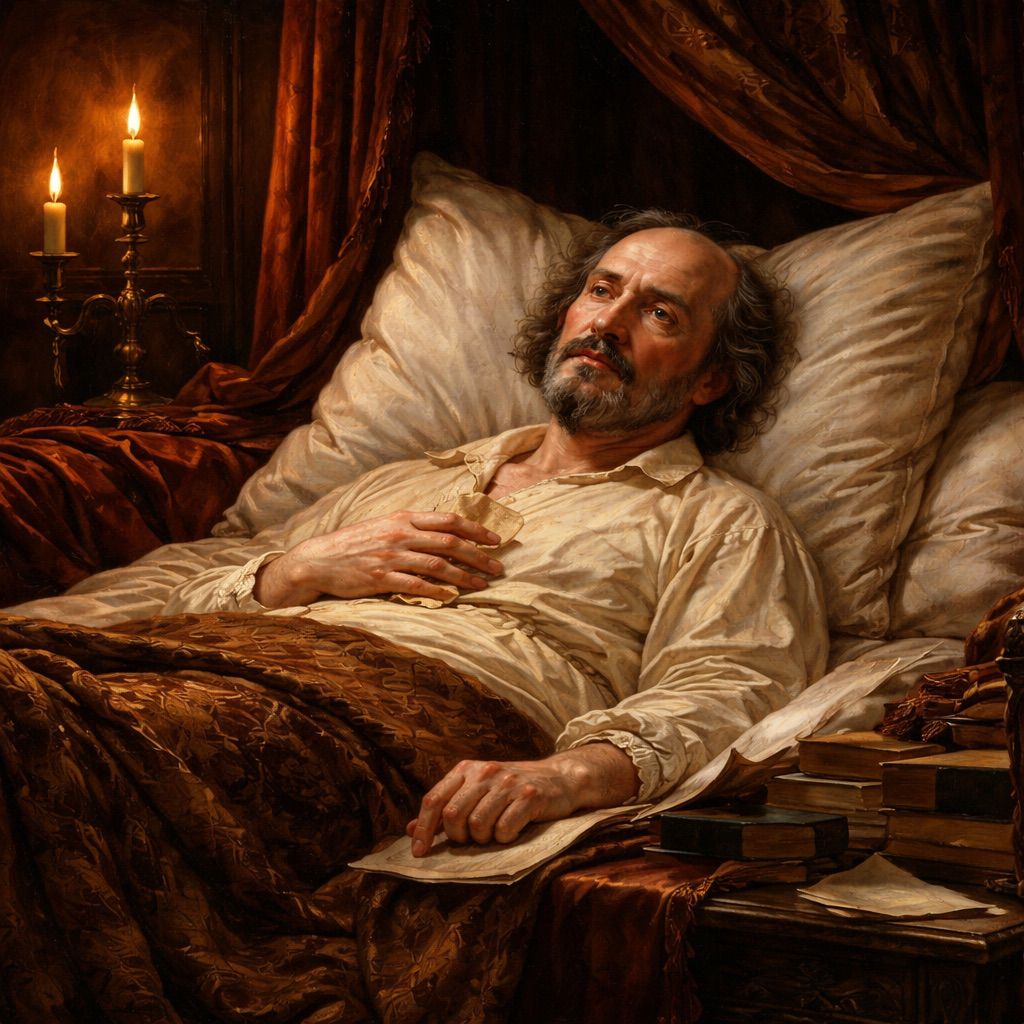
The chill of early spring seeps into Stratford’s streets, carrying with it whispers of mortality. In the town where Shakespeare lived, work, and raised his family, death looms like an unseen presence. It is April 23, 1616 – a day that will see the end of one life, but also marks the beginning of a new chapter in the lives of those left behind.
Shakespeare’s final hours are spent at home, surrounded by loved ones. His wife, Anne, and their family nurse, Judith Quiney, tend to his needs as he succumbs to a fever that has gripped him for days. The exact cause of Shakespeare’s illness remains unknown – some attribute it to malaria, others to dysentery – but one thing is certain: the great playwright will not be among us much longer.
As the sun sets on New Place, the Shakespeare family’s home in Stratford, the room grows quieter. The air thickens with an almost palpable sense of anticipation and grief. William’s body begins to weaken, his vital signs faltering as the life force slowly drains from him. I imagine standing at the window, gazing out onto the streets of Stratford – the sounds of laughter, music, and everyday conversation now muffled by the stillness within.
Shakespeare’s last words are a mystery, lost to history along with so much else about this momentous day. Some reports speak of his family being present, others claim he was alone in his final hours. What is known is that at 2 pm on April 23, William Shakespeare passes into eternity, leaving behind a legacy that will only continue to grow and evolve in the years to come.
The world outside New Place stirs, but for now, it’s as if time itself has slowed. The news of Shakespeare’s death spreads slowly through Stratford, gathering momentum like a whispered rumor on a summer breeze. Neighbors gather at the local taverns, sharing stories and anecdotes about the man they knew – the actor, playwright, poet who had brought them so much joy and inspiration.
In the days that follow, Shakespeare is laid to rest in the Holy Trinity Church in Stratford-upon-Avon. His epitaph, penned by himself, reads: “Good friend for Jesus sake forbeare / To dig the dust enclosed here.” It’s a poignant reminder of his own mortality, and the transience of life itself. As I ponder this moment, I am struck by the quiet intimacy of Shakespeare’s final moments – a man surrounded by loved ones, surrounded by the memories and experiences that had defined him.
April 23, 1616, is more than just the day William Shakespeare left this world behind; it’s also the beginning of a new chapter for his family, friends, and fans. The weight of his legacy will soon bear down upon them – an unspoken responsibility to carry on his work, to honor his memory in their own words and actions. And yet, even as they grieve, there is a sense of hope, of possibility, that seems to hang in the air like the scent of springtime flowers.
In this quiet moment, I am reminded of the power of art to transcend time and mortality – to speak directly to our deepest hopes, fears, and experiences. As Shakespeare’s body rests beneath the earth, his words continue to live on, speaking to us across the centuries with a wisdom that feels both ancient and ageless. His passing leaves behind a void, but it also creates space for new stories, new emotions, and new connections to be forged – a testament to the enduring power of art to shape our understanding of ourselves and the world around us.
The days following Shakespeare’s death are a blur of activity as his family and friends attend to the practicalities of laying him to rest. The town of Stratford-upon-Avon comes together to pay its respects, with neighbors and acquaintances gathering at Holy Trinity Church to bid farewell to the man who had brought them so much joy and inspiration through his words. I imagine the solemn processions, the soft murmur of prayers, and the quiet tears shed as the community mourns the loss of their beloved playwright.
As the funeral rites conclude and Shakespeare’s body is laid to rest in the churchyard, his family is left to grapple with the enormity of what has been lost. His wife, Anne, must navigate the complexities of widowhood, while his daughters, Susanna and Judith, come of age without their father by their side. The financial implications of his death are significant, too – Shakespeare’s playhouse, the Globe, will soon be forced to close due to lack of funding, leaving many of its employees out of work. I wonder what this must have meant for those who relied on the theater as a source of income.
In the months and years that follow, Stratford-upon-Avon slowly returns to its rhythms, but the town is forever changed by Shakespeare’s passing. His friends and fellow writers – men like Ben Jonson and Michael Drayton – will continue to draw inspiration from his work, pushing the boundaries of language and storytelling in ways that would have made him proud. Meanwhile, his family will strive to preserve his legacy, working tirelessly to ensure that his plays and poems remain relevant and accessible to future generations.
As I reflect on this momentous day, I am struck by the way Shakespeare’s death serves as a reminder of the transience of life – the fleeting nature of human connection and creativity. His passing is a poignant reminder that even the most enduring works of art are ultimately the product of individual lives lived in all their fragility and beauty. And yet, it is precisely this fragility that lends his work its timeless power, speaking directly to our deepest hopes, fears, and experiences across the centuries.
As the funeral rites conclude and Shakespeare’s body is laid to rest, a sense of stillness settles over Stratford-upon-Avon. The town, which had once thronged with activity at the Globe, now stands quiet, its residents grappling with the loss of their beloved playwright. For many, Shakespeare’s passing marks not only the end of an era but also the beginning of a new uncertainty. Will his theater company continue to thrive without him? What will become of his family, who had grown dependent on his financial support?
In the weeks and months that follow, Stratford-upon-Avon slowly returns to its rhythms, but the town is forever changed by Shakespeare’s passing. His friends and fellow writers – men like Ben Jonson and Michael Drayton – will continue to draw inspiration from his work, pushing the boundaries of language and storytelling in ways that would have made him proud. Meanwhile, his family will strive to preserve his legacy, working tirelessly to ensure that his plays and poems remain relevant and accessible to future generations.
As I reflect on this momentous day, I am struck by the way Shakespeare’s death serves as a reminder of the transience of life – the fleeting nature of human connection and creativity. His passing is a poignant reminder that even the most enduring works of art are ultimately the product of individual lives lived in all their fragility and beauty. And yet, it is precisely this fragility that lends his work its timeless power, speaking directly to our deepest hopes, fears, and experiences across the centuries.
The weight of Shakespeare’s legacy will soon bear down upon his family, friends, and fans – an unspoken responsibility to carry on his work, to honor his memory in their own words and actions. In this quiet moment, I am reminded of the power of art to transcend time and mortality – to speak directly to our deepest hopes, fears, and experiences. As Shakespeare’s body rests beneath the earth, his words continue to live on, speaking to us across the centuries with a wisdom that feels both ancient and ageless.
In the days that follow, Stratford-upon-Avon begins to stir once more. The town comes together to pay its respects to the man who had brought them so much joy and inspiration through his words. Neighbors gather at Holy Trinity Church to bid farewell to their beloved playwright, and a sense of community washes over the town as they mourn the loss of their friend. As I imagine standing among this crowd, I am struck by the way Shakespeare’s death serves as a reminder that even in our darkest moments, there is always hope – hope that his legacy will continue to inspire future generations, and that his words will live on long after we are gone.
Years later, when news of Shakespeare’s passing reaches London, the city’s theaters fall silent. The players who had once performed his plays with such passion and energy now struggle to come to terms with the loss of their master playwright. His death marks a turning point in English literature – a moment when the creative energies that had driven his work begin to coalesce into new forms and styles, shaping the course of drama and poetry for centuries to come.
In this quiet moment, as Stratford-upon-Avon slowly returns to its rhythms, I am reminded of the power of art to transcend time and mortality – to speak directly to our deepest hopes, fears, and experiences. Shakespeare’s passing may mark the end of an era, but it also creates space for new stories, new emotions, and new connections to be forged – a testament to the enduring power of art to shape our understanding of ourselves and the world around us.
The hours tick by at New Place as Shakespeare’s life force ebbs away, his body weakened by the relentless fever that has consumed him for days. I imagine the gentle hum of conversation between Anne and Judith Quiney, the soft whispers of comfort and reassurance as they tend to their beloved William in his final moments. The room is heavy with anticipation, grief, and love – a potent mixture that seems to fill every corner, every breath.
The weight of Shakespeare’s legacy is already beginning to settle upon those left behind. His family must navigate the complex web of emotions that accompanies loss, while also ensuring that their lives continue in some semblance of normalcy. For Susanna and Judith, growing up without their father will be a daunting task, one that requires strength, resilience, and determination. The financial implications of his death are equally significant – the Globe’s closure means unemployment for many, and uncertainty for all those who had come to rely on the theater as a source of income.
In the days that follow Shakespeare’s passing, Stratford-upon-Avon begins to stir once more. Neighbors gather at Holy Trinity Church to bid farewell to their beloved playwright, and a sense of community washes over the town as they mourn the loss of their friend. The solemn processions, the soft murmur of prayers, and the quiet tears shed by those who had known Shakespeare’s genius – all these serve as poignant reminders that even in our darkest moments, there is always hope.
Years later, when news of Shakespeare’s passing reaches London, the city’s theaters fall silent. The players who had once performed his plays with such passion and energy now struggle to come to terms with the loss of their master playwright. His death marks a turning point in English literature – a moment when the creative energies that had driven his work begin to coalesce into new forms and styles, shaping the course of drama and poetry for centuries to come.
As I reflect on this momentous day, I am struck by the way Shakespeare’s death serves as a reminder that even the most enduring works of art are ultimately the product of individual lives lived in all their fragility and beauty. His passing may mark the end of an era, but it also creates space for new stories, new emotions, and new connections to be forged – a testament to the enduring power of art to shape our understanding of ourselves and the world around us.
I imagine standing amidst the quiet crowd at Holy Trinity Church, surrounded by the gentle rustle of prayer books and the soft murmur of mourning. In this moment, I am reminded that Shakespeare’s legacy is not just about his plays or poems – it’s about the people who loved him, lived with him, and were inspired by him. His death serves as a poignant reminder of the human cost of creativity, the sacrifices made by those who strive to bring beauty into the world.
The exact date of William Shakespeare’s passing may be lost to history, but its impact will continue to resonate for generations to come. As I ponder this moment, I am struck by the way his death serves as a reminder that even in our darkest moments, there is always hope – hope that his legacy will continue to inspire future generations, and that his words will live on long after we are gone.