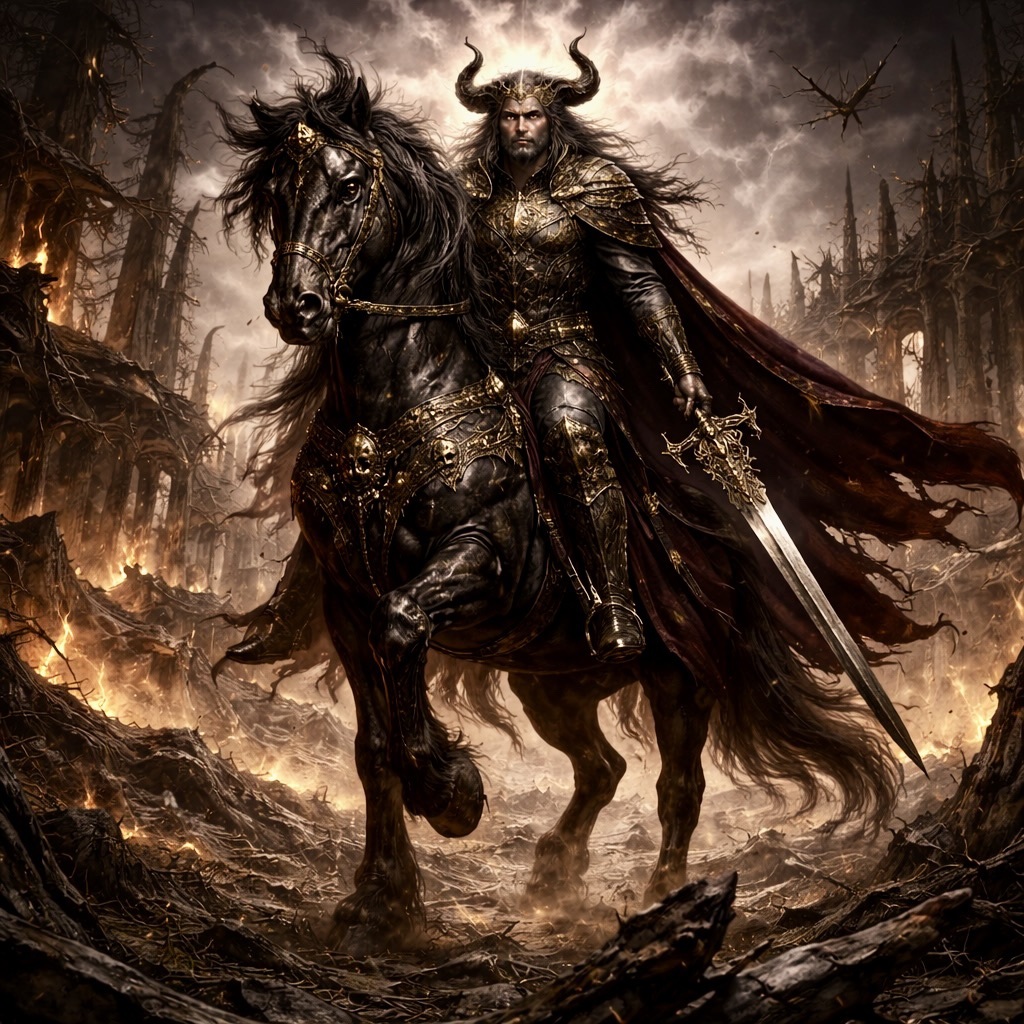
Cimejes, sometimes written as Cimeies, is not a demon of spectacle. He does not dominate the imagination through grotesque excess or theatrical cruelty. Instead, his presence is quieter, more austere, and far more unsettling once you understand what he represents. In the grimoires of the Ars Goetia, Cimejes is listed as a Marquis of Hell, a title that immediately places him in a realm of command, discipline, and structure. Yet unlike other infernal nobles who rule passions or desires, Cimejes governs aftermath. He is the demon of what remains when ambition collapses, when battles are over, and when what was once valued has been forgotten or buried.
Cimejes is described as appearing as a warrior riding a black horse, a detail that anchors him firmly in the imagery of war. But this is not the romanticized war of banners and glory. This is war seen from the other side: broken ground, scattered weapons, abandoned strongholds, and the silent accounting of loss. His authority is not over victory, but over consequence. He teaches grammar, logic, and rhetoric, but he is also said to reveal hidden or lost things, particularly treasures concealed in the earth. This combination is not accidental. Language, reason, and loss all revolve around memory and structure. Cimejes governs what has been displaced from its original order.
In medieval demonology, a marquis was traditionally responsible for border territories and military defense. Cimejes fits this role perfectly. His domain exists at the borders between use and abandonment, between knowledge and obscurity. He does not create chaos; he manages what chaos leaves behind. Where others incite ambition, Cimejes catalogs its debris.
The black horse upon which Cimejes rides is symbolic of inevitability. Horses in myth often represent momentum, the forward movement of events that cannot easily be stopped. A black horse adds the dimension of finality. Cimejes arrives not at the beginning of a journey, but near its end. His appearance signals that something has already been decided, already lost, already buried. What remains is understanding.
One of the most intriguing aspects of Cimejes is his association with education. He teaches grammar, logic, and rhetoric, the classical foundations of structured thought. These disciplines are not creative in the emotional sense. They are corrective. They refine, categorize, and impose order. This aligns with Cimejes’s broader symbolism. He does not inspire; he clarifies. He takes what has been scattered and teaches how to interpret it.
The ability to reveal hidden treasures further reinforces this theme. Treasures, in demonological language, are not always gold or jewels. They can be forgotten truths, suppressed memories, or overlooked opportunities. Cimejes reveals what lies beneath the surface, but only what already exists. He does not invent value; he uncovers it. In this way, he resembles an archaeologist of consequence, unearthing what others abandoned in their rush forward.
Cimejes is often misunderstood as a demon of simple destruction because of his martial imagery. In reality, he is far more restrained. He does not delight in ruin. He governs it. This distinction matters. Ruin is not inherently evil. It is a state of transition. Civilizations rise, decay, and leave behind fragments. Cimejes presides over that phase, ensuring that what is lost is not entirely erased.
Unlike demons who tempt or deceive, Cimejes operates without urgency. His power is patient. He waits until the dust settles. This patience makes him especially resonant in a modern context. We live in a culture obsessed with growth and novelty, often at the expense of reflection. Cimejes represents the moment when forward motion pauses and reckoning begins.
His martial bearing also suggests discipline rather than aggression. Armor, weapons, and posture all imply order, hierarchy, and restraint. Cimejes does not fight wildly. He stands ready, composed, and observant. He embodies the soldier who understands that every advance creates a rear, every victory creates vulnerability, and every conquest leaves something unguarded behind.
In symbolic terms, Cimejes is the demon of inventory. He accounts for what remains after desire has burned itself out. This makes him deeply uncomfortable to confront, because he does not allow denial. He reveals what was sacrificed, what was forgotten, and what was never recovered. There is no illusion in his presence, only assessment.
The alternate spelling, Cimeies, reflects the instability of his domain. Names shift when things are no longer actively maintained. Spelling variations are a linguistic form of decay, and Cimejes exists comfortably in that decay. He is not diminished by inconsistency. He inhabits it.
Cimejes also represents the idea that knowledge itself can be a form of aftermath. Grammar, logic, and rhetoric are often learned after mistakes have been made. They are tools for correction, not impulse. In this sense, Cimejes governs learning born of consequence. He teaches not how to begin, but how to understand what has already happened.
In fiction and modern occult symbolism, Cimejes often appears as a stern, reserved figure, neither cruel nor kind. He is not interested in moral judgment. He is interested in accuracy. This neutrality is what gives him weight. He does not console. He reveals.
The ability to find lost things connects Cimejes to memory. What is lost is not always gone. Sometimes it is simply buried beneath newer layers of experience. Cimejes uncovers these layers methodically. He does not rush the process. He respects the weight of what is found.
Ultimately, Cimejes represents the discipline of reckoning. He is the demon who asks, “What remains?” when everything else has passed. In a world that constantly urges movement, ambition, and escalation, that question is deeply unsettling. It forces attention away from fantasy and toward reality.
Cimejes endures in demonology because ruin is inevitable. Every system, no matter how powerful, eventually leaves fragments behind. Someone must govern that stage. Someone must stand watch over what was abandoned. Cimejes fills that role, not as a destroyer, but as a custodian of aftermath.
To understand Cimejes is to accept that loss is not the end of meaning. It is the beginning of interpretation. He does not promise restoration. He promises clarity. And for those willing to face what has been left behind, that clarity can be its own form of power.