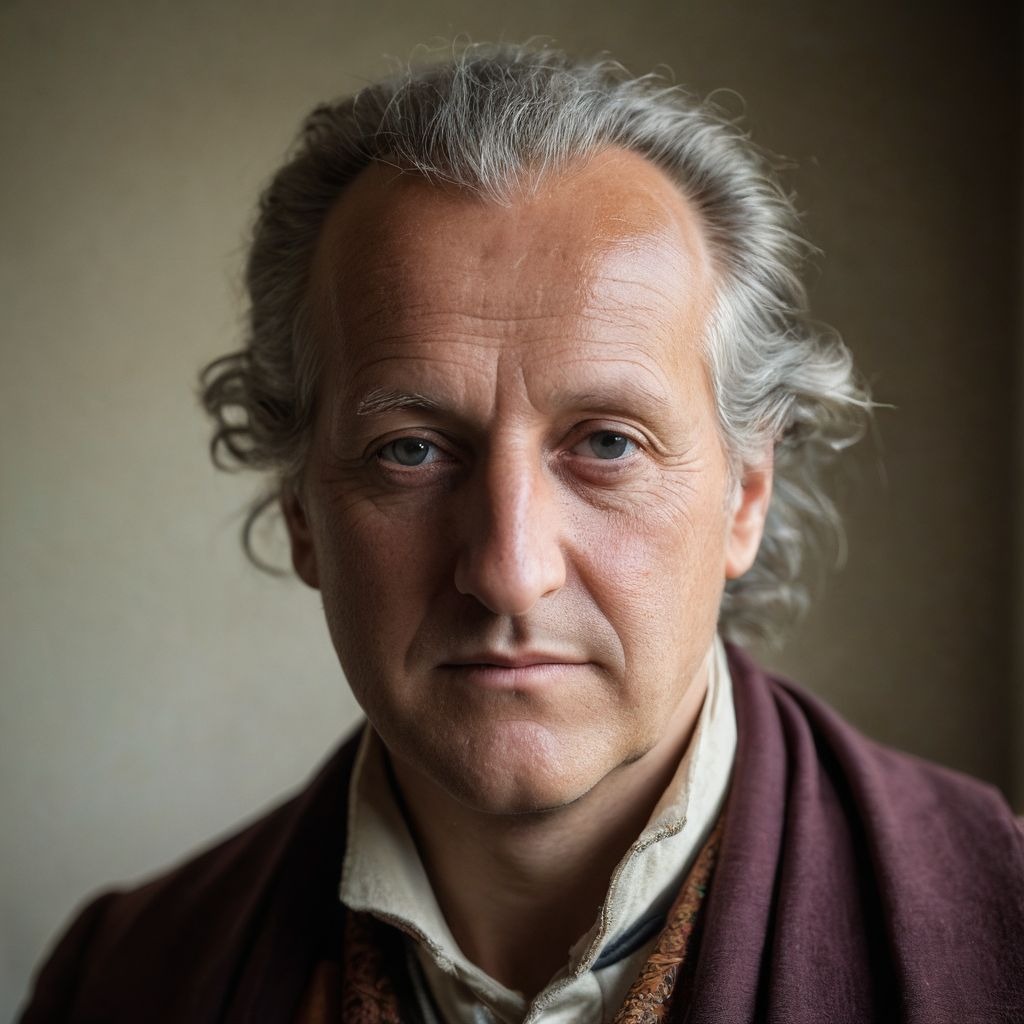
Goethe’s words have a way of lingering, like the scent of old books on a dusty shelf. I’ve always been fascinated by the way his thoughts seem to unfold, layer upon layer, each one sparking new questions and connections in my mind. As I sit here with my pen, trying to put into words why he captivates me so, I find myself drawn back to his concept of the “Urphanomen” – that primal phenomenon which underlies all human experience.
For me, it’s as if Goethe is speaking directly to the uncertainty that comes with growing up. In college, I was constantly grappling with the idea that there must be a deeper truth beneath the surface level of things. It sounds cliché now, but it felt like an existential crisis at the time – how could we possibly understand anything when everything seemed so fleeting and ephemeral? Goethe’s concept of the Urphanomen resonated deeply with me, offering a glimpse into that hidden reality he believed lay beyond our everyday perceptions.
What I find compelling about Goethe is his willingness to explore the unknown, even when it means challenging conventional wisdom. His ideas on morphology, for instance, which posits that all living things share a common form or essence, strike me as both beautiful and unsettling. It’s as if he’s suggesting that beneath our surface-level differences lies a deeper unity – a notion that can be both comforting and disturbing at the same time.
I’ve always felt a sense of unease when confronted with this idea, partly because it resonates so deeply with my own experiences of feeling disconnected from others. As someone who’s struggled to form close relationships in the past, I find myself drawn to Goethe’s emphasis on the individual’s subjective experience. His concept of the “daimon” – that inner guide or daemon which guides us toward our true purpose – speaks to me on a deep level.
At the same time, there’s something about Goethe’s work that feels both nostalgic and forward-looking at the same time. He wrote extensively on the importance of experiencing life directly, rather than relying solely on books or intellectual abstractions. This emphasis on direct experience strikes me as both refreshing and challenging – how can we reconcile our desire for connection with others (which is so deeply tied to our need for meaning) with the demands of living in a world that increasingly values efficiency and productivity?
As I write these words, I find myself wondering whether Goethe’s ideas are ultimately meant to be comforting or provocative. Is his emphasis on the individual’s subjective experience intended to empower us, or does it only serve to underscore our isolation? These questions swirl around me like clouds on a summer day – they refuse to settle, leaving me with more uncertainty than clarity.
Still, I’m drawn back to Goethe again and again, each time finding new layers of meaning in his words. Perhaps that’s because he speaks directly to the discomforts and contradictions of being human – those moments when our assumptions are turned upside down and we’re forced to confront the abyss within ourselves.
As I delve deeper into Goethe’s ideas, I find myself fascinated by the way he blurs the lines between reason and emotion, science and art. His concept of “Naturphilosophie” – a philosophical approach that seeks to understand the natural world through intuition and experience – resonates with my own struggles to reconcile the rational and emotional aspects of my own life.
I think back to my time in college, when I was torn between pursuing a degree in science and following my passion for creative writing. Goethe’s emphasis on the interconnectedness of all things makes me wonder whether there’s a hidden logic underlying our seemingly disparate experiences – whether the rules that govern the natural world might also apply to human emotions and relationships.
It’s this idea that Goethe’s ideas are not just abstract concepts, but living, breathing entities that can be experienced directly, that draws me in. His notion of “Wahlverwandtschaft” – elective affinities, or the connections we form with others through shared experiences and interests – speaks to my own struggles to form meaningful relationships.
I think about my closest friends, and how our bonds were forged through late-night conversations, shared laughter, and mutual passions. Goethe’s idea is that these affinities are not just superficial connections, but deep, abiding links that can be felt in the body as much as the mind. It’s a notion that both comforts and unsettles me – does it mean that I’ve been searching for validation in all the wrong places?
As I ponder this question, I find myself returning to Goethe’s concept of the “Urphanomen” once more. What if our experiences, emotions, and relationships are all part of a larger web of interconnectedness? Might we be able to tap into that primal phenomenon, to access a deeper level of understanding that transcends words?
The thought sends shivers down my spine – not just because it’s exhilarating, but also because it’s terrifying. What if I’ve been living in a state of perpetual disconnection, never truly grasping the world around me? Goethe’s ideas leave me with more questions than answers, and yet, I’m drawn back to them again and again, like a moth to flame.
In this uncertainty, I find a strange kind of solace. For the first time in my life, I feel like I’m not alone in my confusion – that there are others who have walked this path before me, and who continue to grapple with the same questions. Goethe’s legacy is not just a collection of ideas; it’s a reminder that we’re all part of a larger conversation, one that stretches across centuries and continents.
As I write these words, I’m left with a sense of wonder – not just about Goethe’s ideas, but about the human experience itself. What if our lives are not just individual stories, but threads in a larger tapestry? And what if we’re all searching for the same thing: a deeper understanding of ourselves and our place in the world?
As I delve deeper into Goethe’s concept of interconnectedness, I find myself drawn to his notion of “Bildung” – the idea that personal growth and self-cultivation are lifelong processes. For me, this resonates with my own experiences of feeling like I’m still figuring things out, even after completing college. It’s as if Goethe is reminding me that there’s no final destination, only a continuous journey of discovery.
I think about how I’ve always been drawn to writing as a way to process and make sense of the world around me. For Goethe, writing was also a means of self-discovery – he saw it as a way to tap into his own inner life and explore the mysteries of existence. His journals and letters are like windows into his soul, revealing his deepest thoughts and emotions.
As I read through his works, I’m struck by the way he weaves together seemingly disparate threads of thought and experience. It’s as if he’s trying to capture the essence of reality itself – not just the surface-level appearances, but the hidden patterns and connections that underlie everything. This is what I find most compelling about Goethe: his willingness to probe the depths of human experience and to confront the unknown.
I wonder if this is why his ideas have remained so relevant across centuries. Is it because they speak directly to our fundamental desire for meaning and connection? Or is it because he’s tapping into something deeper – a universal language that transcends time and culture?
As I ponder these questions, I find myself thinking about my own place in the world. What does it mean to be a writer, to be a seeker of truth and understanding? Is it possible to live a life that’s guided by curiosity and a love of learning, rather than external expectations or pressures? Goethe’s legacy seems to suggest that yes, it is – that we can cultivate our own inner light and follow its guidance into the unknown.
But what if this path is fraught with uncertainty and self-doubt? What if I’m not sure where I’m going or how to get there? These are questions I’ve been grappling with for years, and Goethe’s ideas only seem to add more complexity to the mix. And yet, it’s in this very uncertainty that I find a strange kind of freedom – a reminder that I don’t have to have all the answers, and that the journey itself is often more important than the destination.
As I sit here with my pen, trying to make sense of Goethe’s ideas and their relevance to my own life, I’m struck by the way his words keep slipping into my mind like a refrain. “Die Welt ist alles was uns bleibt” – the world is everything that remains to us. This phrase has become a kind of mantra for me, a reminder that our experiences, emotions, and relationships are all part of a larger web of interconnectedness.
It’s a thought that sends shivers down my spine, not just because it’s exhilarating, but also because it’s terrifying. What if this is true – what if everything we think we know about the world is just a surface-level appearance? What if there’s something more beneath the surface, waiting to be discovered?
The uncertainty is almost palpable as I sit here, surrounded by the trappings of my own life: books, papers, pens. And yet, it’s in this very uncertainty that I find a sense of peace – a reminder that I’m not alone on this journey, and that there are others who have walked this path before me.
As I close my eyes and let Goethe’s words wash over me, I feel a sense of connection to the world around me – a sense that we’re all part of something much larger than ourselves. It’s a feeling that’s both familiar and strange, comforting and unsettling at the same time. And yet, it’s one that I know I’ll carry with me for the rest of my life.
As I sit in this quiet space, surrounded by the whispers of Goethe’s words, I’m struck by the way his ideas have become a part of me – like a thread woven into the fabric of my being. It’s as if I’ve been living with him for years, absorbing his thoughts and emotions like a sponge.
I think about how his concept of “Naturphilosophie” has influenced my own approach to writing. I used to see it as a way to escape into the world of words, but now I realize that it’s so much more than that. It’s a way to tap into the natural world, to listen to its rhythms and patterns, and to let them guide me in my creative pursuits.
Goethe’s emphasis on the importance of direct experience has also changed the way I approach life. I used to rely heavily on books and intellectual abstractions, but now I’m drawn to experiences that allow me to connect with the world around me – like hiking in the woods, or watching a sunset over the ocean. These moments are like little doors opening up into new dimensions of understanding.
But what if this emphasis on direct experience is also a way of avoiding complexity? What if it’s easier to immerse myself in nature than to confront the messy, imperfect reality of human relationships? I think about my own struggles with intimacy and connection – how I often feel like I’m trying to navigate a labyrinth with no clear exit.
Goethe’s idea that our experiences are interconnected, that they’re part of a larger web of meaning, is both comforting and unsettling. It’s comforting because it suggests that I’m not alone in this journey, that there are others who have walked similar paths before me. But it’s also unsettling because it implies that my individual experiences are not as separate or unique as I might think.
I wonder if this is why Goethe’s ideas feel both nostalgic and forward-looking at the same time. He was a product of his era, yet he was also a visionary who saw beyond the limitations of his own time. His work speaks to us today because it continues to challenge our assumptions about the world and our place in it.
As I sit here with these thoughts swirling around me, I feel like I’m standing at the edge of a great precipice – looking out into an unknown landscape that stretches out before me like an endless sea. It’s both exhilarating and terrifying, this feeling of uncertainty and possibility.
And yet, as I breathe in Goethe’s words, I realize that this is exactly where I want to be. I want to be at the edge of the unknown, with no safety net or clear destination in sight. Because it’s here, in this place of uncertainty, that I feel most alive – like I’m tapping into a deeper level of understanding and connection that transcends words.
As I close my eyes and let Goethe’s ideas wash over me, I feel a sense of peace settle in – not a resolution or a clear answer to any question, but a deepening sense of trust. Trust that the journey itself is worth it, trust that the unknown is where we’ll find our truest selves.
And so, I take another step forward into the void, letting Goethe’s words guide me like a beacon in the darkness.