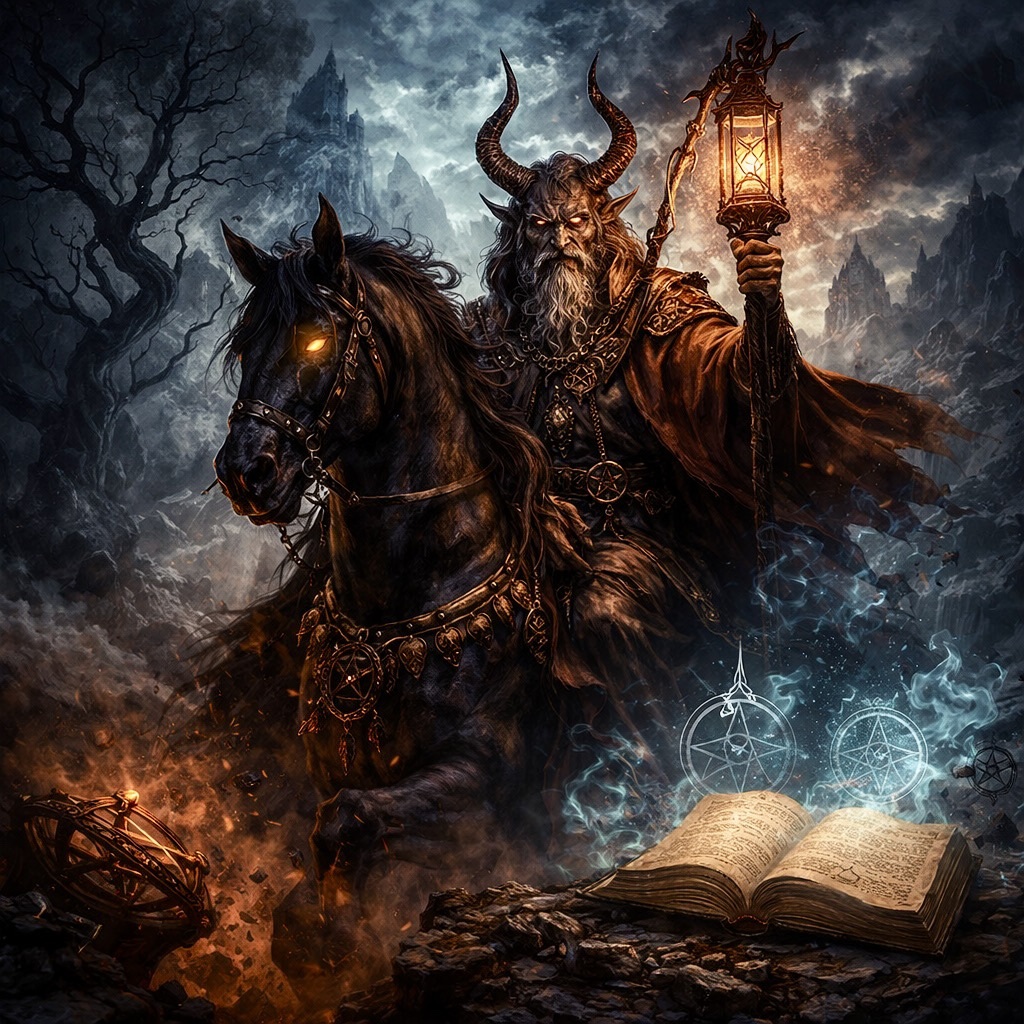
Among the shadowed pages of Renaissance grimoires, where demons are cataloged with careful precision and strange authority, the name Bathin appears with an air of quiet mystery. Unlike many infernal spirits described as chaotic tempters or destructive forces, Bathin occupies a more enigmatic position within the hierarchy of demonology. He is listed among the seventy-two spirits of the Ars Goetia, a section of the famed grimoire known as The Lesser Key of Solomon. In these ancient texts, Bathin is described as a Great Duke of Hell who commands thirty legions of spirits and possesses unusual powers related to knowledge, movement, and transformation. His influence extends beyond mere destruction or deception. Instead, Bathin represents guidance through unseen paths, mastery over hidden routes, and the strange ability to carry individuals across vast distances in an instant.
In the grimoires, Bathin’s appearance is described in vivid terms. He is said to appear as a strong man with the tail of a serpent riding upon a pale or skeletal horse. Sometimes he is depicted holding a staff or lantern, objects traditionally associated with travelers and guides. The serpent tail adds a layer of symbolism that is difficult to ignore. Serpents have long been associated with wisdom, transformation, and hidden knowledge across many cultures. By combining the image of a serpent with that of a mounted traveler, Bathin becomes a figure representing both movement and enlightenment. He is not merely a demon of wandering; he is a demon of purposeful travel.
This idea of supernatural travel held tremendous fascination for medieval and Renaissance occultists. The world in which these grimoires were written was far different from the one we inhabit today. Long journeys were dangerous, slow, and uncertain. A trip across a continent might take months and expose travelers to disease, bandits, storms, and political unrest. In such a world, the idea of instantaneous movement—or guidance through hidden routes—would have felt miraculous.
According to the ancient texts, Bathin possesses the power to transport individuals from one country to another with supernatural speed. While modern readers might interpret this ability metaphorically, Renaissance magicians took such claims quite seriously. They believed that spiritual entities could manipulate the natural world in ways that human beings could not understand.
The fascination with supernatural travel reveals much about the mindset of the era. Exploration was expanding rapidly during the Renaissance. Sailors crossed oceans into lands unknown to Europeans, and new maps of the world were constantly being drawn. Knowledge of geography was incomplete and mysterious, leaving room for speculation about hidden routes, secret passages, and magical shortcuts through the fabric of reality itself.
Bathin’s association with travel may therefore reflect the cultural excitement surrounding exploration. Just as sailors relied on navigational instruments and stars to guide their journeys, occult practitioners imagined spiritual forces capable of guiding travelers through unseen dimensions.
The lantern often depicted in artistic interpretations of Bathin reinforces this theme. Lanterns symbolize illumination in darkness. They guide travelers along uncertain roads and reveal hidden obstacles. In mythological terms, the lantern represents knowledge that allows individuals to move safely through unfamiliar territory.
In this sense, Bathin becomes something like a supernatural guide through the unknown. He illuminates paths that would otherwise remain invisible. His presence suggests that knowledge itself is a form of travel—a journey through unfamiliar landscapes of thought and discovery.
Another ability attributed to Bathin involves teaching the virtues of herbs and precious stones. This aspect of his mythology connects him to the long tradition of natural magic that flourished during the Renaissance. Scholars of the period believed that plants, minerals, and celestial bodies contained hidden powers that could influence health, fortune, and spiritual development.
The study of herbal medicine was especially important during this time. Without modern pharmaceuticals, healers relied heavily on plants to treat illness. Knowledge of which herbs could cure or harm someone was highly valued. By attributing such knowledge to a demon like Bathin, grimoires acknowledged that hidden understanding of nature often felt mysterious and powerful.
It is important to remember that Renaissance scholars did not draw strict boundaries between science, magic, and religion the way modern society does. Astronomy and astrology were intertwined. Alchemy existed alongside early chemistry. Spiritual forces were believed to influence physical reality in ways that were not yet understood.
Within this worldview, Bathin’s knowledge of herbs and stones represented mastery over the hidden properties of the natural world. Precious stones were believed to hold protective and healing powers, while herbs could influence everything from health to emotional states.
Bathin therefore becomes more than a demon of travel. He represents exploration in a broader sense—the pursuit of knowledge about both the physical world and the unseen forces believed to shape it.
The serpent tail attributed to Bathin deepens this symbolism even further. Throughout history, serpents have represented cycles of transformation and renewal. In ancient mythology, the serpent shedding its skin symbolized rebirth and change. The serpent also appears frequently as a guardian of sacred knowledge.
In the biblical story of Eden, the serpent introduces humanity to knowledge of good and evil. In Greek mythology, the staff of Asclepius, entwined with a serpent, became a symbol of medicine and healing. Across many cultures, serpents represent wisdom that exists beyond ordinary perception.
By giving Bathin a serpent’s tail, demonologists may have been emphasizing his role as a guide through transformative knowledge. Travel changes people. It exposes them to new cultures, ideas, and perspectives. In the same way, the pursuit of knowledge can transform a person’s understanding of the world.
Bathin’s mythological role therefore combines two forms of journey: physical travel across distant lands and intellectual travel through new ideas.
The skeletal or pale horse he rides also carries symbolic meaning. Horses have historically been associated with movement, freedom, and power. A skeletal horse, however, introduces darker undertones. It suggests a creature that exists between life and death, between worlds.
In folklore, pale horses often symbolize passage between realms. They appear in stories about ghost riders, spectral messengers, and supernatural travelers. Bathin’s horse may therefore represent the ability to cross boundaries that ordinary humans cannot cross.
Occult practitioners believed that certain rituals could allow communication with spiritual beings who existed beyond the physical world. Bathin’s horse becomes a metaphor for that crossing point—the vehicle that carries knowledge between dimensions.
Modern readers might interpret these symbols psychologically rather than literally. From a psychological perspective, Bathin could represent the human drive to explore the unknown. Curiosity has pushed humanity across oceans, into space, and deep into scientific discovery.
Every major advancement in history began with someone venturing into unfamiliar territory. Explorers sailed beyond the edges of known maps. Scientists experimented with dangerous chemicals. Philosophers questioned long-held assumptions about reality.
Bathin embodies that spirit of exploration. He is the guide who leads seekers into hidden territories of knowledge and experience.
This interpretation becomes especially compelling when considering Bathin’s calm and cooperative demeanor in the grimoires. Unlike many other demons who are described as deceitful or hostile, Bathin is often portrayed as helpful when properly summoned.
Such descriptions suggest that knowledge itself is not inherently dangerous. It becomes dangerous only when pursued recklessly or without preparation. Renaissance magicians believed that strict ritual discipline was necessary to interact safely with spiritual forces.
Circles of protection were drawn on the ground, sacred names were invoked, and complex procedures were followed to ensure that spirits remained under control. These rituals symbolized the importance of structure and intention when seeking knowledge.
Even today, exploration requires discipline. Scientific research follows rigorous methodology. Pilots rely on careful navigation systems. Travelers study maps and plan routes before embarking on journeys.
Bathin’s mythology reflects this understanding. The demon offers guidance, but the seeker must approach with preparation and respect.
The connection between travel and knowledge appears repeatedly throughout human history. Ancient philosophers believed that wisdom came through experience rather than theory alone. Greek scholars traveled across the Mediterranean to study mathematics, astronomy, and philosophy from different cultures.
During the Age of Exploration, European explorers returned from distant lands with new plants, animals, and cultural knowledge that reshaped scientific understanding. Trade routes connected civilizations and allowed ideas to spread across continents.
Bathin’s role as a guide through distant lands therefore mirrors a fundamental truth about human development. Progress often begins when individuals leave familiar surroundings and encounter something unexpected.
The same principle applies to intellectual exploration. Scientific breakthroughs frequently occur when researchers challenge established assumptions. Creative discoveries emerge when artists experiment with unfamiliar techniques.
Bathin becomes a symbol of that leap into uncertainty—the moment when curiosity overcomes fear and a person steps onto a path that leads somewhere unknown.
Yet demonology also reminds us that exploration carries risks. The grimoires caution that demons should never be summoned carelessly. Knowledge gained without wisdom can lead to unintended consequences.
History offers many examples of discoveries that produced both benefits and dangers. Nuclear technology brought both energy production and devastating weapons. Industrial progress improved living standards while contributing to environmental challenges.
Bathin’s mythology therefore reflects the dual nature of exploration. New knowledge can illuminate the world or disrupt it depending on how it is used.
In contemporary occult traditions, Bathin is sometimes invoked as a spirit of insight and transformation rather than literal travel. Practitioners interpret his powers as the ability to guide individuals through periods of personal change.
Life itself often resembles a journey through unknown territory. People change careers, move to new countries, and navigate emotional challenges that reshape their identities. During these transitions, individuals often seek guidance from mentors, teachers, or philosophical traditions.
Bathin’s archetype fits naturally into this context. He becomes the symbolic guide who illuminates hidden possibilities and encourages seekers to move forward despite uncertainty.
Stories about supernatural guides appear in many mythological traditions. Greek mythology featured Hermes, the messenger god who traveled freely between realms. Norse mythology described Odin wandering the world in search of wisdom. In many spiritual traditions, mysterious figures appear to travelers at moments of decision, offering guidance or warning.
Bathin belongs to this long lineage of mythic guides. Whether viewed as a literal spirit or symbolic archetype, he represents the presence that appears when someone stands at a crossroads between the familiar and the unknown.
His lantern illuminates the path ahead, but it does not reveal the entire journey. Travelers must still walk the road themselves.
That image captures something essential about human experience. No guide—spiritual or otherwise—can remove uncertainty entirely. Exploration always involves risk. Yet it is precisely that risk that makes discovery meaningful.
The Renaissance magicians who wrote about Bathin lived in a world filled with mystery. They believed that unseen forces shaped reality in ways that science had not yet explained. While modern knowledge has changed our understanding of the universe, the sense of wonder surrounding exploration remains.
Space missions send probes to distant planets. Scientists study the depths of the ocean where sunlight never reaches. Artificial intelligence researchers explore new forms of machine cognition. Each of these pursuits reflects the same curiosity that drove ancient explorers across uncharted seas.
Bathin’s mythology reminds us that exploration is not merely a physical act. It is also an intellectual and emotional journey. The courage required to seek new knowledge remains one of humanity’s defining traits.
In the end, Bathin stands as a fascinating figure within demonology precisely because he represents movement rather than stagnation. He guides travelers through darkness with a lantern held high. He rides across boundaries that others fear to cross.
Whether interpreted as myth, psychology, or spiritual symbolism, Bathin embodies the restless curiosity that has always pushed humanity forward.
The road he travels stretches beyond the horizon, disappearing into landscapes that no map has yet recorded. And somewhere along that road, lantern light flickers in the distance, inviting the next traveler to follow.