
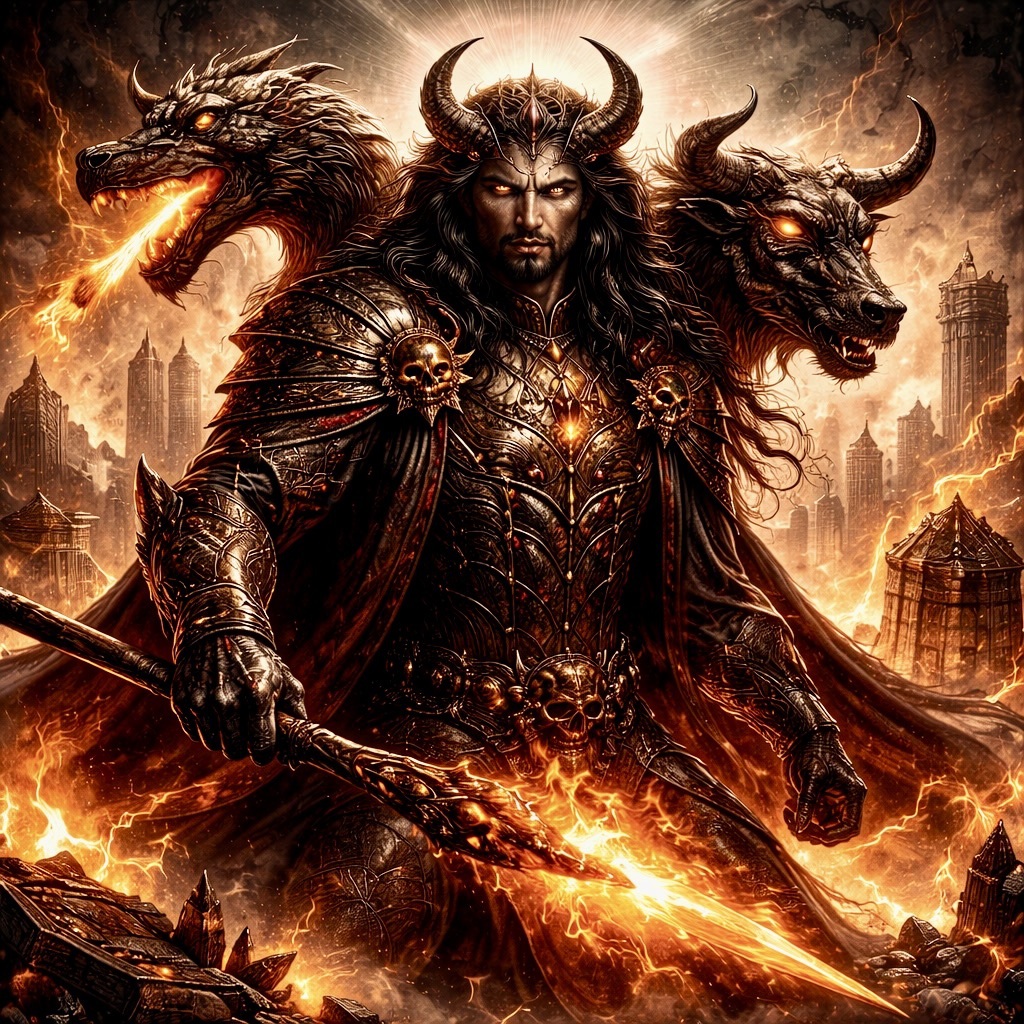
Aim, also known as Aym, is not a subtle demon. He does not whisper doubts, tempt desire, or patiently corrode belief. He arrives with fire, noise, and irreversible consequence. In the Ars Goetia, Aim is listed as a Great Duke of Hell, commanding twenty-six legions and appearing as a man with three heads—one human, one serpent, and one calf—while wielding firebrands capable of setting cities ablaze. This imagery is not symbolic flourish. It is a declaration. Aim governs destruction that exposes reality rather than conceals it.
Aim’s domain is ruin with purpose. He destroys cities, fortresses, and reputations not for amusement, but to reveal what was already unsustainable. Where other demons manipulate systems from within, Aim burns them down from the outside. He is the demon of forced clarity, the one who removes illusions by eliminating the structures that support them.
The three heads attributed to Aim represent distinct but unified modes of perception. The human head symbolizes conscious awareness and judgment. Aim knows exactly what he is destroying and why. The serpent head represents cunning, instinct, and the primal recognition of weakness. Serpents do not attack strength. They strike vulnerability. The calf’s head represents stubborn material attachment—wealth, property, tradition, and false security. Aim destroys what people cling to most fiercely.
Fire is Aim’s primary instrument, and fire is never ambiguous. It consumes indiscriminately, but it also illuminates. Under Aim, destruction is public. There is no quiet collapse. There is no denial. When Aim acts, everyone knows something has ended.
Unlike demons associated with chaos, Aim is precise. He does not burn randomly. He targets structures that have outlived their integrity. His fires are surgical in intent even when catastrophic in scale. Aim does not believe in gradual reform. He believes in collapse as correction.
In demonological texts, Aim is said to teach cunning, provide truthful answers about private matters, and reveal hidden truths. This combination is important. Aim does not destroy blindly. He knows what he is dismantling. He understands secrets, weaknesses, and fault lines before he ignites them. Under Aim, destruction is informed.
Psychologically, Aim represents the moment when denial becomes impossible. He is the force behind sudden breakdowns that expose long-ignored problems. Burnout, public scandal, institutional collapse, and personal implosion all carry Aim’s signature. He appears when systems refuse to change voluntarily.
Aim’s association with firebrands reinforces this. Firebrands are not wildfires. They are carried deliberately. Aim does not rely on chance. He chooses ignition points carefully. He understands how quickly destruction spreads once introduced at the right location.
The Duke title reflects authority over territory and infrastructure. Aim governs environments rather than individuals. He does not tempt one person at a time. He reshapes landscapes. His influence is felt across communities, organizations, and cultures.
The calf head is particularly telling. Calves symbolize wealth, sacrifice, and comfort. In ancient traditions, calves were offerings and idols. Aim destroys idols. He targets what people treat as untouchable. Under Aim, sacred cows burn first.
The serpent head reinforces instinctual intelligence. Aim recognizes weakness intuitively. He does not need extensive analysis to know where collapse will begin. He senses instability and exploits it decisively.
The human head completes the triad. Aim is aware. He does not hide behind instinct or inevitability. His destruction is intentional, not accidental. This makes him frightening. There is no randomness to blame.
Aim’s fires are also deeply tied to truth. Lies require structure to persist. Fire removes structure. When Aim burns something down, excuses burn with it. What remains is what could survive exposure.
In modern symbolic terms, Aim resembles whistleblowers, revolutions, corporate collapses, and public reckonings. He is present wherever entrenched systems refuse reform until they are destroyed. Aim is not patient. He does not negotiate.
Unlike demons who promise power, Aim promises consequence. Those who call upon him do not gain control. They trigger events that cannot be undone. Aim does not rebuild what he destroys. He leaves that task to others.
Aim is also associated with cunning, which might seem contradictory to his blunt force. But his cunning lies in timing. He waits until structures are weakest, most overextended, or most arrogant. Then he acts.
There is an implicit warning in Aim’s lore. Destruction is not selective once it begins. Those who believe they can control the fire often discover they are standing too close. Aim does not protect allies. He clears ground.
Aim endures in demonology because destruction is inevitable where stagnation persists. Systems that refuse adaptation invite catastrophe. Aim embodies that catastrophe.
To engage with Aim symbolically is to accept that some problems cannot be solved through reform. Some must be ended. He does not ask whether destruction is ethical. He asks whether it is necessary.
Aim is not the demon of chaos for its own sake. He is the demon of endings that expose truth, of fire that removes lies, of collapse that reveals what was never stable.
When Aim passes through, what remains is honest—even if it is ash.