
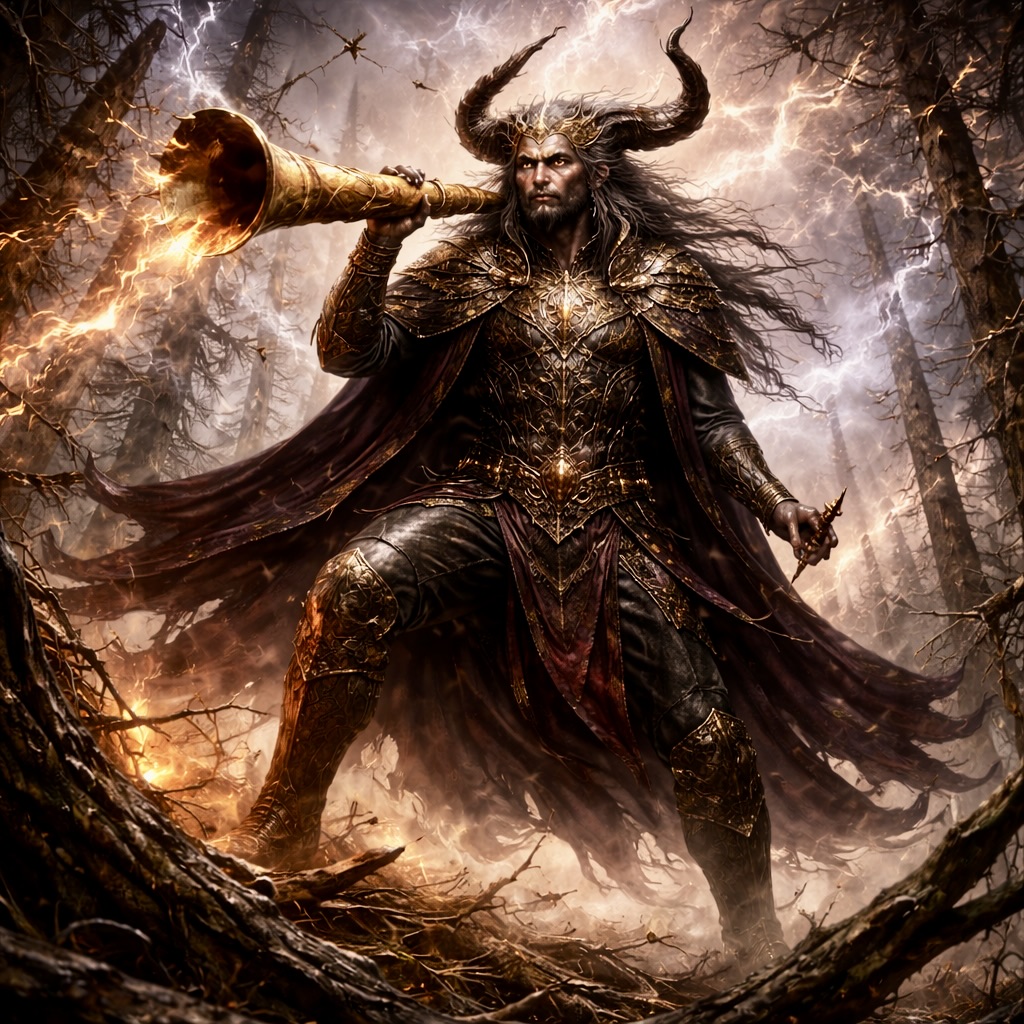
Amdusias is not a demon that arrives quietly. In the grimoires where his name is written, he is associated with sound before sight, vibration before form. He is described as a Great Duke of Hell, commanding legions, but his authority does not manifest through law, deception, or temptation. It manifests through resonance. Music, thunder, the cracking of trees, the subtle pressure that sound exerts on the world—this is Amdusias’s domain. He is less a whisper in the mind and more a force that makes the air itself respond.
In the Ars Goetia, Amdusias is said to appear initially as a unicorn, an image that seems almost absurd until it is understood symbolically. The unicorn is not gentleness in this context, but rarity, raw power, and untamed force. Only when commanded does Amdusias take on human form, often with horns, reinforcing the idea that his true nature exists somewhere between animal instinct and conscious will. This duality matters. Amdusias is not chaos without direction; he is structured force, sound shaped into intent.
Music is the most intriguing aspect of Amdusias’s mythology. He is said to cause musical instruments to be heard, even when none are present. This is not the comforting music of celebration, but something deeper and more unsettling. It is the reminder that sound is never passive. Sound moves bodies, stirs emotions, and alters environments. Long before modern science explained resonance and vibration, demonology recognized sound as power, and Amdusias became its embodiment.
Unlike demons who specialize in manipulation or knowledge, Amdusias affects the physical world directly. Trees fall at his command. Forests bend and break. Storms answer him. These descriptions place him closer to natural disaster than moral allegory. He is the demon of reverberation, of cause and effect made audible. Where other infernal figures influence minds, Amdusias influences matter.
This connection to nature makes Amdusias stand out. Hell, in many traditions, is removed from the natural world, a realm of punishment and abstraction. Amdusias, however, is deeply tied to earth, wood, air, and weather. He reminds us that destruction is not always moral or immoral; sometimes it is simply force meeting structure. A storm does not hate a forest. It moves through it.
In occult practice, Amdusias is often associated with mastery over sound, music, and performance. He is said to teach instruments and musical arts, but there is always an edge to this teaching. His music is not merely entertainment. It is influence. Anyone who has stood in front of a powerful sound system or felt music vibrate through their chest understands this instinctively. Sound bypasses intellect and goes straight to the body. Amdusias rules that pathway.
The falling trees attributed to Amdusias are more than spectacle. Trees symbolize stability, growth, and time. To fell them is to interrupt continuity. Amdusias represents moments when stability gives way, when structures—natural or social—can no longer withstand accumulated pressure. His presence marks thresholds, the point at which vibration becomes collapse.
What makes Amdusias especially compelling is that he does not appear to act out of malice. There is no narrative of cruelty attached to him. He does not punish sinners or tempt the faithful. He acts. The grimoires do not moralize his behavior; they describe it. This neutrality is unsettling. It suggests a kind of power that operates independently of ethics, much like natural forces do.
In modern symbolic terms, Amdusias can be understood as the embodiment of amplification. Small inputs become overwhelming outputs. A note becomes a roar. A vibration becomes a fracture. This makes him an uncannily relevant figure in an age of amplified voices, viral media, and cascading effects. Amdusias is what happens when resonance is no longer contained.
His horns are significant as well. Horns have long symbolized both musical instruments and animal power. They produce sound, but they also signify aggression and dominance. Amdusias’s horned form merges these meanings. He is both the instrument and the force behind it. Sound is not something he uses; it is something he is.
Amdusias’s rank as a Duke places him in a position of command rather than subservience. He directs legions, not individuals. This reinforces the idea that his influence operates on a large scale. He is not concerned with personal transformation. He reshapes environments. When Amdusias is invoked in myth, the world itself responds.
There is also an implicit warning in Amdusias’s lore. Sound, once released, cannot be taken back. Vibrations travel outward, interacting with everything they encounter. Words, music, and noise all share this property. Amdusias symbolizes the permanence of impact. Once something resonates, it leaves traces long after the sound has faded.
Unlike more psychological demons, Amdusias does not linger in ambiguity. His effects are visible and audible. Trees fall. Storms rise. Music fills the air. This clarity makes him terrifying in a different way. There is no mystery about what he does, only uncertainty about when and how far it will go.
In artistic and fictional portrayals, Amdusias often appears as a dark conductor, orchestrating chaos like a symphony. This is an apt metaphor. Music is ordered sound, chaos given structure. Amdusias stands at the intersection of order and destruction, proving that the two are not opposites but collaborators.
Ultimately, Amdusias represents the truth that sound is never harmless. Every vibration carries force. Every resonance changes something. He is the demon of audible consequence, the reminder that the world is always listening, always responding.
To understand Amdusias is to respect the power of what is set into motion. He does not ask for belief. He proves himself through impact. In that sense, Amdusias is not merely a figure of demonology, but a mythic acknowledgment of a physical reality humans have always known: what we unleash into the world, especially through sound and force, does not vanish. It echoes.