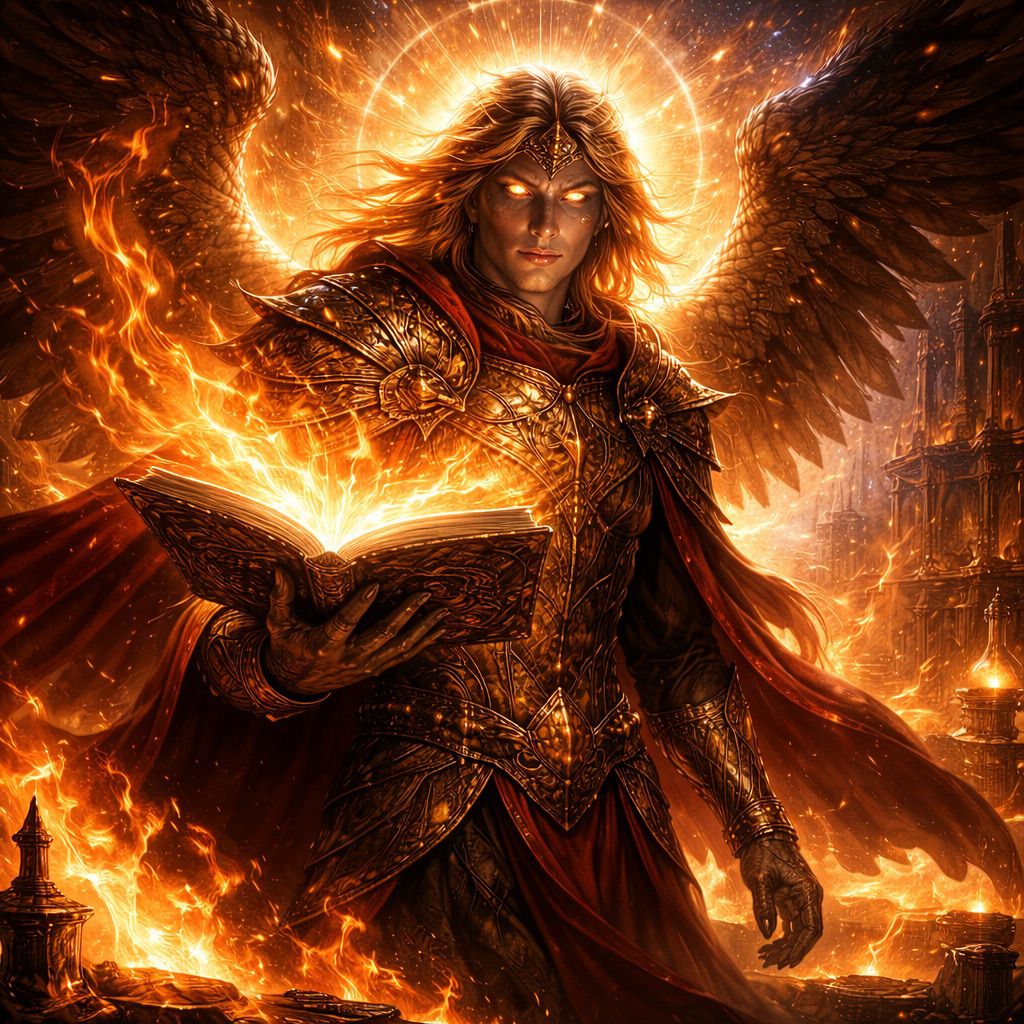
In demonology, Amy is a figure who rarely draws attention through terror or grotesque spectacle, yet his presence carries a gravity that lingers long after his name is spoken. Listed in the Ars Goetia as a President of Hell, Amy governs knowledge that burns rather than dazzles, illuminates rather than comforts. He is described as appearing first as a flame, a living fire that speaks, before assuming human form. This origin matters. Amy is not knowledge discovered accidentally. He is knowledge that must be endured.
Amy’s fire is not the wild destruction associated with rage or punishment. It is controlled, deliberate, and revealing. Fire, in this context, is the oldest tool of human understanding. It lights darkness, refines raw material, and exposes what cannot survive heat. Amy embodies this principle. He teaches liberal sciences, astrology, and the understanding of spirits, but his lessons are never neutral. What he reveals changes the one who learns it.
Unlike demons associated with deception or manipulation, Amy is aligned with disclosure. He shows how the universe is structured beneath appearances, how celestial movements influence human behavior, and how hidden forces interact with visible systems. This makes him attractive to scholars, seekers, and those dissatisfied with surface-level explanations. Amy does not offer comfort. He offers clarity.
The fact that Amy appears first as fire is deeply symbolic. Fire is knowledge before it is form. It is potential, danger, and illumination all at once. To encounter Amy in this state is to encounter truth without narrative. Only after command does he take on a human shape, suggesting that understanding must be structured before it can be used.
Amy’s rank as a President places him in a role of administration rather than domination. He governs processes of learning and revelation. He does not rule through force. He rules through insight. This distinction separates Amy from demons who impose outcomes directly. Amy equips others to act, for better or worse.
Astrology plays a significant role in Amy’s lore. But this is not astrology as entertainment or vague prediction. Under Amy, astrology is pattern recognition. It is the study of cycles, influence, and timing. Amy teaches how celestial movements reflect internal states and social shifts. He does not claim the stars control destiny absolutely. He teaches how they condition possibility.
This conditioning is where Amy becomes unsettling. Once patterns are understood, choice feels narrower. Knowledge replaces hope with probability. Amy does not remove free will, but he exposes how constrained it often is. This is why his fire is described as both enlightening and dangerous.
Amy also teaches the liberal sciences, a term that historically encompassed grammar, logic, rhetoric, astronomy, and philosophy. These are disciplines of structure and interpretation. Amy’s influence is felt wherever systems of meaning are constructed. He does not invent systems; he reveals how they function and where they fail.
In psychological terms, Amy represents the moment when curiosity overrides comfort. He is the demon of the question that cannot be unasked. Once something is understood, innocence cannot be recovered. Amy’s lessons are irreversible not because they are evil, but because they are accurate.
Unlike demons associated with cruelty, Amy is often described as calm and composed. There is no urgency in his presence. Knowledge does not rush. It waits. Amy’s fire burns steadily, not explosively. This patience makes him more dangerous than volatile spirits. His influence accumulates quietly.
Amy’s association with hidden treasures is often misunderstood. These treasures are not always material. They are buried insights, suppressed truths, and overlooked connections. Amy reveals where they lie, but he does not retrieve them for you. Discovery still requires effort. The cost is paid in responsibility.
In modern symbolic interpretation, Amy feels almost contemporary. He resembles the force behind data analysis, systemic thinking, and predictive modeling. He is the demon of understanding how systems work well enough to anticipate outcomes. Like modern knowledge systems, Amy does not care whether outcomes are kind.
Fire as Amy’s core symbol also suggests purification through loss. What survives Amy’s knowledge is stronger, but something is always burned away. Illusions, false certainty, and comforting myths do not endure. Amy leaves behind a clearer, harsher landscape.
Amy’s human form, when described, is not monstrous. This is important. He does not need terror to command attention. His authority comes from what he knows. In a world that increasingly values information over morality, Amy feels less like a demon and more like a mirror.
Those who seek Amy are often not reckless. They are dissatisfied with partial truths. They want the mechanism, not the metaphor. Amy gives them that, but he does not guide how it will be used. Knowledge, under Amy, is not inherently redemptive.
What makes Amy enduring in demonology is that he represents a timeless human impulse: the desire to understand reality even when that understanding costs comfort. Every era that values knowledge above wisdom walks Amy’s territory, whether it names him or not.
Amy is not the enemy of truth. He is its embodiment without mercy. He does not lie. He does not soften. He reveals and steps aside.
To encounter Amy symbolically is to accept that illumination always casts shadows. The fire that lights the way also shows what cannot be unseen.