
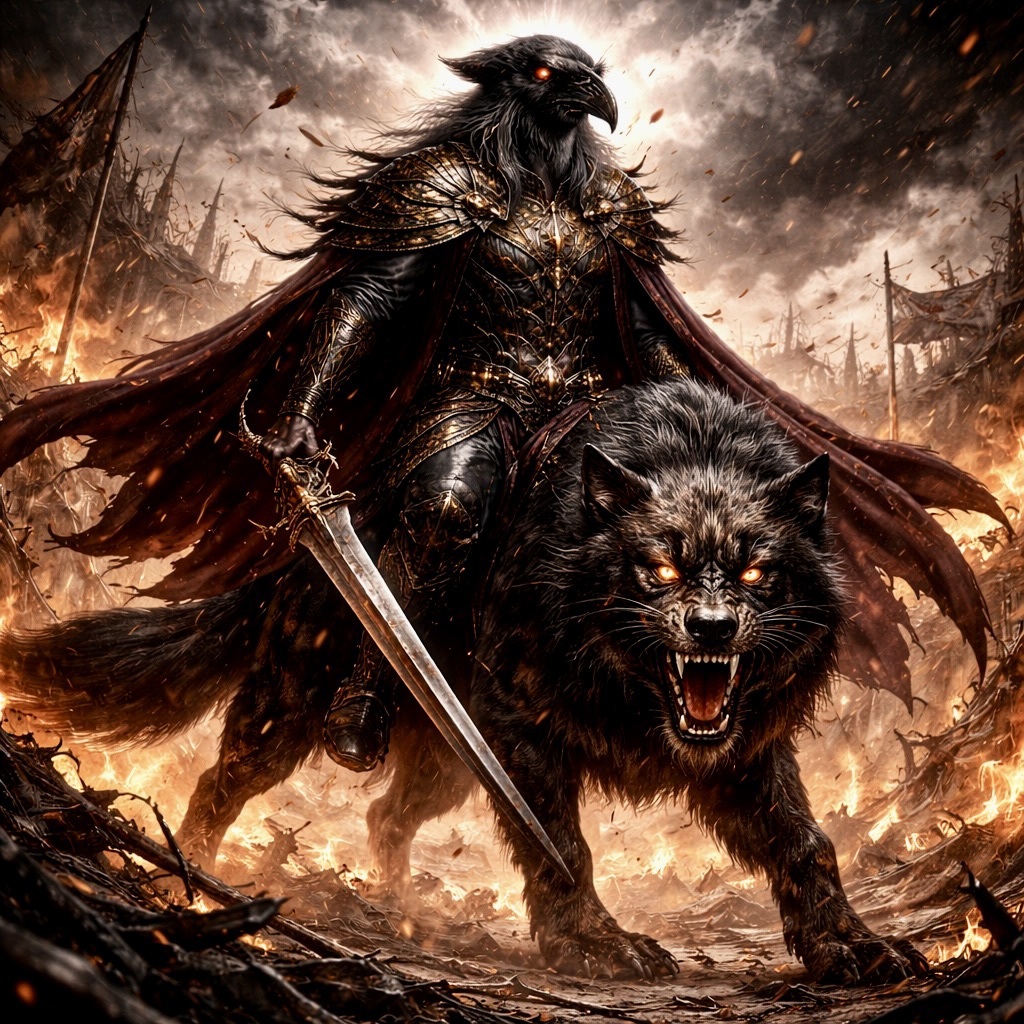
Andras is not subtle, and he is not patient. Among the spirits of the Ars Goetia, he stands out as one of the most openly hostile, volatile, and dangerous figures ever committed to parchment. Where many demons manipulate quietly, negotiate cleverly, or seduce with promises, Andras operates with a blunt and terrifying clarity of purpose. He exists to create conflict, to fracture alliances, and to turn trust into a weapon. His presence does not linger gently. It explodes, and when it does, something vital is usually destroyed.
In demonological texts, Andras is described as a Great Marquis of Hell who appears as an angel with the head of a raven, riding a powerful black wolf and carrying a bright, razor-sharp sword. Every element of this imagery is intentional. The raven is a symbol of death, prophecy, and ill omen. The wolf represents predation, pack hierarchy, and sudden violence. The sword is not ceremonial; it is functional. Andras does not threaten symbolically. He kills.
What makes Andras uniquely feared, even among demons, is that grimoires consistently warn practitioners never to summon him lightly. He is said to be treacherous even toward those who call upon him, and if disrespected or improperly constrained, he may kill the summoner outright. This warning is rare in occult texts, which often treat demons as dangerous but manageable. Andras is different. He is not interested in cooperation. He is interested in collapse.
The domain of Andras is discord. He delights in sowing conflict between individuals, families, allies, and nations. He does not need to invent grievances. He amplifies what already exists. A doubt becomes suspicion. A disagreement becomes hatred. A rivalry becomes bloodshed. Andras works by accelerating fracture until reconciliation is no longer possible.
Unlike demons who tempt with pleasure or power, Andras tempts with certainty. He offers clarity in conflict. He sharpens sides. He removes ambiguity. Once Andras’s influence takes hold, there is no middle ground left to stand on. You are friend or enemy, ally or traitor, target or executioner. This absolutism is part of his danger. Nuance cannot survive him.
The raven-headed form of Andras reinforces this role. Ravens are intelligent, observant, and associated with battlefields and corpses. They do not kill indiscriminately, but they are always present when killing occurs. Andras does not always strike the first blow. Often, he waits until violence is inevitable, then ensures it is decisive.
The wolf he rides is equally important. Wolves are creatures of hierarchy and loyalty, but they are also capable of turning on their own when dominance is challenged. Andras weaponizes this trait. He turns packs against themselves. He dissolves unity from the inside. Betrayal, under Andras, is not accidental. It is engineered.
Andras’s sword is the final symbol. It represents execution, not battle. Battles imply uncertainty. Execution implies outcome. When Andras draws his blade, something has already been decided. His violence is not chaotic. It is purposeful and final.
In occult lore, Andras is sometimes associated with murder, especially murder that arises from conflict rather than passion. He governs killings that result from betrayal, conspiracy, or ideological fracture. This makes him one of the darkest mirrors held up to human behavior. Most violence is not random. It is justified, rationalized, and planned. Andras embodies that process.
Psychologically, Andras represents the part of the human mind that seeks enemies in order to feel certain. When complexity becomes unbearable, Andras offers simplicity through division. He reduces the world into opposing camps and then dares them to destroy one another. This is why his influence is so corrosive. It feels clarifying even as it ruins everything it touches.
Historically, figures like Andras resonate during periods of civil unrest, religious schism, and ideological extremism. He thrives when societies fracture along lines of belief, identity, or power. He does not care which side wins. He cares that the conflict becomes irreversible.
Unlike demons who can be bargained with, Andras is described as contemptuous of weakness. He does not reward hesitation. He does not tolerate fear. Those who seek him often believe they are strong enough to command him, only to discover that strength without restraint is exactly what he preys upon.
There is also a profound warning embedded in Andras’s mythology. He does not create evil out of nothing. He exposes it. He brings to the surface what was already festering. In that sense, Andras is less a corrupter than a catalyst. He accelerates outcomes humans were already moving toward.
This makes him deeply uncomfortable as a symbol. It is easier to blame external forces for violence than to acknowledge the internal fractures that make violence possible. Andras removes that comfort. He shows how quickly principles turn into weapons and how easily loyalty turns into justification for cruelty.
Modern interpretations of Andras often cast him as the embodiment of radicalization, the unseen force that turns disagreement into dehumanization. He is present wherever language shifts from debate to destruction, from persuasion to eradication. He does not whisper lies. He shouts convictions.
Andras endures in demonology because conflict is eternal. As long as humans form groups, define identities, and draw lines between “us” and “them,” there will be something for Andras to exploit. He is not the origin of hatred. He is its acceleration.
To invoke Andras, even symbolically, is to accept that something will be broken beyond repair. He does not restore balance. He does not teach lessons. He ends things. Relationships. Alliances. Lives. His clarity comes at the cost of everything else.
Andras is feared not because he is chaotic, but because he is honest about violence. He strips away the illusion that conflict can always be controlled. He reminds us that once certain forces are unleashed, they no longer belong to those who summoned them.
In the end, Andras represents the moment when disagreement becomes war, when trust collapses into suspicion, and when certainty demands blood. He is not a demon of temptation, but of consequence. And once he is present, there is no turning back.