
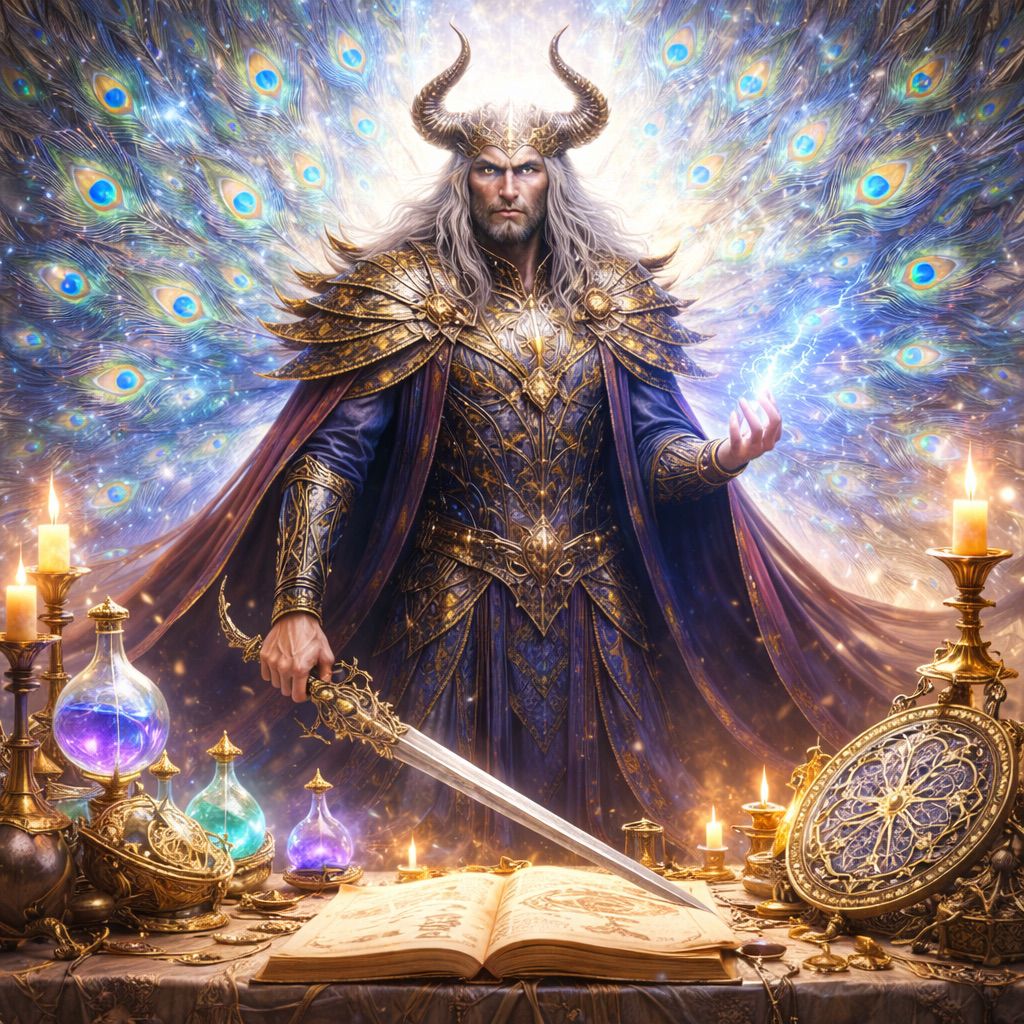
Andrealphus is not a demon of passion, temptation, or chaos. He is something far colder, far more exacting, and in many ways more unsettling. Where other infernal figures appeal to desire, ambition, or fear, Andrealphus appeals to intellect stripped of empathy. In the grimoires of the Ars Goetia, he is listed as a Marquis of Hell, a rank associated with authority, command, and structure. But unlike martial or political demons, Andrealphus rules over abstract order. His domain is geometry, astronomy, measurement, and the rigid logic that reduces the world to angles, distances, and predictable motion.
Andrealphus is described as appearing initially in the form of a peacock, a striking and unusual image in demonology. The peacock is often associated with beauty, symmetry, and display, but also with vanity and cold detachment. This form is not decorative. It is symbolic. The peacock’s feathers form natural geometric patterns, precise and repeating, eye-like shapes arranged with mathematical consistency. To encounter Andrealphus as a peacock is to confront beauty that is exact, ordered, and indifferent to human feeling.
Only when commanded does Andrealphus assume a human shape, and even then he retains something distant and calculating in his presence. He teaches geometry perfectly, makes men subtle in measurements, and instructs in astronomy. These are not arts of inspiration. They are arts of control. Geometry defines space. Astronomy defines time and movement. Measurement defines limitation. Andrealphus governs the frameworks that make the universe predictable.
This predictability is where his true menace lies. Andrealphus does not deceive. He clarifies. He strips away uncertainty and replaces it with certainty so precise it can become suffocating. In his world, there is a correct answer, a correct angle, a correct calculation. Anything that cannot be measured is irrelevant. Emotion, ambiguity, and intuition hold no value unless they can be quantified.
The association with astronomy places Andrealphus among the watchers rather than the movers. He does not shape fate through desire or force. He observes patterns, calculates trajectories, and understands inevitability. In ancient thought, astronomy was not merely scientific; it was prophetic. The movement of stars was believed to reveal destiny. Andrealphus’s mastery of this art suggests dominion over foresight without mercy.
What makes Andrealphus especially unsettling is his transformation of beauty into discipline. The peacock’s display, often seen as extravagant or vain, becomes under Andrealphus a demonstration of structural perfection. Beauty exists because it obeys rules. The feathers are beautiful because they align, repeat, and mirror one another. This is not beauty meant to comfort. It is beauty meant to assert order.
In demonological symbolism, Andrealphus represents the danger of intelligence divorced from compassion. Knowledge without conscience. Precision without restraint. He does not misuse geometry or astronomy. He uses them exactly as they are meant to be used. And that is the problem. When systems function perfectly, they do not care who is harmed by their efficiency.
The marquisate of Andrealphus reinforces this interpretation. A marquis governs borders and defenses. Andrealphus governs the borders of understanding. He defines where certainty ends and ignorance begins. Once something falls within his domain, it is fixed, categorized, and no longer open to interpretation.
Unlike demons who tempt with promises of pleasure or power, Andrealphus offers mastery. Mastery over space, motion, and proportion. This is deeply attractive to minds that crave control. But the cost is subtle. When everything is reduced to measurement, humanity itself becomes a variable rather than a value.
In modern symbolic terms, Andrealphus feels eerily contemporary. Algorithms, models, simulations, and predictive systems all echo his influence. These systems are not evil. They are precise. They optimize, calculate, and forecast. And like Andrealphus, they do not care about individual suffering unless it affects the model. The peacock demon becomes a mirror held up to modern rationalism.
Andrealphus does not rage. He does not threaten. He does not seduce. He waits. He calculates. He knows where things are going long before they arrive. This makes him a figure of inevitability rather than confrontation. Those who fall under his influence often do so willingly, believing they are choosing clarity over confusion.
Yet there is a warning embedded in his lore. Perfect measurement leaves no room for mercy. Perfect prediction leaves no room for hope. Andrealphus embodies the extreme end of rational order, where uncertainty is eliminated at the cost of freedom.
His peacock form reinforces this warning. The peacock does not fly far despite its wings. Its beauty is heavy. It is bound to display rather than escape. Andrealphus’s knowledge is similarly heavy. It dazzles, but it anchors. It impresses, but it confines.
In occult tradition, those who seek Andrealphus do so for intellectual power, not transformation. They want accuracy, foresight, and command over systems. Andrealphus provides this without deception. He gives exactly what is asked. What he does not give is balance.
Ultimately, Andrealphus represents the cold edge of intelligence. He is the demon of correct answers that leave no room for kindness, of systems that function flawlessly while ignoring the human cost. He reminds us that understanding the universe is not the same as understanding ourselves.
Andrealphus endures because humanity will always be tempted by certainty. In a chaotic world, the promise of perfect measurement is seductive. But his presence asks an uncomfortable question: when everything can be calculated, what happens to compassion?