
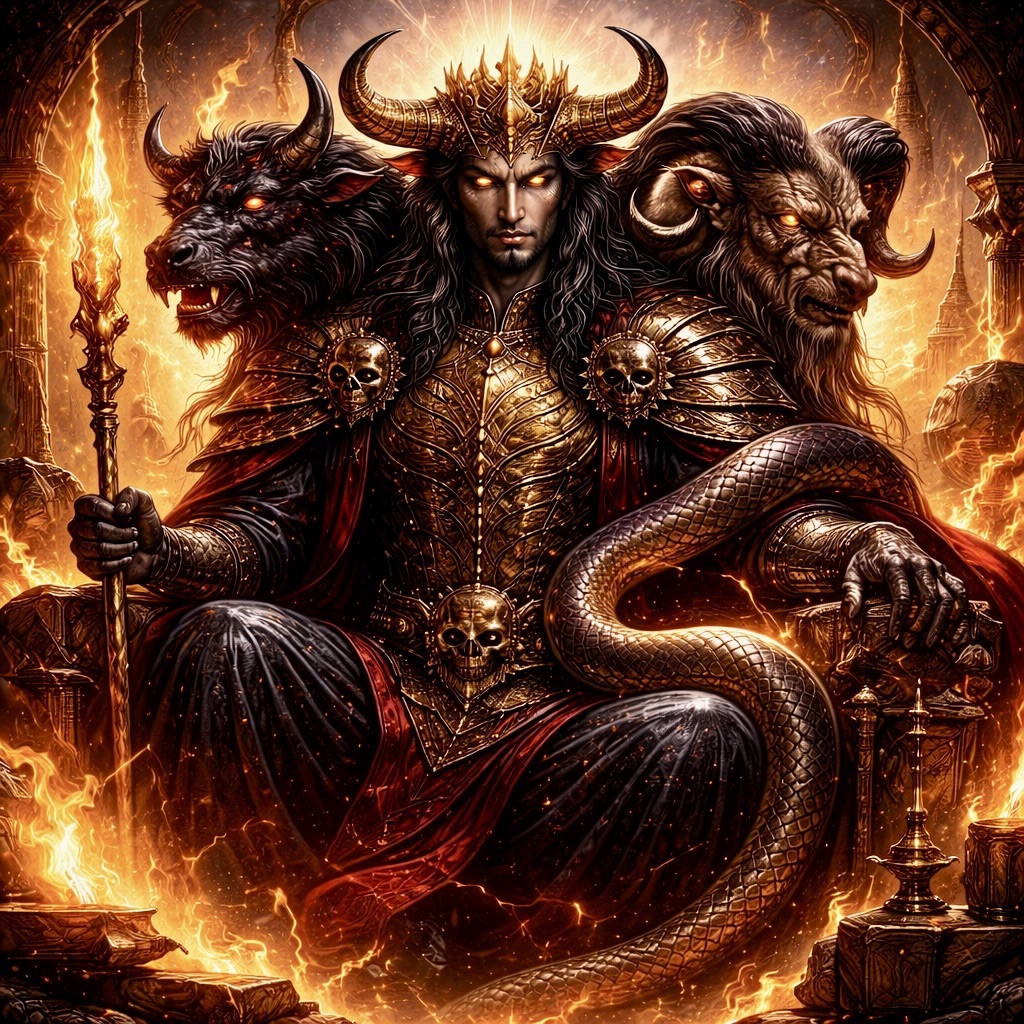
Asmoday, also known as Asmodeus in the Ars Goetia, is not merely a demon of lust, as popular culture often reduces him. He is far more complex, far more intelligent, and far more unsettling. In Goetic demonology, Asmoday is a Great King of Hell, commanding seventy-two legions and appearing in a form that is deliberately overwhelming: three heads—one of a man, one of a bull, and one of a ram—riding a dragon and carrying a lance, with flames flickering around him. This is not excess for its own sake. Every element of Asmoday’s form is symbolic of a force that dominates human behavior from the inside out.
Asmoday governs desire, but not only sexual desire. He governs fixation, compulsion, and the relentless drive toward gratification that overrides judgment. Lust is merely the most visible expression of his domain. Beneath it lies something far more pervasive: obsession. Asmoday understands how desire mutates into identity, how wanting becomes justification, and how justification becomes inevitability.
The three heads attributed to Asmoday represent different dimensions of this force. The human head symbolizes intellect and rationalization. Asmoday is not ruled by impulse alone; he understands logic, argument, and persuasion. The bull represents brute appetite, physical hunger, and raw consumption. The ram represents aggression, stubbornness, and the will to charge forward regardless of consequence. Together, these aspects form a complete picture of how desire operates when unchecked: it thinks, it wants, and it pushes.
Asmoday’s association with wrath is often overlooked, but it is essential. Desire frustrated turns into anger. Obsession denied becomes violence. Asmoday governs this transition seamlessly. He does not see lust and rage as opposites. He sees them as stages of the same process. When the world refuses to accommodate desire, wrath emerges to force compliance.
In demonological texts, Asmoday is described as exceedingly knowledgeable, particularly in mathematics, astronomy, and the mechanical arts. This detail shocks those who expect him to be a creature of chaos. But Asmoday is not chaotic. He is precise. Obsession requires focus. Desire sustained over time requires planning. Asmoday teaches how passion becomes systematized.
Asmoday’s intelligence is what makes him truly dangerous. He does not simply inflame desire. He teaches how to pursue it efficiently. He shows how to remove obstacles, exploit weaknesses, and justify excess. Under Asmoday, indulgence becomes strategy.
The dragon Asmoday rides reinforces this symbolism. Dragons are creatures of dominance, hoarding, and destructive intelligence. They are not mindless beasts. They are calculating predators. Asmoday does not stumble into indulgence. He claims it.
Historically, Asmodeus appears in Jewish, Christian, and later occult traditions as a destroyer of marriages, a corrupter of fidelity, and a spirit of disruption. But these narratives often miss the deeper truth. Asmoday does not destroy relationships arbitrarily. He exploits existing fractures. He amplifies dissatisfaction, resentment, and unspoken desire until collapse feels inevitable.
Psychologically, Asmoday represents the human tendency to prioritize gratification over consequence. He is the voice that says “now” louder than the voice that says “later.” He does not invent temptation. He magnifies it.
Asmoday’s ability to teach mathematics and structure is especially revealing. He understands ratios, limits, and thresholds. He knows exactly how much pressure a system can tolerate before it breaks. Desire under Asmoday is not reckless. It is calibrated.
Unlike demons who manipulate through illusion, Asmoday manipulates through honesty. He does not deny desire’s existence or power. He embraces it openly. His corruption is convincing because it feels authentic. Under Asmoday, people feel more like themselves, not less. That is the trap.
Wrath under Asmoday is not random violence. It is entitlement expressed as force. When desire is framed as deserved, opposition becomes injustice. Asmoday teaches this framing expertly. Resistance becomes provocation.
In modern symbolic terms, Asmoday feels disturbingly familiar. He resembles addiction cycles, consumer obsession, and identity built around appetite. He is present wherever desire is marketed as fulfillment and restraint is framed as repression.
Asmoday’s kingship is crucial. Kings in demonology do not tempt individuals alone; they shape cultures. Asmoday governs systems that normalize excess and reward indulgence. He does not need to corrupt everyone. He changes the environment so corruption feels natural.
The ram’s head symbolizes aggression and forward momentum. Asmoday does not retreat from consequences. He plows through them. He teaches how to rationalize damage as necessary fallout.
The bull’s head symbolizes endurance and physicality. Desire under Asmoday is not fleeting. It persists. It demands repetition. Satisfaction does not end obsession; it feeds it.
The human head completes the cycle. Intelligence ensures that desire is never experienced as mindless. It is explained, defended, and philosophized. Under Asmoday, indulgence becomes ideology.
Asmoday’s wrath also manifests internally. Guilt, frustration, and self-loathing often accompany unchecked desire. Asmoday does not relieve these feelings. He weaponizes them. Shame becomes fuel.
In demonological warnings, Asmoday is often described as cruel, but cruelty is not his goal. Consumption is. Anything that interferes with consumption is expendable.
Asmoday endures because desire is inseparable from humanity. Attempts to erase it fail. Attempts to ignore it backfire. Asmoday thrives where desire is denied without understanding.
Symbolically, Asmoday represents the cost of indulgence without restraint and restraint without insight. He punishes hypocrisy more harshly than excess.
To encounter Asmoday symbolically is to confront what you want when no one is watching, and what you are willing to sacrifice to get it. He does not force answers. He reveals priorities.
Asmoday is not the demon of pleasure alone. He is the demon of appetite given intellect, aggression given justification, and desire given a throne.