
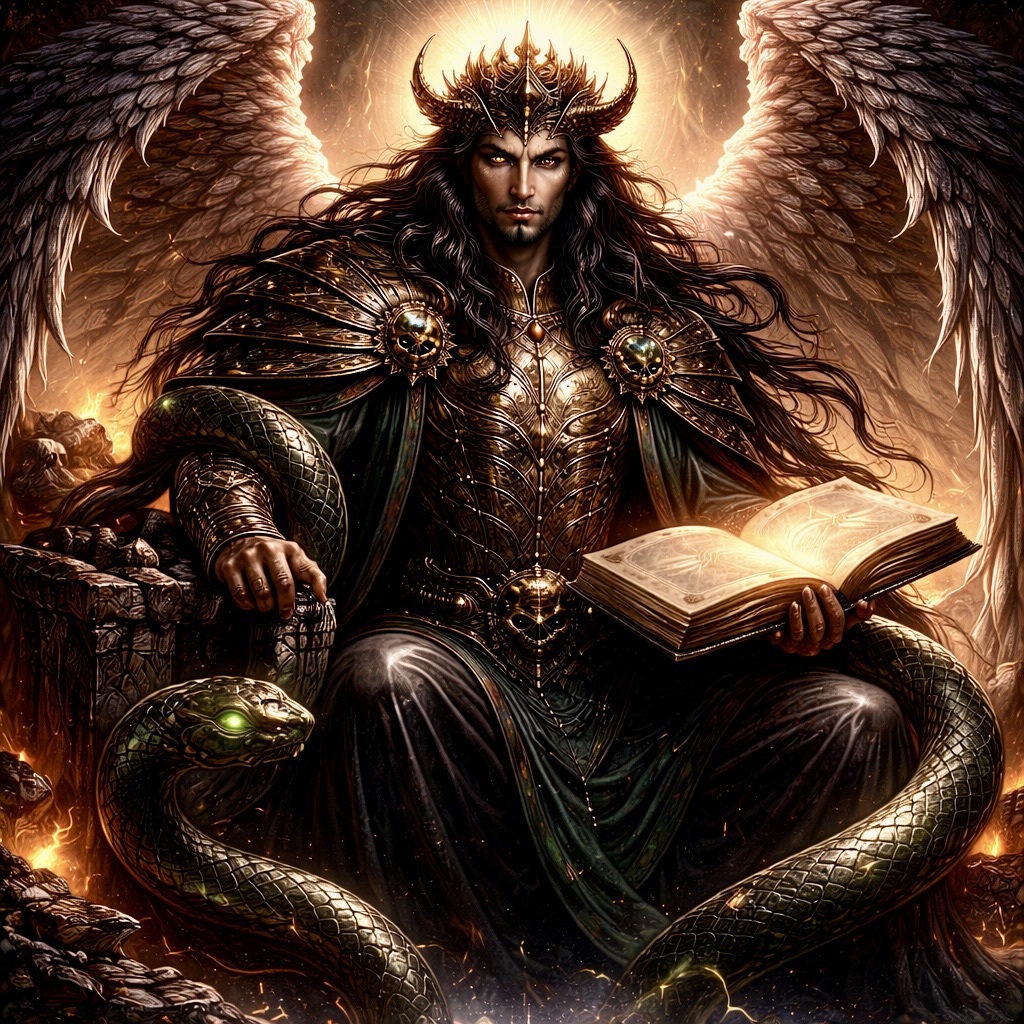
Astaroth is a demon who does not need to threaten, shout, or seduce openly. His power operates through something far more dangerous: persuasion that sounds reasonable. In the Ars Goetia, Astaroth is named as a Great Duke of Hell, commanding forty legions and appearing as a fallen angel riding a monstrous beast, often depicted with serpent-like features. He speaks softly, answers questions willingly, and offers insight freely. And that is exactly why he is feared.
Unlike many demons whose domains revolve around excess or destruction, Astaroth governs knowledge—specifically knowledge that corrodes rather than enlightens. He is associated with sloth, despair, skepticism, and the slow erosion of conviction. Astaroth does not push people toward ruin violently. He invites them to sit down, think, question, and remain still until action feels pointless.
Astaroth’s angelic appearance is central to his symbolism. He does not arrive as something obviously monstrous. He appears beautiful, articulate, and familiar. This reflects his origins as a fallen angel and reinforces his role as a corrupter of intellect rather than appetite. Astaroth does not inflame desire. He cools it. He does not excite ambition. He drains it.
The serpent imagery that accompanies Astaroth is not accidental. Serpents symbolize ancient wisdom, but also decay, temptation, and cyclical destruction. Astaroth embodies the knowledge that explains too much. The kind of insight that makes effort feel naive and hope feel childish. He does not deny meaning outright. He questions it until it collapses under its own weight.
One of Astaroth’s most defining traits is his willingness to answer questions truthfully. This detail is often misunderstood. Truth alone is not inherently beneficial. Context, framing, and intent determine whether truth builds or dissolves. Astaroth gives truth stripped of encouragement, stripped of purpose, stripped of reason to act. Under Astaroth, knowledge becomes heavy.
In demonological tradition, Astaroth is associated with sloth, but not laziness in the physical sense. His sloth is intellectual and spiritual paralysis. He convinces people that effort is futile, that systems are corrupt beyond repair, that resistance is pointless. He does not argue loudly. He reasons patiently.
Astaroth teaches sciences, history, and philosophy, but always with an undertone of futility. He emphasizes cycles of decay, inevitability of collapse, and the repetition of failure. Under his influence, understanding increases while motivation disappears. This is his true corruption.
Psychologically, Astaroth represents nihilism disguised as wisdom. He is the voice that says, “You’re not wrong—but it doesn’t matter.” He does not deny injustice. He normalizes it. He does not excuse corruption. He frames it as universal and unchangeable.
This makes Astaroth especially dangerous to intellectuals, skeptics, and thinkers. He does not target the impulsive. He targets the reflective. Those who value reason, evidence, and nuance are particularly vulnerable to his influence because he speaks their language fluently.
Astaroth’s rank as a Duke reinforces his role as a regional corrupter rather than a tyrant. He does not dominate whole civilizations outright. He infects institutions, philosophies, and cultures slowly. He spreads apathy through insight.
Unlike demons who manipulate fear, Astaroth manipulates resignation. Fear motivates action. Resignation prevents it. Under Astaroth, people stop fighting not because they are defeated, but because they are convinced that fighting is meaningless.
His association with despair is subtle. Astaroth does not create despair directly. He removes hope methodically. He exposes flaws, contradictions, and hypocrisies without offering alternatives. This makes his influence feel mature, rational, and unavoidable.
In medieval demonology, Astaroth was often linked to vanity and pride as well. This may seem contradictory to sloth, but the connection is clear. Intellectual pride convinces people that they see too clearly to act. That engagement is beneath them. Astaroth cultivates this posture expertly.
Modern symbolic interpretations of Astaroth feel uncomfortably familiar. He resembles ideological exhaustion, burnout culture, and the belief that systems are too broken to fix. He is present wherever critique replaces commitment and awareness replaces responsibility.
Astaroth’s serpent mount reinforces the idea of decay that moves continuously. Serpents shed skin, but they do not grow beyond their nature. Astaroth teaches that change is superficial, that patterns repeat endlessly, and that progress is illusion.
There is also an important warning embedded in Astaroth’s lore: truth without purpose can be as destructive as lies. Knowledge that strips away motivation without offering direction leaves people stranded. Astaroth does not lie, but he withholds reasons to care.
Unlike demons associated with chaos, Astaroth prefers stagnation. Chaos still produces energy. Stagnation drains it. He does not want the world to burn. He wants it to rot quietly.
Astaroth endures in demonology because despair is cyclical. Every generation reaches moments where systems feel irreparable. Astaroth thrives in those moments, whispering that disengagement is wisdom.
To engage with Astaroth symbolically is to confront the temptation of giving up under the guise of insight. He does not force surrender. He rationalizes it.
Astaroth is the demon of truths that paralyze, of knowledge that corrodes will, of understanding divorced from hope.
He is not the enemy of intelligence. He is the enemy of action.