
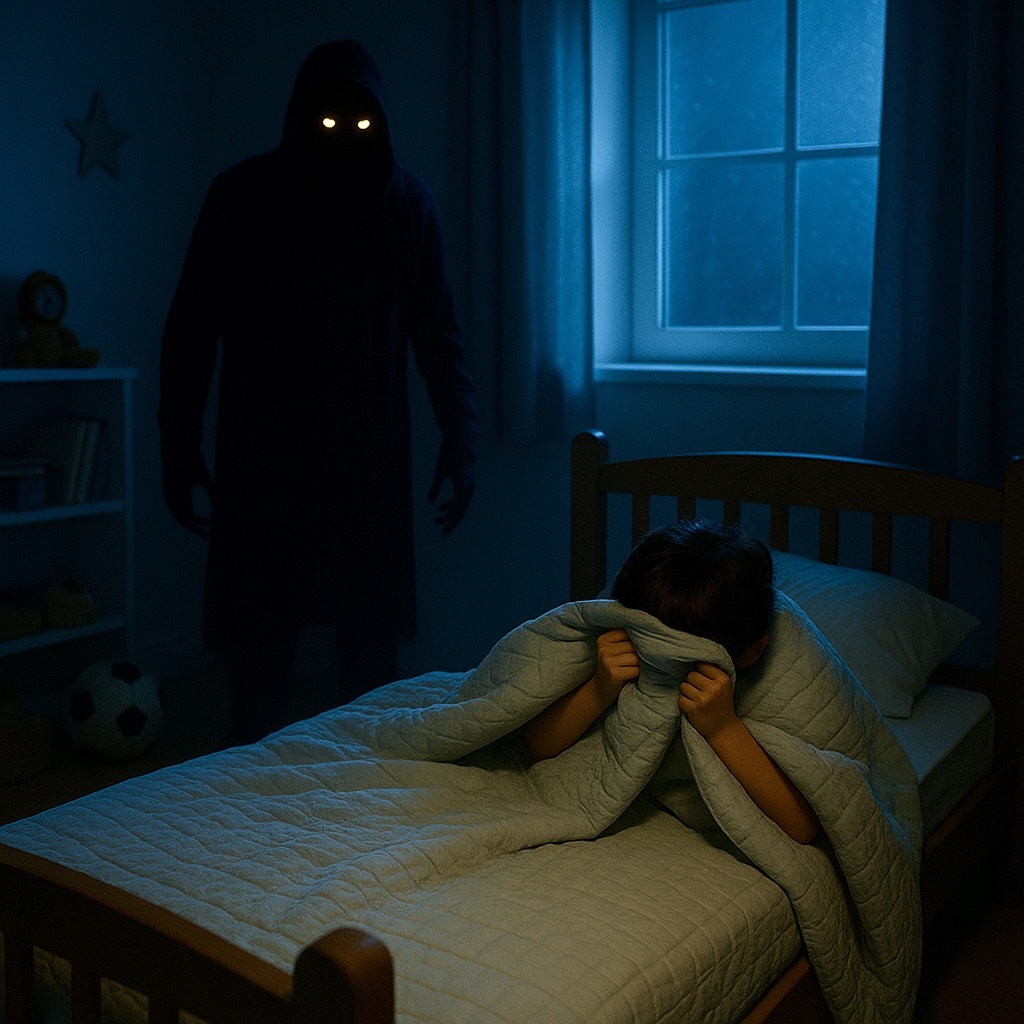
Every culture has a monster whispered into the ears of children at night, a shadowy figure who lurks just beyond the candlelight, ready to snatch them away if they disobey. In English-speaking lands, it’s the Boogeyman. In Spain and across Latin America, it is something older, darker, and far more personal: El Cuco. Known also as El Coco in Spain and El Cucuy in Mexico, he is the shapeless terror who comes when children refuse to listen. His form is vague — sometimes a shadow, sometimes a skeletal figure, sometimes a faceless man hiding in the closet — but his threat is always the same: if you misbehave, if you defy your parents, El Cuco will come. He will steal you away. He will never return you. On October 20, when his legend is remembered, we are reminded that sometimes the greatest fears are not the monsters with claws and fangs, but the ones we invent to make children obey.
El Cuco is not bound by a single description. In fact, his power comes from his ambiguity. He has no fixed appearance, which makes him infinitely adaptable to the imagination. To some, he is a dark shadow, a formless figure that hovers in the corner of the room. To others, he is a haggard man with hollow eyes, or a grotesque beast lurking under the bed. Parents rarely describe him in detail, because his vagueness allows children to fill in the blanks with their own fears. In this way, El Cuco is less a monster than a mirror — reflecting whatever frightens the child most. He is a shapeless embodiment of dread, always fitting the space he is invoked in.
The origins of El Cuco trace back to Spain, where El Coco was known as a child-snatching monster. The word “coco” itself refers to a hollowed-out gourd, often carved into a grotesque face. These gourds were used to frighten children, and over time, the name became attached to the idea of a lurking boogeyman. When Spanish colonization spread to Latin America, the figure of El Cuco traveled with it, taking on local variations and blending with indigenous myths. In Mexico, he became El Cucuy, more demonic in appearance, sometimes with glowing red eyes. In the Caribbean, he lingered as a shapeless phantom. No matter where he went, he kept the same purpose: to terrify children into obedience.
Parents used El Cuco as a tool of discipline. “Go to sleep, or El Cuco will come.” “Don’t wander into the dark, or El Cucuy will take you.” He became the perfect parental weapon because he required no proof. Children didn’t need to see him; the threat was enough. Unlike physical punishments, which could be resisted or explained, El Cuco was absolute. He was the terror that lived in shadows, the punishment that could strike anywhere. He wasn’t just feared — he was believed, because he filled the gaps of imagination with horror.
But El Cuco was more than just a bedtime threat. He reflected deeper cultural anxieties about childhood, obedience, and survival. In societies where danger was real — where children wandering into forests, rivers, or streets could meet deadly ends — El Cuco embodied those dangers in a single, unforgettable figure. He wasn’t only about discipline; he was about protection. By making children fear the shadows, parents kept them safe from the real dangers that lurked there. In this way, El Cuco was both cruel and necessary, a monster invented to guard children from the world by scaring them into caution.
The legend of El Cuco also highlights the power of storytelling in shaping behavior. Children who feared him went to bed on time, stayed close to home, and obeyed rules. But the cost of that obedience was fear — fear that lingered long after childhood. Many adults in Spain and Latin America still recall lying awake as children, eyes wide open, convinced they saw El Cuco lurking in the corner. His legacy is not just in keeping kids safe but in embedding a primal unease that shadows them even as adults.
What makes El Cuco particularly terrifying is his ambiguity of motive. Unlike other monsters who kill for hunger or rage, El Cuco’s goal is simple: to take children. Where he takes them is never clear. Some say he eats them. Others say he drags them to his lair, where they vanish forever. Still others claim he keeps them in cages, feeding on their fear. The lack of resolution makes him more horrifying. Death is final, but El Cuco’s fate is uncertain. He represents not just punishment but disappearance, the fear of being lost, of being forgotten, of never returning home.
El Cuco has endured for centuries because he adapts with time. In modern Latin America, he appears in films, songs, and even memes, but the fear he carries is unchanged. Parents still invoke his name, though often with a smile, half-serious, half-playful. Children still whisper about him at night, daring each other to summon him. His legend has crossed into the global imagination, with references appearing in horror films and literature outside the Hispanic world. The Boogeyman may be universal, but El Cuco is unique — sharper, older, and culturally richer, tied to both Spanish roots and Latin American reinvention.
His power lies in the fact that he is not a monster children seek out. Vampires, werewolves, and witches often draw fascination as well as fear. But El Cuco is pure dread, devoid of allure. No one wants to see him, and yet everyone feels his presence. He is the ghost of the parent’s warning, the echo of fear in the dark, the thing that moves just outside the corner of your vision. His story is less about him and more about us — about the way humans use fear to teach, protect, and control.
So on October 20, when the story of El Cuco is told, we are not just telling a tale about a monster. We are telling a story about childhood, about obedience, about the fears we inherit and pass on. El Cuco is not just a figure of terror but a cultural memory, one that binds families, communities, and generations together through shared fear. And maybe, just maybe, when you hear a bump in the night, or feel that strange certainty that something is watching, you’ll remember what your parents once told you: be good, or El Cuco will come.