
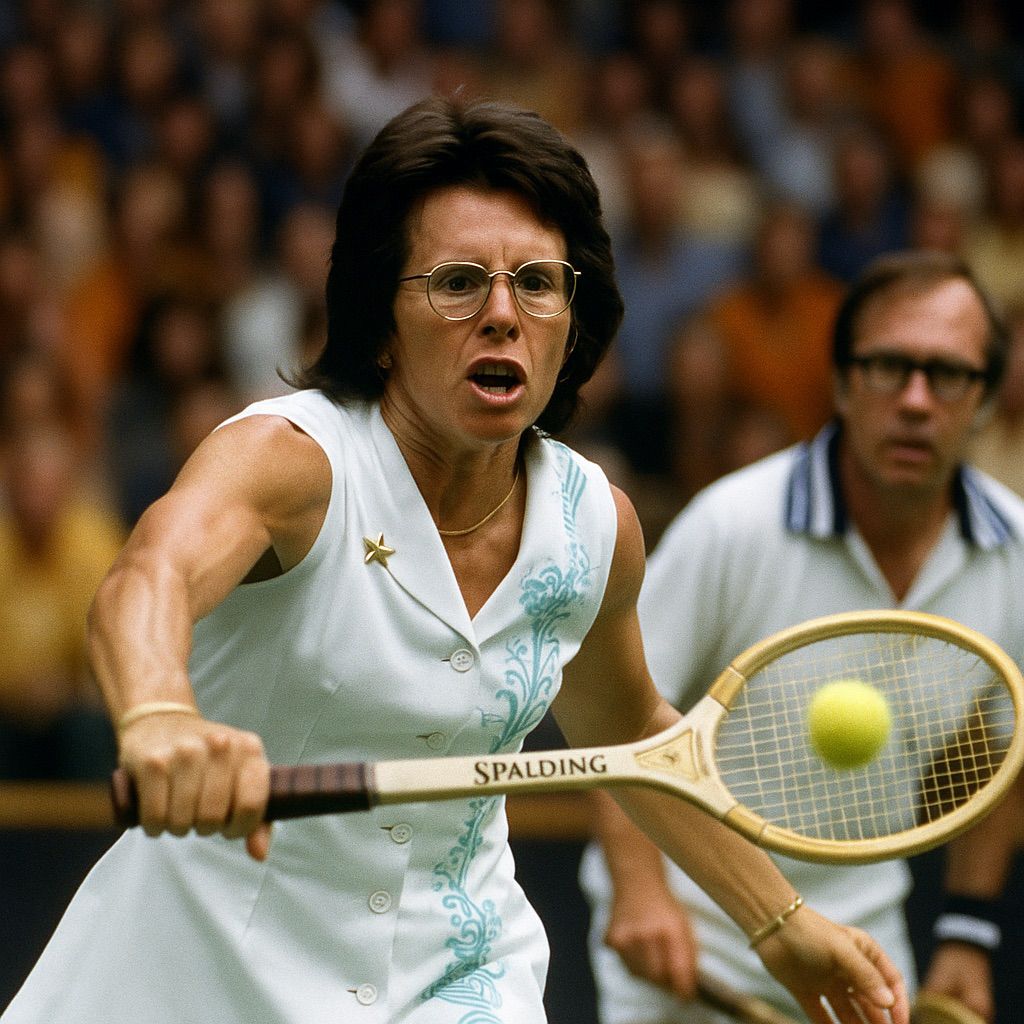
Houston, September 20, 1973. The Astrodome throbs like the belly of some giant neon beast, and I’m in the middle of it, ears ringing, brain boiling, heart sprinting like a rabbit trapped under floodlights. This isn’t tennis — don’t let anyone fool you. This is bloodsport dressed up in polyester whites. This is a carnival, a hustler’s sideshow, a morality play staged on AstroTurf with 30,000 howling witnesses in the cheap seats and another 90 million tuning in through the glowing altars of their television sets. The line between sport and circus has dissolved, and what remains is a bizarre American ritual: one man, one woman, one match that has nothing to do with backhands and everything to do with the future of gender itself.
Bobby Riggs is first on stage, and Christ, what an entrance. Fifty-five years old, wheezing like an overstuffed slot machine, he struts into the stadium in a “Sugar Daddy” jacket, waving a lollipop the size of a frying pan. The crowd screams with the kind of gleeful hate usually reserved for pro wrestlers or crooked politicians. Riggs is America’s appointed clown, the loudmouthed carny who turned himself into a national act by shouting the thing everybody whispered at the bar: women can’t cut it. Not in tennis. Not in sports. Not anywhere. He plays it like stand-up comedy, a male chauvinist pig routine so shameless it circles back around to performance art. But make no mistake: beneath the grin, he means it. He really thinks Billie Jean King is just another mark, another pigeon for the hustler to fleece under the hot lights.
And then Billie Jean arrives — Cleopatra carried on a golden litter by bare-chested men, the queen in sneakers, gliding into the arena with a face carved from steel. She doesn’t smile. She doesn’t wink. She’s not here for the sideshow. She’s here for execution. The roar is deafening. Kids are jumping in front of televisions, beer is sloshing in living rooms, women lean forward on couches across America like they’re watching Joan of Arc march into battle. Because that’s what this is: a crusade dressed as a tennis match.
I light a cigarette, the smoke curling up into the cheap seats. The air tastes like sweat, beer, and revolution.
The game begins, and immediately Riggs is in trouble. His legs are too old, his tricks too stale. He’s been peddling the same junk-ball routine for years — lobs, drop shots, little hustles designed to frustrate. It worked on Margaret Court in May, when he humiliated her in the so-called “Mother’s Day Massacre.” That match emboldened him, convinced him the whole women’s game was a con waiting to be exposed. But Billie Jean is no Margaret Court. She studied him, dissected his little hustler’s toolbox, and tonight she came to torch it.
Point after point, she hammers him into the corners, stretching him across the court like an old rubber band. Riggs huffs, puffs, swats weakly, but the precision of King’s groundstrokes tears through him like a chainsaw through papier-mâché. The crowd senses it early, murmurs turning into roars with each passing rally. By the end of the first set, 6-4, Riggs looks rattled, the smirk flickering on his face like a neon sign on its last bulb.
Second set, King is merciless. She pushes him back, keeps him running, playing not only with power but with psychology. Every shot is a declaration: you thought women couldn’t play? Watch this. She takes it 6-3. The Astrodome is a madhouse, half the crowd delirious with joy, the other half drunk on disbelief. Riggs is cooked, but he doesn’t know it yet. He staggers into the third like a washed prizefighter who refuses to hear the bell. King finishes it 6-3 again, and suddenly it’s over. Done. The great hustler is slumped on the court, the con blown apart under the weight of reality. Billie Jean raises her arms, and the place detonates like the Fourth of July.
The scoreline goes up in lights: 6-4, 6-3, 6-3. History etched into numbers, simple and brutal.
And here’s where the madness really begins.
Because this was never just about tennis. Don’t kid yourself. This was America in the 1970s, chewing on the jagged gristle of its own contradictions. Nixon in the White House, Vietnam unraveling, women marching in the streets demanding equality, men clinging to the last scraps of their comfortable superiority. The country was a pressure cooker, hissing with resentment and change, and the Battle of the Sexes was the valve release. Riggs wasn’t just an old gambler with a racket. He was the embodiment of every boss who told his secretary she’d never make it, every coach who told a girl she couldn’t play, every father who laughed at the idea of daughters doing more than serving dinner. And King wasn’t just a tennis player. She was the fuse on a bomb, the living rebuttal to centuries of dismissal.
Her victory was a thunderclap. It told little girls glued to television screens that they could step onto a court, a field, a stage, and not just belong but dominate. It told little boys that their smug grins weren’t safe anymore. It told America that equality wasn’t an abstract theory. It was real, and it had a score: 6-4, 6-3, 6-3.
I remember the delirium afterwards. Bars erupting. Women pounding their fists on tables, screaming with joy. Men grumbling into their beer mugs, muttering about “just a show match.” But it didn’t matter. The image was already burned into history: Billie Jean King, arms raised, eyes fierce, standing over the carcass of chauvinism in the middle of the Astrodome. Riggs had been reduced to what he always was — a hustler past his prime. But King was reborn, transformed from champion to icon, from athlete to revolutionary.
Even now, decades later, the shockwaves haven’t faded. The Battle of the Sexes gets replayed in documentaries, re-enacted in films, dissected in classrooms. Some sneer and say it wasn’t a fair fight — Riggs was old, King was in her prime. But that’s missing the point. The point was never the contest itself. The point was the stage, the spectacle, the symbolism. Riggs represented the past. King represented the future. And on that night, in front of ninety million witnesses, the future won.
I left the Astrodome dizzy, the roar still ringing in my ears. The night air felt different, electric, like the country had just shifted half an inch on its axis. Somewhere in that chaos, equality had notched a victory, not the last, not the final, but one that mattered. Sport had done what speeches and protests couldn’t: it put the fight in front of everyone, forced them to watch, and gave them a score they couldn’t argue with.
And that’s the truth of September 20, 1973. Billie Jean King didn’t just beat Bobby Riggs. She torched an entire narrative, and the fire is still burning.