
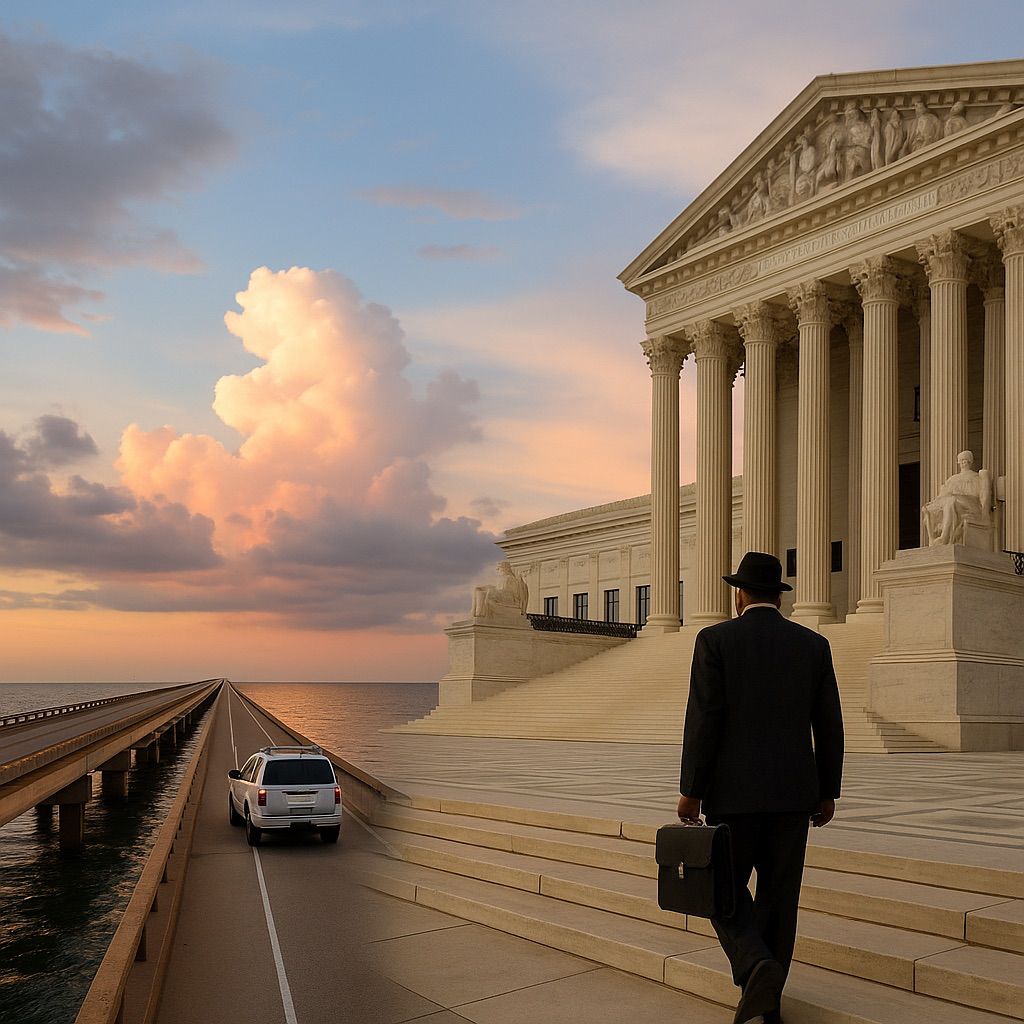
There are days on the calendar that behave like doorways—you step through and discover two rooms that shouldn’t share a wall and yet somehow complete each other. August 30 is one of those uncanny thresholds. On that date in 1956, the Lake Pontchartrain Causeway opened and drew a straight, improbable line across a moody, shallow inland sea, replacing hours of detour with a continuous ribbon of concrete that seemed to surf the horizon. Eleven years later, on August 30, 1967, the United States Senate confirmed Thurgood Marshall as the first Black justice of the Supreme Court, drawing an equally improbable line across centuries of exclusion and saying, with the weight of the law, that the highest bench in the land could finally reflect more of the people it judges. A bridge and a justice: one carries cars, one carries precedent; both carry hope. It’s tempting to keep civil engineering and civil rights in separate lanes, but they share a simple, stubborn verb: to connect. The Causeway taught communities separated by water how to live as neighbors; Marshall taught a nation separated by custom how to live by its Constitution. August 30 is therefore less a date than a lesson in what it takes to cross distances—rebar and resolve, pylons and patience, bearings and bravery.
Begin on the water. Lake Pontchartrain is not quite a lake; it breathes with the Gulf through tidal straits, wears a thin sheet of brackish gray-green, and hides its moods behind a calm surface that can turn petulant when the wind hustles in from the east. The New Orleans that leans on its southern shore has always been a city of detours—cypress and marsh, meanders and levees, culture and routes that curl before they arrive. Before 1956, the trip to the Northshore required loops of road around lake edges or long waits for ferries that moved at the speed of weather. Then the Causeway arrived—two dozen miles of low, repeating spans pouring north from Metairie like a string of gray prayer beads. It is not grand in the way of suspension bridges with their taut harps and skyline signatures; its grandeur is repetition and endurance: a cadence of segmented concrete lifting and falling, lifting and falling, until land appears again like an answered wish. An entire generation grew up measuring time by the number of light standards passed, by the length of the straightaway when the world thins to a line, by the midpoint drawbridge that lets masts slip through like needles threading a seam. Engineers will tell you the mind of the Causeway is in its details—precast girders seated like vertebrae, expansion joints that exhale under heat, pilings driven down into stubborn beds to discourage the lake from reclaiming the line. Locals will tell you its soul is in what it lets you do—kiss someone goodnight on one side and make breakfast on the other, keep a job that would otherwise demand a move, visit a grandmother whose cooking keeps both sides of the lake honest.
Every bridge is also a bet—on materials, on human behavior, on the weather’s manners. The Causeway’s designers wagered that the everyday drama of commuting across open water could be made routine. They drew diagrams that had to survive not just tides and the occasional tantrum of a storm, but the softer erosions of monotony and fog. They added turnouts so stalled cars wouldn’t turn a bridge into a parking lot; they added call boxes so panic could reach help; they added a small fleet of patrols that glide like shepherds along the lanes, coaxing the anxious along, corralling the reckless. When hurricanes grumble across the Gulf, the bridge becomes a barometer of prudence; close it too late and it becomes a trap; close it too early and a region’s commerce seizes up. The Causeway taught officials to choreograph safety and taught drivers to respect the mysteries of crosswinds and whitecaps. In exchange, it gave the region a new map. Suburbs on the Northshore swelled, weekend plans expanded, and the cultural exchange accelerated—jazz festivals commuted, restaurant reputations traveled, families braided themselves across water without checking timetables.
Now turn to Washington, D.C., where different spans rise and fall—bridges made of logic and memory. Thurgood Marshall’s journey to the Supreme Court did not begin in 1967 or even with Brown v. Board of Education; it began in classrooms where a Black student burned through textbooks like kindling and decided that the law could be a way of talking a stubborn nation into telling the truth. He trained at Howard University’s law school under Charles Hamilton Houston, who smuggled strategy into syllabi and taught students that segregation wasn’t simply immoral but illogical, inefficient, unconstitutional, and therefore defeatable in court. Marshall absorbed the gospel of careful preparation: file suits that target the rotten beams of the structure, gather plaintiffs whose courage can endure cross-examination, stack up facts until a judge can’t pretend not to see them. On the road as NAACP counsel, he slept in homes that put a lookout at the window and a pistol under the pillow; he debated sheriffs with smiles that weren’t surrender; he argued before benches that applauded themselves for their neutrality while sitting under murals that didn’t include a single person who looked like him. By the time he stood to argue Brown, he had already built the staircase—cases against whites-only primaries, against restrictive covenants that quarantined Black families out of opportunity, against separate-but-equal sham policies that used the language of parity to disguise theft.
When President Lyndon Johnson nominated Marshall for the Supreme Court, the Senate’s advice-and-consent stage became its own weather system. The hearings showed the country a man whose voice combined preacher and professor, generosity and granite. He answered questions designed to belittle with patience that refused to shrink. He parried those who baited him into seeming “too radical” by returning to the steady drumbeat of constitutional text and lived reality. The vote did not crown a saint; it seated a lawyer. But make no mistake, the moment had sanctity for many Americans. In living rooms from Baltimore to Baton Rouge, families who had memorized Marshall’s victories nodded at the television and felt years slide off their shoulders. Confirmation did not end struggle; it widened the corridor where struggle could be argued and inscribed. On the bench, Marshall wrote opinions that read like field guides for fairness and dissents that read like letters from the future, reminding colleagues of the people missing from their abstractions. He insisted that the Constitution was not a museum piece but a meeting promise—constantly tested, sometimes disappointing, capable of growth.
It is easy to talk about precedence and concrete as if they were separate species of progress, but the Causeway and Marshall share anatomy. Each depends on foundations you can’t see from a distance. Under the waterline, pilings; under the holding of a right, decades of organizing, strategy, and small town cases that never make it into the textbooks. Each uses joints to accommodate stress: a bridge must flex or crack; a constitutional order must adjust to lived experience or betray itself. Each has to be maintained—inspection crews with measuring tapes and hammers, citizens with ballots and stubborn attention. Each faces load limits: too much traffic, and a span strains; too much cowardice in political branches, and a court buckles under what it refuses to hold. Each—this is crucial—makes a promise about destination. A bridge says, “You can get there from here.” A justice says, “You can belong there from here.” The Causeway’s promise is geographic; Marshall’s is civic. Both change how people plan their days and their lives.
There are human stories nested in both triumphs that make the metaphors honest. Consider an ironworker standing knee-deep on a platform in 1955, wind trying to steal his hat, palms the color of effort. He may never drive the Causeway to a white-tablecloth restaurant on the other side, but he likes the idea that a nurse on a night shift will get home in time for breakfast because of his welds. Consider a young secretary in 1967, sorting mail at the Supreme Court, whose father once said the building wasn’t meant for people like them. On the day of Marshall’s swearing-in, she lingers under a coffered ceiling too ornate to be friendly and feels something unseen move out of the doorway. Later, on a lunch break, she writes her mother a postcard that says simply, “I saw him.” Decades pass. The ironworker’s grandson proposes to his girlfriend on the midpoint of the Causeway at sunset, patrol car idling behind them to keep the moment safe. The secretary’s niece stands in a courtroom gallery and hears an attorney cite a Marshall opinion to protect a tenant from a landlord’s games. If the Causeway is a linear miracle, Marshall’s confirmation is a layered one; both prove that infrastructure—roads, laws, norms—is the shape of our kindness to strangers.
Of course, progress invites correction and accountability. The bridge you cheer can also carry the archipelago of sprawl, leaking heat into an atmosphere already under siege; the court you celebrate can also hand down decisions that crack communities and invite cynicism. The work of love, public and practical, is to build while questioning. Who is served by this path over water? Who is missed by this path through law? The Causeway, for all its utility, raised questions about wetlands and where we choose to grow. Marshall’s tenure, for all its brilliance, unfolded alongside political tides that sometimes turned the court away from the most vulnerable. None of this negates the victories; it clarifies the maintenance schedule. The bridge adds railings and new decks as storms teach their lessons; citizens add turnout strategies and new arguments as courts forget their courage. August 30 teaches that we do not bless milestones because they are flawless but because they hold when we test them and invite us to keep testing.
There is also a rhythm here worth noticing: how bold acts feel in the moment versus how they look in hindsight. Opening day on the Causeway must have tasted like risk—a long reach over water that dared drivers to believe in math. Confirmation day must have tasted like relief with a stern aftertaste—an appointment earned times ten, a victory that still had to be defended case by case. Now, from our vantage, both look inevitable, as if the Causeway rose from the lake without argument and Marshall’s seat had been dusted for him long ago. We should resist that softening. The people who make these things happen are not removed from fear; they just decide it isn’t the most interesting thing in the room. Engineers read weather reports and adjust cure times for concrete; senators count votes and decide which fight is worth a scar. And somewhere far from the podiums, a parent tells a child, “Look. That’s ours now—a way across.” Look. That’s ours now—a voice in the room.
Think too about what these August 30 gifts did to time. The Causeway compressed hours into minutes and, with that compression, changed what was reasonable and what was lazy. Courting someone across the lake became feasible; keeping a promise to show up became a little harder to wriggle out of. Marshall’s presence compressed the distance between petition and possibility. Lawyers who might have trimmed arguments to fit the fragile tolerances of an all-white bench brought bolder filings. Plaintiffs who had learned to expect polite dismissal saw eyes that recognized their neighborhoods. Time, tightened, becomes obligation. If it’s easier to get to each other, we must. If the law is more likely to hear us, we must speak.
The pairing of bridge and justice also reminds us that systems—physical and legal—are stories we tell with materials. The Causeway says humans can lay down a sentence across water: subject (pilings), verb (carry), object (neighbors). The Court says humans can lay down a sentence across conflict: subject (people), verb (are), object (equal). One is written in concrete and steel, the other in opinions and dissents, both legible to anyone willing to read the pattern. When the Causeway disappears into fog, drivers lean into lane markers and trust the rhythm of lights; when the law disappears into jargon, citizens lean into stories—of kids bused, ballots counted, hospitals integrated—and trust the rhythm of justice. In both cases, faith is not blind; it is trained by use. The best compliment you can pay either system is not reverence but reliance.
So what should we do with a date like August 30 besides salute it? Perhaps treat it as a maintenance reminder and a blueprint. Check the bridge in your own life—the habit, meeting, or commute that connects you to people who depend on you. Is the deck sound? Are the joints dry? Build a new span if a friendship has been allowed to silt up or if a zip code has become an alibi. Check the justice in your own civic life—the ways you vote, volunteer, read, donate, argue. Are you relying on someone else’s patrol to keep the crossing safe? Are you letting cynicism close lanes that ought to stay open? Find a small case to take up—at a school board, housing clinic, or neighborhood council—and learn the local equivalent of expansion joints and pilings. We honor engineers and jurists best not by statues but by imitating their patience with complexity.
Finally, humanize the abstract with gratitude. Somewhere today a nurse will cross the Causeway at dawn, coffee burning her tongue, a radio murmuring weather, the long flat water naming the line between shift and sleep. Somewhere today a law student will read a Marshall dissent and understand, maybe for the first time, that the law is not a machine for the powerful but a language anyone can learn well enough to fight in. Somewhere today a child will look out from a backseat and ask why the road floats, and a parent will say, “Because people decided to make a way.” Somewhere today a client who has never been listened to without hurry will sit in a courtroom and hear their name said correctly by a judge whose understanding of fairness was shaped by a man who knew what it cost to be ignored. August 30 is their day, and ours—proof that the distances we inherit are not destiny.