
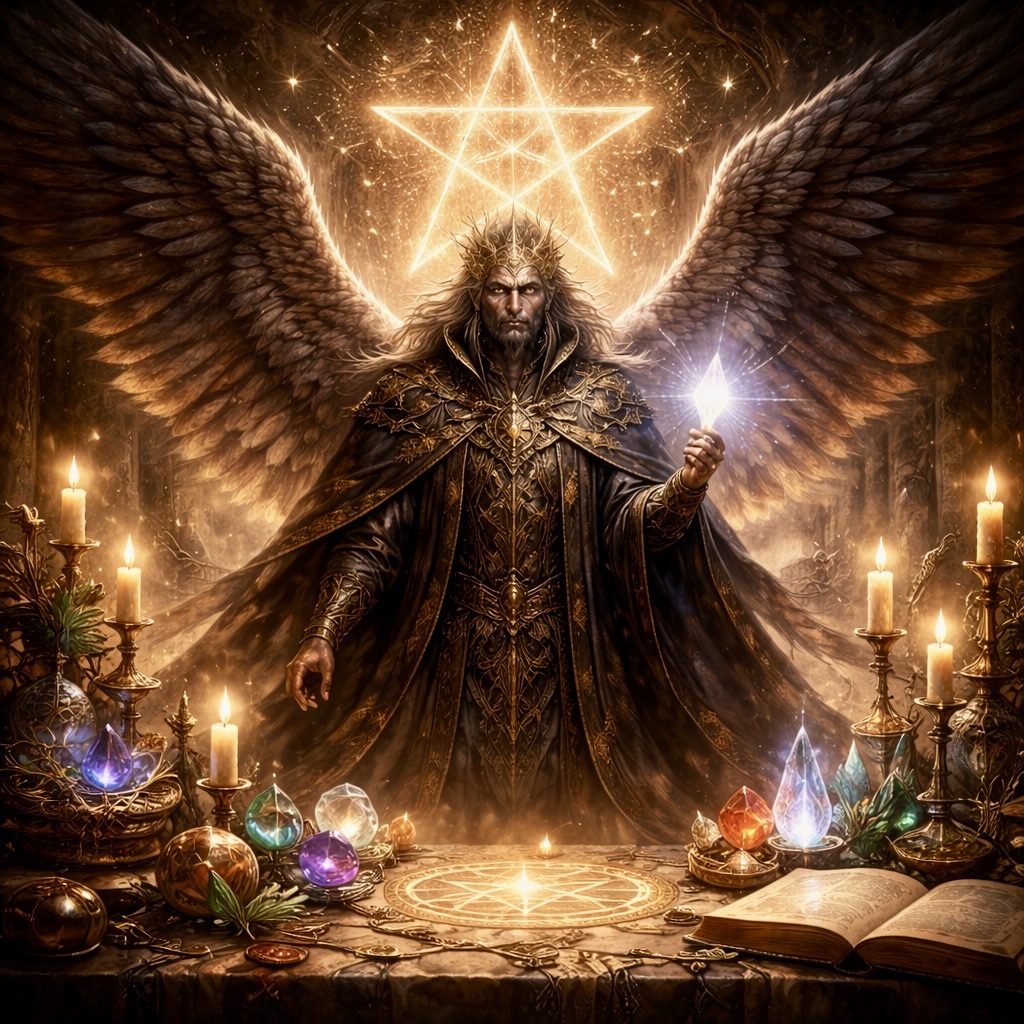
Decarabia is one of those infernal figures whose reputation is built less on fear and more on curiosity. In the old demonological texts, he is not described as a roaring tyrant or a punisher of souls, but as a keeper of hidden knowledge, a quiet revealer of truths that already exist but remain unseen. His power does not come from destruction or temptation, but from interpretation. Decarabia governs the secret language of stones, herbs, birds, and gems, translating the natural world into meaning for those who know how to ask. In this way, he occupies a strange and fascinating space within the Ars Goetia, somewhere between demon, scholar, and natural philosopher.
According to the grimoires, Decarabia appears initially in the form of a pentagram, a five-pointed star suspended in the air. Only after being commanded does he take on a more recognizable shape, often described as a man with wings or a birdlike form. This transformation is deeply symbolic. The pentagram has long represented hidden order, balance, and the structure underlying apparent chaos. To encounter Decarabia first as a symbol rather than a body suggests that his essence is abstract before it is physical. He is knowledge before he is form.
Decarabia’s rank is that of a Marquis of Hell, a title that implies authority without absolute dominion. A marquis governs borderlands, territories at the edge of kingdoms. This fits Decarabia perfectly. His domain lies at the border between the human and the natural, the spoken and the unspoken, the observed and the interpreted. He does not create secrets; he reveals them. He teaches the virtues of stones and herbs, the qualities hidden within gems, and the meanings carried by the flight and calls of birds.
In medieval and early modern Europe, this kind of knowledge was not trivial. Stones and herbs were believed to carry inherent properties that could heal, harm, protect, or curse. Birds were omens, their movements read as messages from beyond human understanding. To know the true nature of these things was to possess power, not the loud power of conquest, but the quiet power of insight. Decarabia embodies this belief, serving as a supernatural librarian of the natural world.
What makes Decarabia particularly intriguing is his relationship with truth. Unlike demons associated with deception, Decarabia is described as truthful when properly constrained. He reveals what is already there. This does not make him safe, however. Knowledge without context can be dangerous, and understanding without wisdom can lead to ruin. Decarabia does not decide how his revelations will be used. He provides information, and the consequences belong to the one who asked.
The pentagram form attributed to Decarabia has been the subject of much interpretation. In many traditions, the five-pointed star represents the elements: earth, air, fire, water, and spirit. Decarabia’s connection to stones, herbs, and birds aligns neatly with this symbolism. He is a unifier of elements, a reminder that the natural world speaks a coherent language if one knows how to listen. His star-shaped appearance reinforces the idea that knowledge itself has structure, even when it seems mysterious.
Birds play a central role in Decarabia’s mythology. He is said to understand their songs and the meanings behind their movements. This places him in a long tradition of augury, the ancient practice of divination through observing birds. To ancient and medieval observers, birds were messengers between worlds, creatures that moved freely between earth and sky. Decarabia’s command over their language suggests mastery over liminal spaces, those places where boundaries blur and insight emerges.
Stones and gems, too, are central to Decarabia’s influence. In an era when gemstones were believed to hold specific virtues, knowing their true nature was invaluable. A stone could protect a traveler, enhance memory, or ward off illness. Decarabia’s teachings would have appealed to alchemists, healers, and scholars seeking to unlock the hidden properties of matter. Even today, the symbolic power of stones persists, suggesting that Decarabia’s appeal is not limited to superstition, but rooted in a deeper human impulse to find meaning in the material world.
Decarabia’s wings are another important symbol. Wings represent freedom, perspective, and transcendence. A winged Decarabia suggests an elevated viewpoint, the ability to see patterns invisible from the ground. This aligns with his role as a revealer of hidden connections. He does not change the world; he changes how it is seen. In doing so, he challenges the assumption that knowledge must come from human reasoning alone. Sometimes, understanding comes from observing what has always been present.
Unlike many demons, Decarabia is not described as hostile or malicious. His danger lies in indifference. He offers truths without concern for how they will be received or applied. This makes him a compelling metaphor for knowledge itself. Information is neutral. It can heal or harm, enlighten or overwhelm. Decarabia embodies this neutrality, standing as a reminder that insight carries responsibility.
In modern interpretations, Decarabia often appears as a figure of esoteric wisdom, a guide through hidden systems rather than a villain to be defeated. He resonates with those drawn to symbolism, natural magic, and the idea that the world is layered with meaning. In this sense, he feels almost contemporary, a patron of pattern-seekers and systems-thinkers in an age obsessed with data and interpretation.
The image of Decarabia as a star transforming into a winged being also speaks to the human experience of understanding. Knowledge often begins as an abstract concept, a symbol or theory, before becoming something lived and embodied. Decarabia’s manifestation mirrors this process. He is an idea that takes shape, a pattern that becomes a presence.
Decarabia’s continued relevance lies in his subtlety. He does not dominate narratives through spectacle. He lingers at the edges, waiting for those who are willing to look closely. His power is patient, observational, and deeply tied to the world as it is, not as we wish it to be. In a culture that often values loud certainty over quiet insight, Decarabia stands as a reminder that some truths are revealed only to those who slow down enough to notice.
Ultimately, Decarabia represents the hidden coherence of the natural world. He is the whisper behind patterns, the logic beneath symbolism, and the reminder that meaning is often already present, waiting to be recognized. Whether approached as a demon of occult lore or as a metaphor for interpretive knowledge, Decarabia endures because he reflects a timeless human desire: to understand the world not just as a collection of objects, but as a network of signs.
To engage with Decarabia is to accept that knowledge is not always comforting. It can unsettle, complicate, and challenge assumptions. But it can also deepen appreciation for the intricate systems that surround us. In this way, Decarabia is less a figure of fear and more a figure of revelation, a star that points not outward, but inward, toward a more attentive way of seeing.