
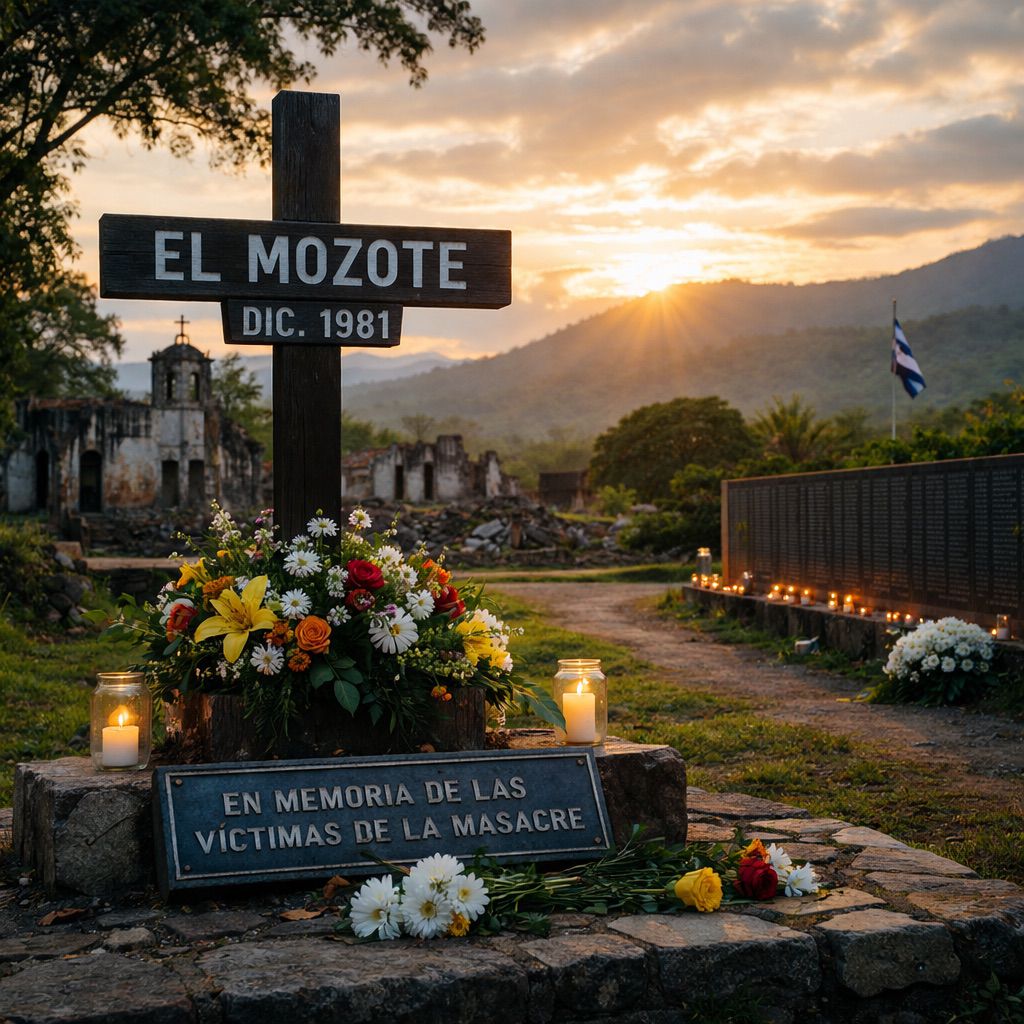
The morning sun that rose over the hills of Morazán in December of 1981 should have been no different than any other, casting its soft gold tones across the valleys and the quiet farming villages of northeastern El Salvador. But for the people of El Mozote, a small rural community whose lives revolved around cornfields, coffee plants, church gatherings, and the rhythms of family and work, the quiet beauty of those days would soon be overshadowed by one of the darkest events in Latin American history. The massacre that unfolded on December 11–12, 1981, would leave 863 people dead, entire families erased from existence, and the world forced to confront the brutal dimensions of a war that had long been painted in ideological simplicity.
El Salvador’s civil war, at least on the surface, seemed like a familiar Cold War script: leftist guerrillas of the Farabundo Martí National Liberation Front (FMLN) fighting against a government backed strongly by the United States. But beneath the geopolitical framing, the conflict was a cauldron of poverty, inequality, repression, and generations of rural neglect. The Salvadoran military, underpinned by U.S. training and funding, had adopted increasingly violent counterinsurgency tactics as the war intensified. Civilian populations in contested regions were no longer treated merely as unfortunate bystanders; they were redefined as potential collaborators, and therefore as legitimate targets.
The Atlacatl Battalion, an elite rapid-response unit created, trained, and heavily supported by U.S. advisers, would become infamous in the months and years that followed. Its members had been trained for efficiency, aggression, and counter-guerrilla strategy. What no amount of official training manuals admitted was that such training would also become the backbone for some of the worst atrocities of the war. What happened at El Mozote was not a spontaneous act of battlefield chaos; it was a methodical, organized mission whose objective was chillingly clear.
On December 10, 1981, the battalion encircled the village. Residents were frightened but still held onto a fragile belief that if they cooperated, no harm would come to them. The town’s reputation as a place sympathetic to guerrillas had long made it a target, but many residents had stayed precisely because they believed that declaring neutrality and avoiding armed involvement would protect them. They were tragically wrong.
The soldiers began by ordering everyone out of their homes. Men, women, children—entire families were gathered together in the village square. What followed was a deliberate pattern of separation: men forced into one location, women into another, children into the convent. The soldiers accused them of supporting the FMLN, of feeding guerrillas, of hiding weapons—accusations that, in the tense logic of counterinsurgency doctrine, required little to justify extreme measures.
The men were the first to be executed. Blindfolded, beaten, interrogated for information they did not have, many of them were shot in groups, their bodies left in open fields or buried hastily. Women were subjected to unspeakable violence before being killed. Children—some as young as infants—were gathered inside a church and murdered in ways so brutal that even decades later forensic experts struggled to process the evidence without emotional collapse.
The soldiers then burned the town. Homes, livestock, personal belongings, and even the bodies of victims were set ablaze in an attempt to erase any trace of what had occurred. El Mozote no longer resembled a community—it looked instead like a ghostly remnant of war, a place where silence lingered heavier than the smoke.
For a time, the Salvadoran military believed the operation had been a success. They denied everything. They accused survivors of lying. They told foreign journalists sympathetic to the villagers that their reporting was communist propaganda. The Reagan administration, eager to maintain military support for El Salvador’s government, quickly dismissed the first press stories about the massacre. Officials went so far as to imply that journalists had fabricated the event or had been manipulated by the FMLN.
But the truth—though temporarily buried—was not so easily silenced. In 1983, human rights investigators and journalists made their way to El Mozote again. This time they met survivors, remnants of buildings, and bones protruding from shallow graves. Forensic experts uncovered tiny skeletons, many belonging to children still wearing their shoes. There was no mistaking what had happened.
The massacre became emblematic not only because of its scale but because of the systemic impunity surrounding it. U.S. officials had denied it. The Salvadoran government had covered it up. And the military officers who planned and carried out the massacre were protected by an amnesty law passed in 1993, just days after the UN Truth Commission released its findings affirming the military’s responsibility.
Still, the dead did not disappear quietly. Families demanded truth. They demanded justice. They demanded dignity for those buried in unmarked graves.
As years passed, El Mozote became a symbol of memory and resistance. Survivors returned to rebuild what they could. Churches erected memorials. Activists organized pilgrimages and educational programs. International organizations provided forensic analysis, counseling, documentation support. In 2016, the Inter-American Court of Human Rights ruled that El Salvador had violated the rights of the victims by refusing to investigate and that the government must reopen the case. For the first time, high-ranking officers were ordered to face judicial proceedings.
Yet the path to accountability remains difficult. Many of those responsible lived long lives abroad or in military retirement. The same geopolitical forces that enabled the massacre continue to influence politics. And the scars left on survivors cannot be erased by tribunals alone.
The story of El Mozote is a story of a community destroyed not because of what people did, but because of who they were—poor, rural, and living in a zone of conflict where suspicions outweighed humanity. It is also a story of silence: the silence forced upon victims, the silence insisted upon by governments, the silence demanded by those who benefited from looking away.
But above all, it is a story of memory. Survivors have ensured that El Mozote is remembered not simply as a tragedy, but as a warning. A warning about the dangers of unchecked military power. A warning about what happens when ideological battles dehumanize entire communities. A warning about the ways great powers can enable atrocities even while speaking the language of freedom and democracy.
Standing in El Mozote today, one sees a town rebuilt—modest homes, gardens, a school, a church. But the ground beneath holds layers of history that refuse to be forgotten. Flowers and crosses mark places where bodies were found. The air carries the echoes of names once spoken in family gatherings, at church festivals, in childhood laughter.
The massacre remains a wound in El Salvador’s national memory, one still in the process of healing. Its lessons extend far beyond national borders. It shows that truth must be protected even when governments fear it. It shows that accountability matters not only for the past but for the future. And it shows that even in the wake of unimaginable violence, communities can rise—not to erase what happened, but to ensure it is never repeated.