
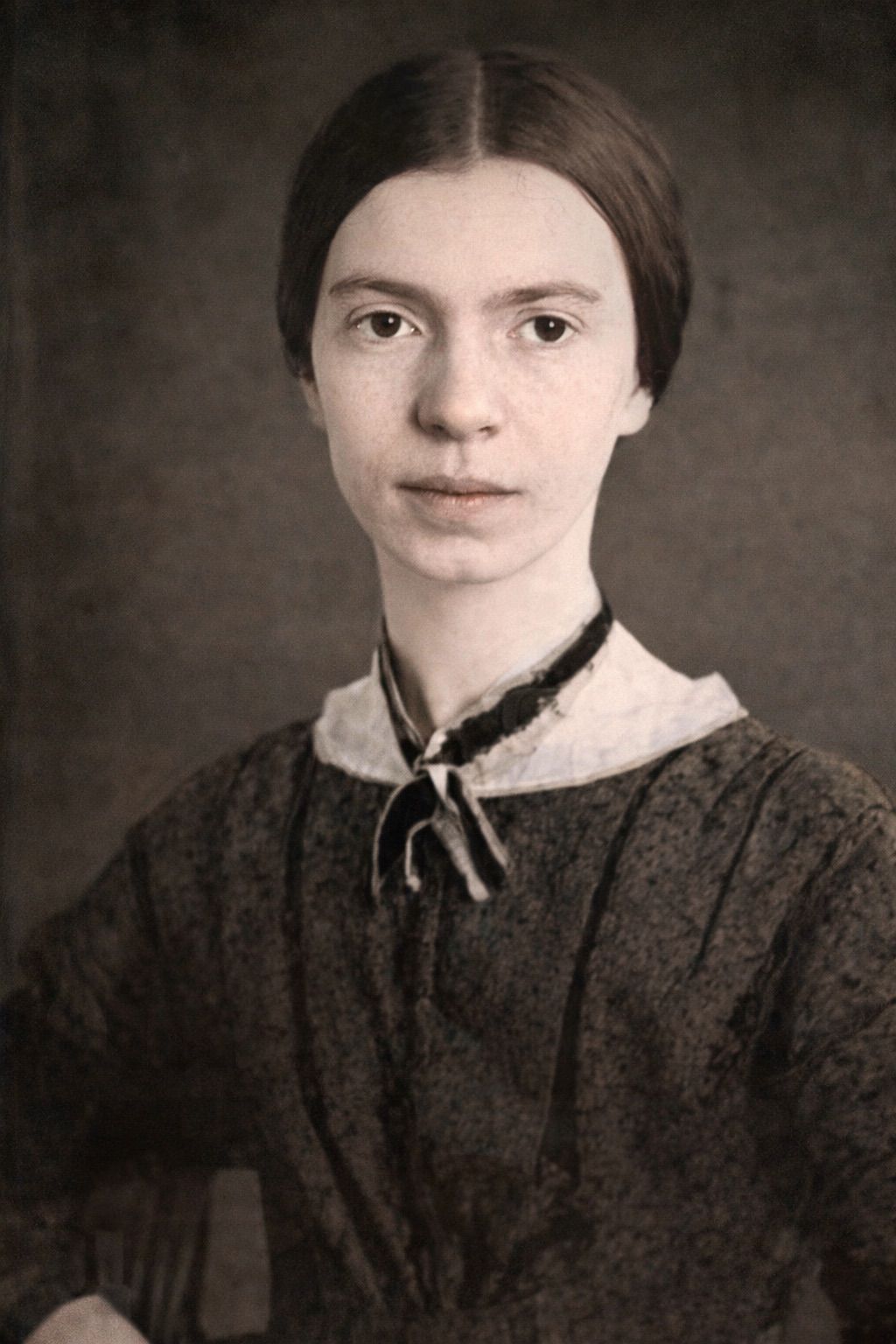
In one of her letters, Emily Dickinson wrote: “A Route of Evanescence, With a revolving Wheel.” This image, later revised to the now-famous line “A Bird came down the Walk,” appears in multiple drafts and variations throughout her writing life. She tried out different phrasings for this concept of fleeting existence, from “Evanescence” to “a Bird” to even a “Way of Light.” Each version is a testament to her persistent exploration of transience, yet each leaves the notion unresolved, as if to mirror its own subject. In her drafts, Dickinson often omitted punctuation or capitalization, creating a sense of fluidity and continuation that defies closure. The phrase “A Route” becomes simply “Route,” suggesting a journey without a clear beginning or end. Similarly, the transition from “Evanescence” to “a Bird” introduces a tangible entity into an abstract concept, grounding it in everyday experience while still preserving its elusive nature. This recurring theme and its many iterations reveal Dickinson’s unfinished thought process, her attention lingering on the ephemeral without seeking definitive answers.
In her letters and draft revisions, Emily Dickinson returns often to the concept of “the possible.” This phrase appears in various iterations throughout her writing life, each instance revealing a subtle shift in emphasis or context. In one letter, she writes, “To live – is ‘the possible’ – isn’t it?” Here, the dash and the question mark suggest a sense of uncertainty, as if Dickinson is posing this idea to herself as much as to her correspondent.
In another instance, a draft poem, the phrase takes on a more assertive tone: “The Possible’s slow fuse is lit / By the Imagination.” This version capitalizes “Possible,” elevating it to a proper noun or perhaps an abstract concept.
Yet in another draft, Dickinson explores the same idea through a different lens: “The possible – Grows by surrender -.” Here, she introduces an element of paradox, suggesting that giving up or letting go might lead to growth and expansion, rather than contraction or loss. The dash after “possible” slows down the reader’s pace, inviting reflection on this unexpected juxtaposition.
Despite these variations, Dickinson never definitively resolves her exploration of “the possible.” Instead, she approaches it from multiple angles, allowing each iteration to resonate in its own unique way.
In the earliest drafts of Emily Dickinson’s letters, one finds an unfinished sentence, “The concept of -,” its trailing dash lingering like an invitation for her pen to return and complete the thought. This incomplete phrase appears again and again throughout her writing life, each iteration a testament to her ongoing engagement with abstract ideas. In one instance, she fills in the blank space not with a single word but with a list: “The concept of Time, of Space, of Eternity.” Yet, this enumeration is itself left unfinished, as if to suggest that the concepts which captivated her were too vast for language alone. In another version of the same sentence, Dickinson replaces the dash with a semicolon and appends an additional clause: “The concept of -; does it not haunt us?” Here, she transforms her initial inquiry into a rhetorical question that implicates both herself and her correspondent. However, what remains constant across these variations is the absence of a definitive answer; Dickinson’s exploration of abstract notions appears perpetually unresolved, leaving room for further contemplation and reflection.
In the margins of her drafts, Emily Dickinson often crossed out and rewrote the word “Power.” Sometimes she replaced it with “Majesty,” or “Sovereignty.” Other times, she left a gap where “Power” had been, only to return to it later. Drafts show that this hesitation was not confined to a single period of her writing life; instead, the word’s recurrence and revision suggest an ongoing exploration, an unresolved thought. In one draft from 1862, she wrote, “To pile like Thunder to its close / Then crumble grand away / While Everything created hid.” The next line begins with a crossed-out “This,” replaced by “That,” before continuing, “is Power’s – most consummate” state. Here, Dickinson seems to be grappling with the nature of power itself—its buildup and dissolution, its ability to inspire both awe and fear. Yet she never settles on one definition or metaphor; instead, her revisions hint at an unending process of questioning and refinement.
In one of Emily Dickinson’s draft revisions, she crosses out the line “To fill a Gap” and replaces it with “Insert the Thing that caused it.” This revision suggests not merely an attempt to mend a rupture but a deliberate insertion of its very source. In another version, Dickinson toys with the phrase “The Soul should always stand ajar,” which later evolves into “The Soul should always sit in looser Robes.” Here, she experiments with different verbs and images—from standing to sitting, from an open door to loose garments—to convey her ideas about accessibility or receptivity. Yet, the core concept of openness remains a consistent thread throughout these variations. Witnesses recall that Dickinson often left her door slightly ajar as if embodying this notion in her daily life. However, despite these recurring themes, no definitive conclusions can be drawn; instead, one is left with an invitation to linger over the traces of her thought process.
In her letters to Thomas Wentworth Higginson, Emily Dickinson returned again and again to the concept of “circumference.” This word appeared in various forms throughout their correspondence: “Circumference thou Bride of Awe,” she wrote once; elsewhere, it was simply “The Missing All — prevented Me…”. In one draft revision, the line read “Boundary” instead—a subtle shift that hinted at Dickinson’s ongoing exploration of this theme without resolving its ambiguity. The phrase also surfaced in other letters and drafts, often unaccompanied by any context or explanation: “Circumference is all,” she declared on one occasion; elsewhere, it was described as an elusive prize—”the Crescent dropped—Existence’s whole Arc, filled up”—that seemed forever beyond her grasp. Despite these variations in wording and emphasis, however, the essential meaning of circumference remained tantalizingly unclear. Was it a physical boundary or a metaphysical one? A symbol of confinement or of possibility? The record alone could not say for certain.
In her correspondence and draft revisions, Emily Dickinson often returned to the concept of “light.” This recurring theme was explored through various metaphors and imagery, each offering a slightly different perspective on its essence. A common phrase that appeared in her letters was “the light within,” which she used to describe an internal radiance or understanding. For instance, in one letter to a friend, Dickinson wrote: “The Light within is the great Revealer of Mysteries.”
In another version of this concept, drafts show a shift towards external sources of illumination. In these instances, light was often personified and given agency, as if it were an entity capable of action.
Despite these variations in wording and imagery, there remained an underlying consistency in Dickinson’s approach to this theme. The concept of light was always treated with reverence and a sense of mystery, suggesting a deep-seated curiosity about its nature and significance. However, despite returning to this topic repeatedly throughout her writing life, she never arrived at a definitive conclusion or interpretation. Instead, each exploration seemed to lead only to further questions and musings on the elusive qualities of light.
In one letter to her sister-in-law Susan Gilbert Dickinson, Emily Dickinson writes, “The Sailor cannot see the North – but knows the Needle can.” Yet, in another draft, she revises this line, stating instead, “A Sailor’s thought is the Needle – his mind – the Northern Star.” These two versions of a similar sentiment, found within her collected correspondences and poetic drafts, offer distinct variations on a central concept. The first iteration presents an analogy between the sailor and the needle, where the sailor’s inability to see the North contrasts with the needle’s inherent knowledge. In this version, Dickinson emphasizes the sailor’s reliance on external guidance – a metaphor perhaps for human dependence on unseen forces or divine intervention. The second variation, however, shifts the focus from external direction to internal guidance; here, the sailor himself embodies both needle and Northern Star, suggesting an inherent sense of purpose or intuition guiding his journey. The subtle yet significant differences between these two versions underscore Dickinson’s exploratory approach to her subject matter – a method that remains open-ended rather than conclusive.
In her letters to various correspondents across decades, Emily Dickinson often returns to the image of a “gash in the cloud.” This striking metaphor appears first in an 1850 letter to Susan Gilbert: “A gash in the cloud looks like a wound – but it isn’t one – for the sun pours through and gilds the earth below…” The phrase resurfaces repeatedly, with variations, throughout her writing life. In another letter, written around 1862, she revises her initial metaphor: “A slash in the cloud looks like a wound, but ’tis only the sun – pouring through – to gild the earth below.” The change from “gash” to “slash” subtly alters the violence of the image, while retaining its evocative power. Yet another draft shows further revision: “A rent in the cloud appears a wound, yet ’tis only the sun, pouring through – to gild the earth below.” Here, Dickinson shifts from active verbs (“gash,” “slash”) to the more passive “rent,” suggesting perhaps a growing distance from her original image. But why does she return again and again to this metaphor? What remains unresolved in her repeated attempts to articulate it? The record offers no clear answer – only the trace of her persistent attention, left for us to ponder.
In her letters and draft revisions, Emily Dickinson repeatedly returns to the concept of “circumference,” yet she never settles on a fixed definition or application for this term. The word first appears in an 1859 letter to Samuel Bowles: “The circumference / Dropped into the Centre / Carried its Reports to God.” In another version, however, Dickinson crosses out “circumference” and replaces it with “creature,” suggesting a fluidity between the two words in her mind. Later drafts of poems and letters reveal further variations on this theme: “Circumference thou Bride of Awe” (1862), “My Business is to love— / Circumferences are incidental” (1875). Each use of “circumference” seems to carry a different weight or implication, as if Dickinson is continually testing the boundaries and possibilities of this term. Yet she never offers an explicit definition or explanation; instead, her writing leaves us with the sense that the meaning of “circumference” remains elusive, even to its creator.
In her correspondence across the years, Emily Dickinson returned frequently to the concept of “possibility.” This word appears first in a letter from 1845, where she wrote: “There is always the ‘possible’—and that, my dear friend, keeps us ever green.” In a later letter dated 1862, she revisited this notion, penning: “The possible—ah, what an enchantress!” Yet, intriguingly, Dickinson seemed to grapple with defining this term. One draft of a poem from the same year reads: “Possibility— / A trembling Bridge / Supporting all.” However, in another version, she crossed out “Bridge” and replaced it with “Beam”—a subtle change that shifts the image from something traversable to something fixed and singular. The word “possibility” resurfaces again in an 1873 letter: “The Possible—is but a Syllable.” This time, she capitalized the term, lending it a weightier, almost divine quality. Yet, even as Dickinson explored this concept through various drafts and letters, she never arrived at a definitive interpretation. Instead, her writings suggest an ongoing exploration of the elusive nature of possibility—a quest that remained open-ended in her work.
In her correspondence, Emily Dickinson often employed the phrase “a Certain Slant of light” to evoke a particular quality of illumination. This specific phrasing appears in various iterations across several drafts and letters, each time retaining its distinct capitalization.
Another version of this concept appears in a draft poem dated circa 1862, where she writes, “There’s a certain Slant of light, / Winter Afternoons -“. Here, Dickinson introduces a seasonal context to her phrase, linking it specifically to the quiet stillness of winter afternoons. The capitalization remains consistent, further highlighting its significance in her poetic vocabulary.
Interestingly, this phrase also undergoes subtle revisions in other drafts.
Despite these variations, the phrase consistently appears without further explanation or context within Dickinson’s writings. She never explicitly defines what she means by ‘a Certain Slant of light,’ allowing readers to infer its meaning from the surrounding text or their own interpretations. This lack of explicit definition adds an element of mystery and subjectivity to her work, inviting readers to engage deeply with her language and imagery.