
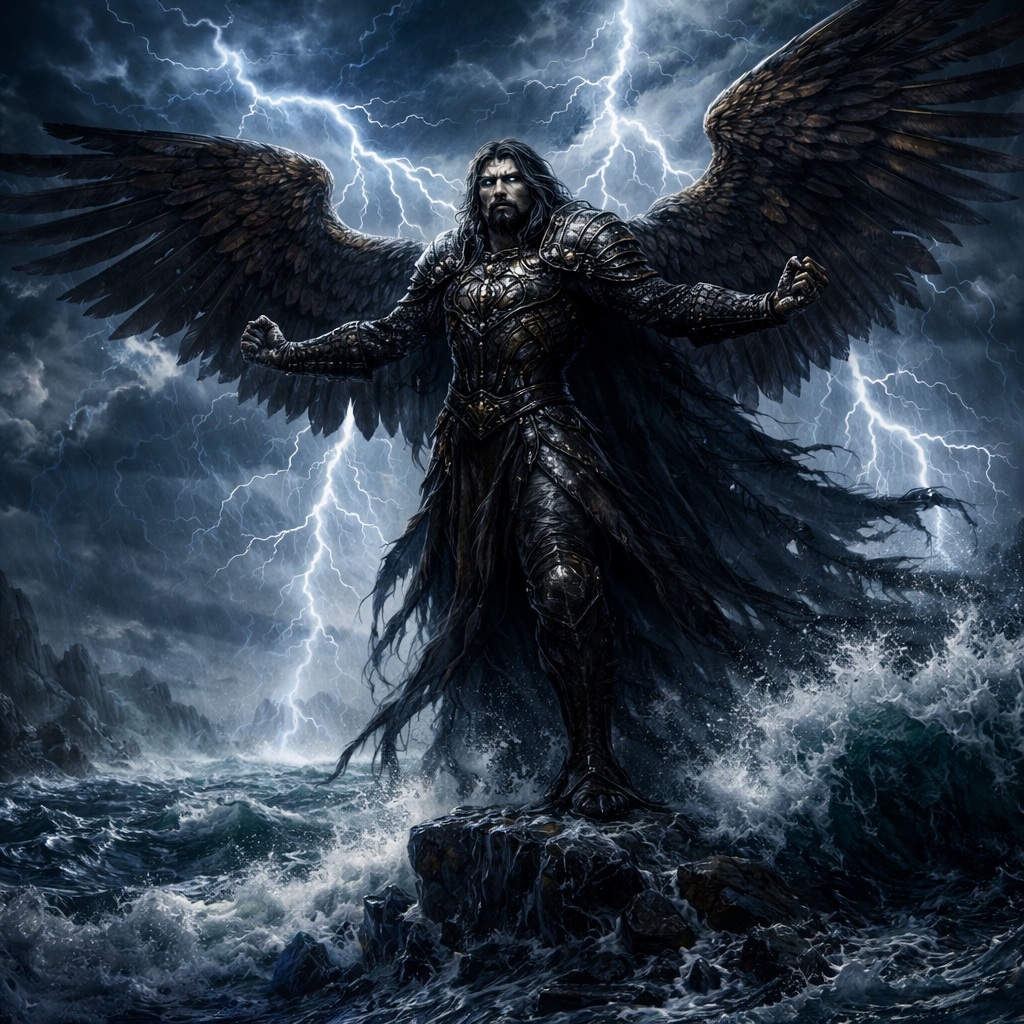
There is a particular kind of fear that rises when the sky turns the color of bruised iron and the sea begins to heave as if something beneath it has awakened. Before radar and weather satellites, before forecasts and barometric charts, storms seemed alive. They moved with intention. They punished without warning. In the old grimoires of demonology, that terrifying force found a name: Focalor. Within the pages of the Lesser Key of Solomon, Focalor is listed as a powerful Duke of Hell who commands three legions of spirits and governs the winds and seas. He is described as appearing in the form of a man with the wings of a griffin, and his power is as violent as it is tragic.
Focalor’s presence in the Ars Goetia is concise but unforgettable. He has the power to drown men and overthrow ships of war. He can raise tempests and destroy vessels, yet when properly constrained by ritual authority, he is said to obey without deceit. Unlike many other spirits in the Goetia, there is an unusual note attached to Focalor’s description: he hopes to return to the Seventh Throne after a thousand years. That detail is brief, almost easy to overlook, but it gives him something rare among infernal beings—regret.
Earlier references to Focalor appear in the Pseudomonarchia Daemonum compiled by Johann Weyer. Weyer’s work sought to catalog and critique the belief in demons, yet in doing so he preserved their mythic frameworks. Across versions, Focalor remains consistent: a spirit of wind and water, destructive yet obedient, powerful yet strangely sorrowful.
The griffin wings attached to his form are symbolically rich. The griffin, a mythical creature with the body of a lion and the head and wings of an eagle, represents strength and vigilance. It is both terrestrial and aerial. By giving Focalor griffin wings, the tradition connects him to dominion over air while grounding him in predatory force. He is not a formless storm. He is embodied wind, intention within turbulence.
The sea has always been humanity’s proving ground. Entire civilizations rose or fell depending on maritime success. A storm could undo years of preparation in a single night. To attribute that power to a Duke of Hell was not superstition born of ignorance; it was myth born of awe. When ships vanished beneath towering waves, when sailors were swept overboard and never seen again, the explanation felt personal. Someone had willed it.
Focalor’s ability to drown men and sink ships is explicit in the grimoires. There is no subtlety in that. He commands waters to overwhelm. But unlike other Goetic spirits known for deception, Focalor is described as obedient when bound within the ritual circle. This obedience matters. In the cosmology of the Goetia, authority—specifically divine authority invoked by the magician—subjugates infernal forces. Focalor’s compliance suggests structure within chaos. Even the storm answers to hierarchy.
Yet it is the note of longing that makes Focalor unique. The text states that he hopes to return to heaven after a thousand years. In a tradition where demons are often portrayed as irredeemable rebels, this hint of repentance feels almost startling. It humanizes him. It suggests a being aware of his fall, conscious of loss.
That longing casts his storms in a different light. Perhaps they are not only acts of destruction but expressions of exile. Wind is restless. It moves without settling. It searches without anchoring. Water erodes, reshapes, and retreats. If Focalor embodies wind and sea, then his domain is movement without home.
From a psychological perspective, Focalor can be interpreted as the embodiment of emotional turbulence. There are moments in life when grief becomes stormlike—sudden, overwhelming, impossible to contain. Relationships capsize. Certainty drowns. The winds of anger or despair feel external, yet they rise from within. Focalor becomes the archetype of that force: the grief-stricken storm that both destroys and longs for restoration.
In maritime history, storms determined destiny. The defeat of fleets, the loss of explorers, the reshaping of trade routes—all hinged on weather. To sailors, the wind was not abstract. It was personal, almost moral. A favorable wind felt like blessing; a hurricane felt like curse. Focalor stands at that intersection of reverence and terror.
Unlike demons associated with temptation or hidden knowledge, Focalor’s power is elemental. He does not whisper secrets. He does not seduce with promises. He raises waves. He bends masts. He tears sails from rigging. His authority is kinetic.
And yet, despite his violence, he is not described as deceitful. That distinction matters. In a hierarchy filled with tricksters, Focalor is straightforward. If commanded to raise a storm, he will. If commanded to cease, he will obey. There is a kind of brutal honesty in that. The storm does not pretend to be calm.
The griffin imagery reinforces that nobility. Griffins guard treasure in myth. They symbolize vigilance and power aligned with guardianship. To graft griffin wings onto Focalor suggests that his fall did not erase his former dignity entirely. He is still majestic, even in exile.
The sea and wind are also agents of change. Coastlines are carved by persistent waves. Forests are reshaped by tempests. Ships driven by wind opened the world to exploration. Focalor’s domain is not purely annihilation; it is transformation. What he destroys, he reshapes.
Modern occult practitioners sometimes interpret Focalor as a spirit of necessary upheaval. In this view, storms clear stagnant air. Floods wash away decay. Turbulence precedes renewal. The destructive aspect is balanced by catharsis. Just as emotional storms can lead to clarity, elemental storms can reset ecosystems.
Still, the danger remains real. The sea does not negotiate. Wind does not compromise. Focalor’s mythology reminds us that power beyond human control can still be addressed within symbolic frameworks. The ritual circle becomes metaphor for boundaries—structures that contain chaos.
There is something deeply poetic about imagining a fallen spirit who commands storms yet yearns for return. It reframes destruction as part of a larger arc. Perhaps his tempests are echoes of celestial power, diminished but potent. Perhaps his obedience reflects lingering memory of divine order.
Focalor’s three legions may seem modest compared to other dukes and kings, yet his elemental authority compensates for numbers. Three is a symbolic number of balance and triads—past, present, future; birth, life, death. Focalor’s power spans cycles.
In contemporary storytelling, he would be the storm-bringer with sorrow in his eyes. Not a cackling villain, but a force of nature burdened by exile. The waves crash not only with fury but with longing.
And perhaps that is why he endures in demonological study. He captures the duality of power and regret. He embodies the truth that strength does not erase sorrow. The wind may roar, but it also wanders.
To stand on a cliff as waves pound below is to feel small. To watch lightning fracture the sky is to feel humbled. Focalor’s legend is an attempt to give that feeling shape. He is the name whispered when ships vanish and storms gather. He is the restless Duke of the Tempest, commanding destruction yet dreaming of return.
In the end, Focalor is more than a demon of wind and sea. He is the storm that rises within and without, the turbulence that tests resilience, the force that humbles pride. And somewhere in the howl of the gale, one might almost imagine a voice—not triumphant, but yearning.