
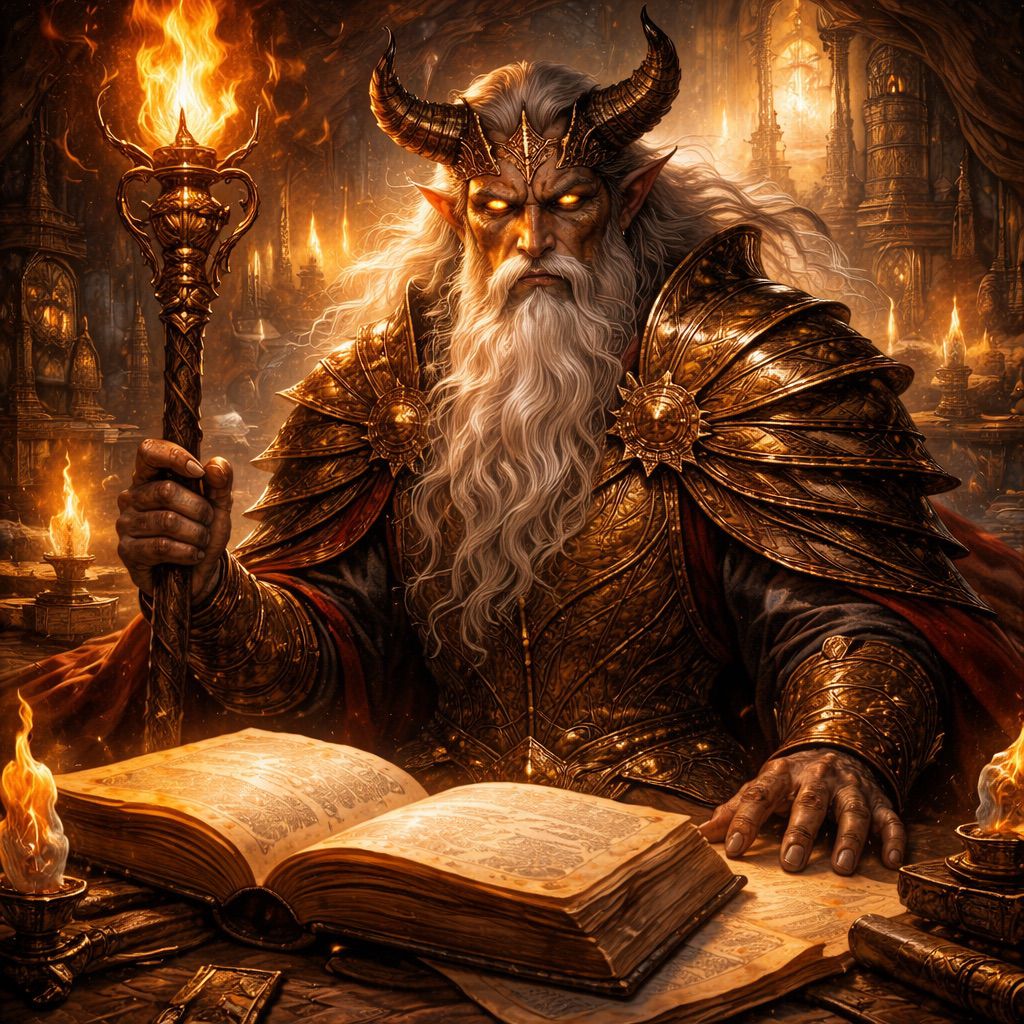
Furcas is a demon who feels old in a way that has nothing to do with age and everything to do with endurance. Among the spirits of the Ars Goetia, he does not present himself as a monster of excess, flame, or terror. Instead, he appears as a stern, elderly man with a long beard, seated or standing with authority, holding a sharp weapon or staff. This imagery is deliberate. Furcas is not the demon of temptation or spectacle. He is the demon of accumulated understanding, of wisdom forged through repetition, error, and consequence.
In the Ars Goetia, Furcas is named as a Knight of Hell, commanding legions and teaching philosophy, rhetoric, logic, astronomy, astrology, chiromancy, and the art of judgment. His title alone sets him apart. Knights are not kings or dukes. They are enforcers of order, bound to codes, duty, and discipline. Furcas does not rule domains. He sharpens minds.
The aged appearance attributed to Furcas is central to his symbolism. Old age in demonology is not weakness. It is persistence. Furcas represents knowledge that has survived being tested, contradicted, and refined. He is not interested in novelty. He values what holds up under pressure. His wisdom is not inspirational. It is corrective.
Furcas teaches philosophy, but not as abstract debate. Under Furcas, philosophy is confrontation with reality. It is the discipline of asking uncomfortable questions and refusing comforting answers. Furcas does not teach how to feel wise. He teaches how to think clearly when wisdom is inconvenient.
Logic and rhetoric also fall under his domain, but again, not as tools for persuasion alone. Furcas understands how arguments are constructed, dismantled, and abused. He teaches how reasoning can be weaponized, and more importantly, how to recognize when it is being used dishonestly. Under Furcas, intelligence without integrity is exposed.
Judgment is one of Furcas’s most important attributes. Judgment is not opinion. It is evaluation informed by structure, evidence, and consequence. Furcas governs the moment when information must be weighed and a decision made, knowing that no outcome will be clean. He does not promise fairness. He promises clarity.
The weapon or staff Furcas carries is symbolic of enforcement. Knowledge, under Furcas, is not passive. It demands application. Once you understand something clearly, you are responsible for acting accordingly. Furcas does not allow ignorance as an excuse once insight has been granted.
Astrology and astronomy also belong to Furcas, but in a practical sense. He does not teach star-gazing for wonder. He teaches cycles, timing, and influence. Furcas understands that judgment improves when context is considered. Decisions made without awareness of timing and environment are incomplete.
Chiromancy, the reading of hands, fits naturally into Furcas’s domain. Hands are tools of action. They reveal labor, habit, injury, and adaptation. Furcas teaches how the body records choices long after the mind forgets them. Under Furcas, nothing is accidental. Everything leaves a trace.
Unlike demons who tempt through pleasure or fear, Furcas tempts through authority. He speaks with certainty earned rather than claimed. This makes him dangerous to the arrogant and humbling to the curious. Furcas does not flatter. He corrects.
Psychologically, Furcas represents the internal judge that develops with maturity. The voice that no longer excuses impulse, that demands accountability, that values restraint over indulgence. Furcas is not kind, but he is stabilizing. He strips away self-deception.
Furcas’s rank as a Knight is significant here. Knights serve causes larger than themselves. Furcas serves structure. He upholds disciplines that keep thought from collapsing into chaos. In this sense, Furcas is a guardian against intellectual decay.
In modern terms, Furcas feels like the embodiment of rigorous education. Not schooling as credential, but learning as discipline. He is present wherever standards matter, wherever reasoning is expected to withstand scrutiny, and wherever judgment carries real consequences.
Unlike demons associated with madness or illusion, Furcas is associated with sobriety. He does not distort reality. He clarifies it. This clarity can feel harsh. Furcas does not soften truths to preserve comfort. He does not adjust conclusions to spare feelings.
The aged appearance of Furcas also reflects patience. He does not rush conclusions. He observes patterns over time. This makes him deeply unsettling in a culture obsessed with speed. Furcas reminds us that wisdom takes time, and shortcuts are visible to those who know where to look.
Furcas’s teachings often leave people quieter rather than energized. Insight under Furcas does not inflate ego. It deflates it. He shows how little most people understand about the systems they judge confidently.
In demonological warnings, Furcas is not described as treacherous or cruel. He is described as severe. Severity here means uncompromising adherence to standards. Furcas does not bend principles to accommodate desire.
Symbolically, Furcas represents the cost of knowing better. Once you understand, you are accountable. There is no return to ignorance without dishonesty. Furcas enforces that boundary.
He endures in demonology because every culture eventually needs correction. When reasoning erodes and judgment collapses, systems fail. Furcas exists as the reminder that structure matters, discipline matters, and clarity is earned.
To engage with Furcas symbolically is to accept that wisdom is not gentle. It is earned through discomfort, discipline, and the willingness to be wrong.
Furcas is not the demon of inspiration. He is the demon of standards.