
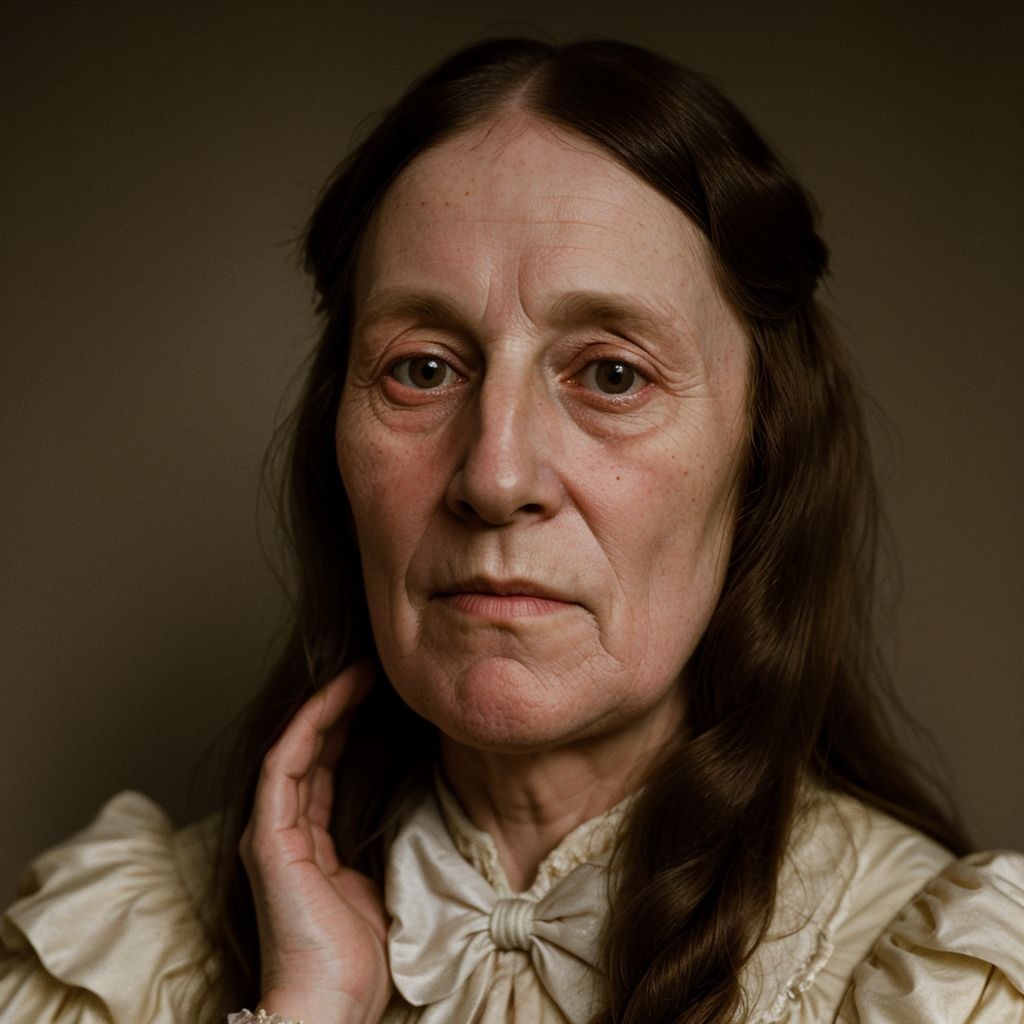
Mary Ann Evans was born on November 22, 1819, at Arbury Hall in Warwickshire, England. Her father, Robert Evans, managed the estate for the Newdigate family, a position that placed the household within the orbit of landed society without granting it social standing. Her mother, Christiana Pearson Evans, oversaw domestic life until her death in 1836. Evans grew up in a household structured by routine, religious observance, and proximity to institutional authority, conditions that shaped her early intellectual discipline.
Her formal education was intermittent. She attended several boarding schools during childhood, where instruction emphasized scripture, classical languages, and moral instruction. By adolescence, Evans had acquired a strong command of Latin, Greek, Italian, and German, largely through independent study. After leaving school, she returned to live with her father, assuming domestic responsibilities while continuing to read widely. Her early reading included theology, philosophy, and contemporary literature, forming a foundation that would later support her editorial and literary work.
In the 1840s, Evans became associated with a circle of freethinkers in Coventry through her friendship with Charles and Cara Bray. This association introduced her to Unitarianism and to continental philosophy, including the works of Ludwig Feuerbach and Baruch Spinoza. During this period, she undertook the English translation of Feuerbach’s *The Essence of Christianity*, published anonymously in 1854. The translation established her reputation within intellectual circles, though her name remained largely unknown to the public.
Evans relocated to London in the early 1850s and began working as an assistant editor at the *Westminster Review*. Her responsibilities included reviewing manuscripts, corresponding with contributors, and shaping editorial policy. The role placed her at the center of mid-Victorian intellectual exchange and brought her into sustained contact with writers, philosophers, and political theorists. It was during this period that she formed a long-term domestic and professional partnership with George Henry Lewes. Because Lewes was legally married to another woman, their relationship existed outside formal social recognition.
Evans did not publish fiction until her late thirties. Her first short stories appeared in *Blackwood’s Magazine* in 1857 under the pseudonym George Eliot. The choice of a male pen name allowed her work to circulate without immediate reference to her gender or personal circumstances. Her first novel, *Adam Bede*, was published in 1859 and was followed by *The Mill on the Floss* (1860) and *Silas Marner* (1861). These works established her public identity while preserving her private anonymity.
Throughout the 1860s and 1870s, Evans published a sequence of novels that expanded in scale and structural complexity. *Romola* (1863) drew on historical research into Renaissance Florence. *Middlemarch* appeared in serial form between 1871 and 1872, followed by *Daniel Deronda* in 1876. These novels were produced alongside extensive correspondence, editorial revisions, and negotiated publication arrangements, much of which survives in letters and journals from the period.
Evans’s working methods were methodical and document-driven. Drafts show extensive revision, and letters to publishers record close attention to serialization schedules, audience reception, and financial terms. Her fiction circulated alongside critical discussion in periodicals, though she rarely participated directly in public debate about her work. Public appearances were limited, and interviews were avoided. Her professional identity was managed through text rather than presence.
In 1880, following the death of George Henry Lewes, Evans married John Walter Cross. The marriage was brief. She died on December 22, 1880, in London, after a prolonged period of ill health. She was buried at Highgate Cemetery.
After her death, Evans’s personal papers and correspondence were edited and published by Cross, introducing new material into public view. These publications influenced subsequent readings of her novels by providing additional context regarding her intellectual formation and domestic life. Over time, her work became a fixture of academic study, with sustained attention from historians of literature, philosophy, and social thought.
Mary Ann Evans wrote under conditions of controlled anonymity, institutional constraint, and prolonged editorial labor. Her career unfolded through translation, criticism, and fiction, with each stage documented through surviving texts rather than public self-presentation. The body of work published under the name George Eliot remains preserved primarily through its textual record, correspondence, and publication history.