
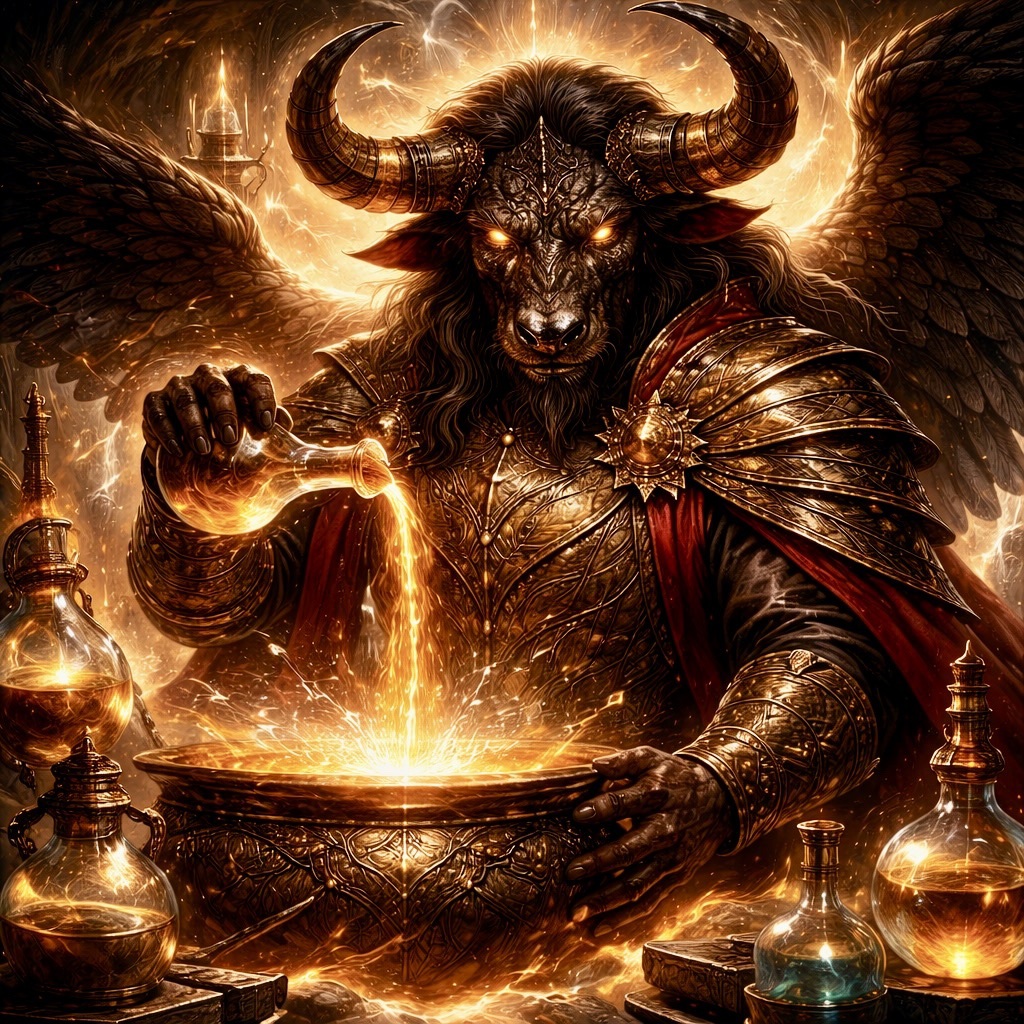
Haagenti is a demon whose reputation rests not on destruction, terror, or domination, but on transformation. In the Ars Goetia, he is listed as a Great President of Hell, commanding legions and appearing first in the form of a bull with the wings of a griffin, before assuming a human shape. This image means everything. Haagenti is not a demon who ends things. He is a demon who changes them, often irreversibly, and almost never gently.
At his core, Haagenti governs alchemy, transmutation, and the refinement of what has already been damaged. He does not create purity. He creates usefulness. This distinction defines his entire character. Where other demons promise power through destruction or deception, Haagenti promises power through conversion. He takes what is broken, corrupted, or raw and reshapes it into something effective.
The bull form attributed to Haagenti is a symbol of stubborn force, endurance, and raw material. Bulls are not subtle animals. They are strength without finesse, power without refinement. The griffin wings add the missing element: elevation, intellect, and command over perspective. Haagenti’s true nature exists at the intersection of brute matter and refined purpose. He does not deny the crude origins of things. He improves them.
Haagenti is most famously associated with turning metals into gold and wine into water or water into wine, but these acts are symbolic rather than literal. Alchemy has never truly been about materials alone. It has always been about process. Haagenti teaches how to take something flawed and render it valuable, not by pretending it was never flawed, but by working through its defects.
This is why Haagenti is deeply unsettling. He does not reject corruption. He incorporates it. Under Haagenti, mistakes are not erased. They are repurposed. Weakness becomes leverage. Failure becomes instruction. He does not promise redemption. He promises adaptation.
When Haagenti takes human form, grimoires describe him as composed, articulate, and unsettlingly calm. There is no urgency in his presence. Alchemy takes time. Transformation requires patience. Haagenti does not rush outcomes. He allows processes to complete, even when they are uncomfortable to witness.
As a President, Haagenti governs systems rather than individuals. He is interested in how things function once transformed. He does not care about moral purity. He cares about results. This makes him attractive to those who feel damaged, compromised, or irreversibly altered by experience. Haagenti does not judge that damage. He asks how it can be used.
Psychologically, Haagenti represents the human capacity to metabolize hardship. He is the force behind resilience that does not romanticize suffering but refuses to waste it. Under Haagenti, pain is not sacred. It is instructive.
Haagenti’s association with wisdom is often misunderstood. The wisdom he grants is not philosophical insight or moral clarity. It is operational wisdom. Knowing what works, what fails, and why. Haagenti teaches discernment born of experience, not theory.
Unlike demons who manipulate illusion, Haagenti deals in reality. He does not hide what something was. He shows what it can become. This makes him dangerous to idealists and comforting to pragmatists. Haagenti does not promise perfection. He promises improvement.
The alchemical symbolism surrounding Haagenti also emphasizes containment. Alchemy requires vessels, boundaries, and control. Without structure, transformation becomes explosion. Haagenti understands this deeply. Change without discipline is destruction. He teaches how to apply pressure without collapse.
In modern symbolic terms, Haagenti feels strikingly contemporary. He resembles systems that take waste and turn it into fuel, trauma into motivation, error into iteration. He is the demon of optimization after failure.
Haagenti is also associated with instruction. He teaches willingly, but without sentiment. Those who learn from him often find that their illusions about themselves do not survive the process. Haagenti is not cruel, but he is unsparing.
There is an implicit warning in Haagenti’s lore. Not everything should be transformed. Some things, once refined, become more dangerous than they were before. Haagenti does not prevent this outcome. He facilitates it. Transformation amplifies potential, for better or worse.
The bull-griffin imagery reinforces this duality. Power and intellect together create efficiency. Efficiency without ethics is hazardous. Haagenti does not pretend otherwise.
Haagenti’s endurance in demonology comes from a simple truth: humans are never finished. They are always becoming something else. Some changes destroy. Others refine. Haagenti governs that line.
To engage with Haagenti symbolically is to accept that who you are now is raw material, not a final product. He does not care how you arrived here. He cares what can be done next.
Haagenti is the demon of transformation without apology, of improvement stripped of moral comfort, of alchemy practiced on lives rather than metals.