
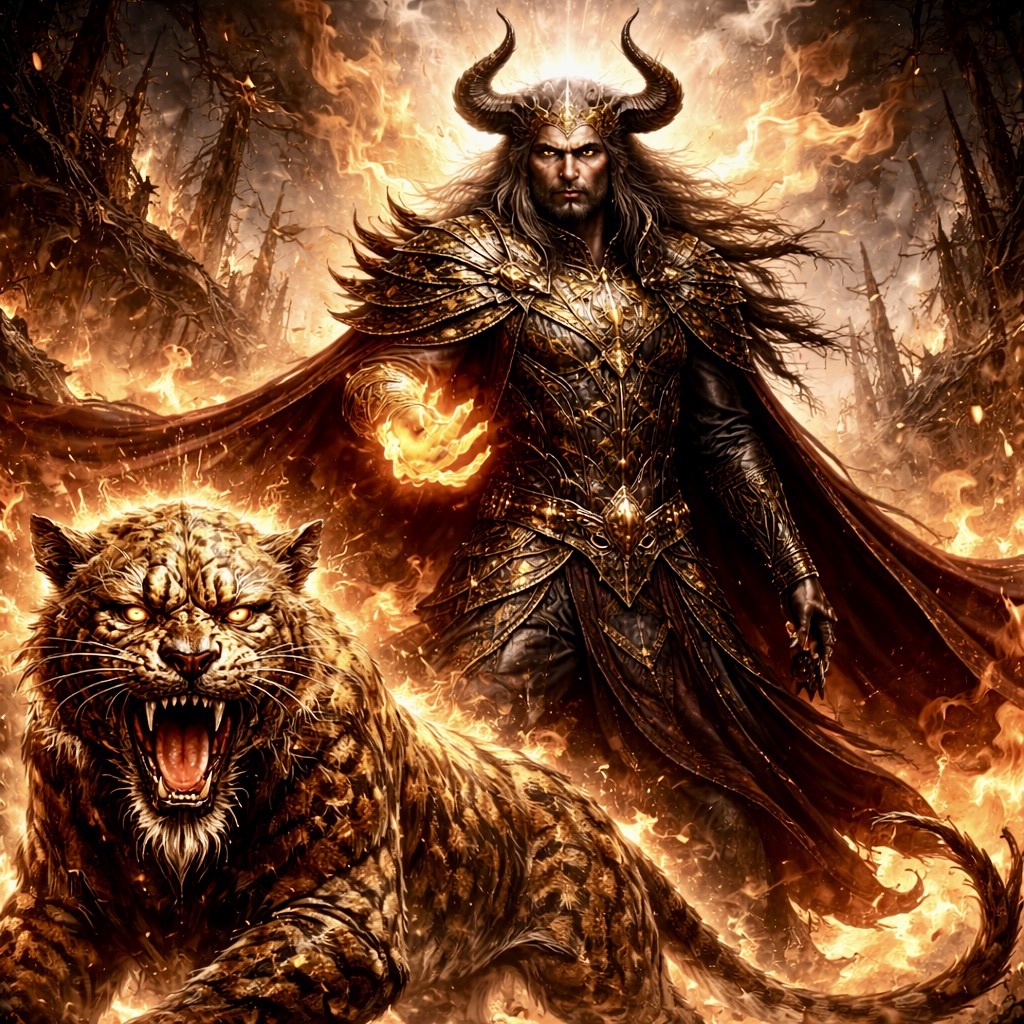
Haures, also known as Flauros, is not a demon who works in shadows. He is fire made articulate, destruction with a voice, revelation delivered through heat so intense it leaves nothing hidden behind. In the Ars Goetia, Haures is described as a Great Duke of Hell, commanding legions and appearing first as a terrifying leopard wreathed in flame. Only when constrained does he assume human form, and even then, the fire never truly leaves him. It simply becomes controlled, focused, and more dangerous.
Fire is the central truth of Haures. Not metaphorically, not symbolically, but fundamentally. Everything about him revolves around combustion: burning enemies, consuming deception, destroying spiritual opposition, and revealing what remains when illusion has been reduced to ash. Haures does not persuade. He exposes. He does not negotiate. He incinerates falsehood until only the irreducible truth survives.
The leopard form attributed to Haures is significant. Leopards are apex predators, patient, precise, and lethal. They do not waste energy. When combined with fire, this imagery becomes terrifyingly efficient. Haures does not burn indiscriminately like a wildfire. He burns with intent. His destruction is targeted, purposeful, and final. This makes him one of the most feared figures in demonology, not because he lies, but because he cannot be lied to.
Haures is said to answer questions truthfully when properly compelled, especially concerning enemies, spiritual opposition, and hidden intentions. But this truth is not gentle. It arrives without cushioning. Those who seek Haures are not looking for comfort or reassurance. They are looking for certainty, even if that certainty destroys relationships, beliefs, or self-image. Haures reveals not only the lies of others, but the lies one tells oneself.
One of Haures’s defining traits is his hatred of deceit. Unlike demons who manipulate, tempt, or distort, Haures despises falsehood. He burns it away. This makes him paradoxical within infernal hierarchy. A demon who values truth sounds contradictory until you understand the kind of truth Haures enforces. It is not moral truth. It is structural truth. What is real survives fire. What is false does not.
In grimoires, Haures is also associated with destruction of enemies, both spiritual and material. But again, this destruction is not random violence. It is elimination of opposition. Haures does not attack out of rage. He removes obstacles. Fire, in this context, is not chaos. It is purification through annihilation.
Haures’s human form is often described as terrible rather than monstrous. There is intelligence in his gaze, focus in his posture, and restraint in his movements. He does not posture or threaten. He knows the outcome before the flame is lit. This calm makes him more frightening than demons who roar or boast. Haures does not need intimidation. His presence is the warning.
Symbolically, Haures represents the moment when denial collapses. He is the demon of irreversible clarity. Once something has been burned away, it cannot be restored. Lies exposed by Haures do not return quietly. They leave scars, reshaped realities, and permanent consequences. This is why his invocation is traditionally warned against unless absolutely necessary. Haures does not give partial answers. He gives final ones.
Fire has always occupied a dual role in human culture. It warms and destroys, illuminates and consumes. Haures embodies the destructive side of illumination. He shows you the truth by removing everything else. In this way, he is deeply uncomfortable. He does not allow ambiguity. He does not permit interpretation. He reveals what is.
In modern terms, Haures feels less like a supernatural monster and more like an inevitability. He resembles moments in life when truth arrives violently: betrayals uncovered, secrets exposed, illusions shattered. Haures is the embodiment of that moment when reality asserts itself with no regard for emotional readiness.
Unlike demons associated with temptation or desire, Haures offers nothing seductive. He offers accuracy. He offers the removal of falsehood. This makes him attractive only to those who value truth over comfort, clarity over peace. And even then, the cost is steep. Haures does not care if the truth ruins you. He cares that it survives.
His fire is also said to protect against spiritual enemies, suggesting that Haures’s destruction is selective. He does not burn indiscriminately. He targets opposition, deception, and obstruction. This reinforces the idea that Haures is not chaos, but enforcement. He is the executioner of reality.
Within the hierarchy of Hell, Haures’s rank as a Duke places him in a position of strategic authority. He is not a foot soldier or a manipulator. He is deployed when something must end completely. When compromise has failed. When concealment has gone too far. Haures is not the first answer. He is the last.
What makes Haures enduring is that fire never goes out of relevance. As long as humans build illusions, there will be moments when those illusions burn. As long as deception exists, there will be forces—natural, psychological, or symbolic—that destroy it. Haures gives that force a name.
He is not merciful. He is not cruel. He is necessary in the way disasters are necessary to reset unstable systems. Haures represents the brutal honesty of reality asserting dominance over fiction.
To invoke Haures, even symbolically, is to accept that something in your life cannot survive truth. He does not ask permission. He does not soften the blow. He reveals, burns, and leaves what remains.
Haures endures because truth is terrifying. Not because it hurts, but because it cannot be undone. And once you have seen what remains after the fire, you cannot pretend it was ever otherwise.