
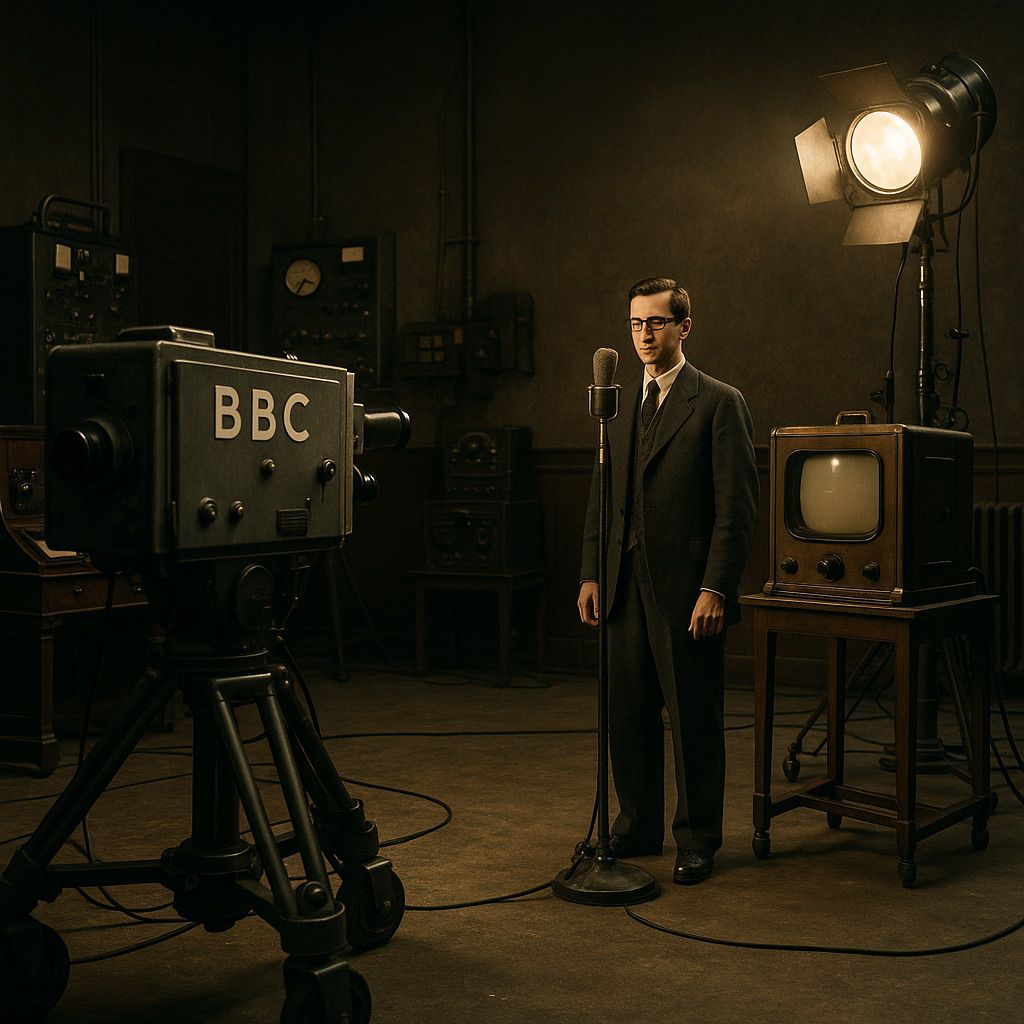
When the British Broadcasting Corporation officially launched the world’s first regular public television service on November 2, 1936, most people had no idea they were standing at the edge of a technological revolution. At the time, television wasn’t yet a household word. It sounded futuristic, almost whimsical—like something written into a science-fiction novel or imagined in the electric dreams of inventors tinkering in cluttered workshops. Radios filled homes with sound, newspapers delivered the news, and cinema provided the moving pictures. The idea that people would someday gather around a glowing box in their living room to watch live broadcasts felt, to many, closer to fantasy than reality.
But in a small studio in Alexandra Palace, perched on a hill overlooking London, a new age quietly switched on.
The BBC’s regular television service began humbly: no fanfare, no fireworks, no global countdown. Just engineers adjusting knobs, presenters trying not to blink too much under blinding lamps, and cameras the size of refrigerators wheezing as they warmed up. It wasn’t glamorous. It wasn’t polished. But like the first faint spark before a roaring fire, it held the unmistakable promise of something unstoppable.
For months leading up to the launch, the BBC had been experimenting with two competing technologies: the mechanically based Baird system and the fully electronic Marconi-EMI system. Engineers debated fiercely. Which one would define the future? Which one could deliver clearer, smoother images? Which one could withstand the scrutiny of a public that had never seen televised faces before? When the decision finally fell in favor of the Marconi-EMI system, the future of broadcasting changed forever. And on that November morning, as the familiar BBC chimes sounded, viewers with the extremely rare and expensive television sets tuned in to witness history: the start of scheduled, ongoing television programming available to the general public.
For most Britons, the event went unnoticed. In fact, fewer than 400 television sets existed at the time, nearly all concentrated around London. Those who owned one had either deep pockets or a deep fascination with cutting-edge technology. But those who tuned in found something mesmerizing: moving images entering their home not from a theater, not from a newsreel, but from a live broadcast produced just miles away. It must have felt like witnessing a kind of magic—fragile, flickering magic, but magic nonetheless.
Inside the Alexandra Palace studio, the atmosphere was a mix of nerves and quiet triumph. The cameras were monstrous, hot, and unforgiving. Presenters had to stand absolutely still, because any movement beyond a slow turn would produce blurs. The lights burned so brightly that performers sometimes fainted. Everything was experimental, uncertain, improvised on the fly. Yet there was a palpable electricity in the air—a sense that something important was happening, even if no one yet understood how important.
The very first broadcasts were modest. Announcers introduced the programs with crisp BBC diction. Variety acts performed brief songs or comedy routines. Newsreaders did their best to look natural while staring intensely into the camera lens. There were costume dramas, cooking demonstrations, small orchestras, and even short educational segments. Some productions barely lasted ten minutes. Others went off the rails in ways both charming and disastrous. Early television felt like theater squeezed into a box, unsure of its boundaries but eager to try everything.
And people watched. Not many at first, but enough to spark the curiosity of their neighbors, friends, and even passersby who glimpsed the strange blue glow through a window. Soon, television sets were placed in shop displays so crowds could gather outside and watch together—men in hats leaning over each other, women clutching shopping bags, children squeezing between grown-ups to catch a glimpse of the moving pictures. The sight of strangers standing in the cold to watch a small, flickering screen became a symbol of public fascination, the beginning of a social and cultural shift that the world could not yet comprehend.
But the BBC television service faced enormous challenges. The technology was expensive. The cameras were so bulky they could barely be moved. The studios were constantly overheating. Broadcast hours were short. And no one could predict whether the public would ever widely adopt this new invention. Yet the BBC pressed on, driven by the belief that television held tremendous potential—not just as a novelty, but as a platform for storytelling, education, journalism, and entertainment that could reach millions.
Then came World War II.
In 1939, just as television was beginning to find its footing, the BBC made the difficult decision to suspend television broadcasting. Engineers feared that the signals could be used by German bombers as navigational beacons. The screens went dark. Alexandra Palace fell silent. It was as if television had vanished before it could take root. And for years, Britons wondered if the experiment would return—or if television had been a brief technological curiosity swept away by global conflict.
But in 1946, when peace returned, the BBC switched the television service back on. It was symbolic—a signal that the world was ready to rebuild, reconnect, and reimagine daily life. And this time, Britain was ready. Television sets began appearing in more homes. Programming expanded. Sports events, royal ceremonies, dramatic productions, and news broadcasts filled the schedule. Families formed nightly rituals around the glowing screen. Television was no longer a luxury—it was becoming part of the fabric of life.
Yet even then, few fully understood how deeply television would shape the decades to come. It would become a witness to coronations, wars, scientific breakthroughs, cultural shifts, generational debates, and global tragedies. It would amplify voices, bridge distances, and create shared experiences unlike anything humanity had known. It would influence politics, fashion, entertainment, advertising, education, and the way people understood the world. It would become a mirror and a storyteller, a window and a stage, a source of comfort and information.
And all of it began with that first flicker of the BBC television service in 1936.
Looking back now, it’s easy to romanticize the moment. But the beauty of that beginning lies in its simplicity: a handful of engineers, a few brave performers, and a glowing dot on a tiny screen that captured the imagination of those lucky enough to see it. No one knew television would change the world. But that’s the way revolutions often begin—not with noise, but with quiet persistence, curiosity, and the courage to try something new.
When the BBC launched the world’s first regular TV service, it didn’t just introduce a new technology. It introduced a new way of living, of seeing, of connecting. It turned the home into a stage and the world into an audience. It laid the groundwork for a media landscape that would eventually span continents, satellites, cable networks, streaming platforms, and digital universes.
Television did not merely enter homes—it became a part of them.
And the world would never be the same again.