
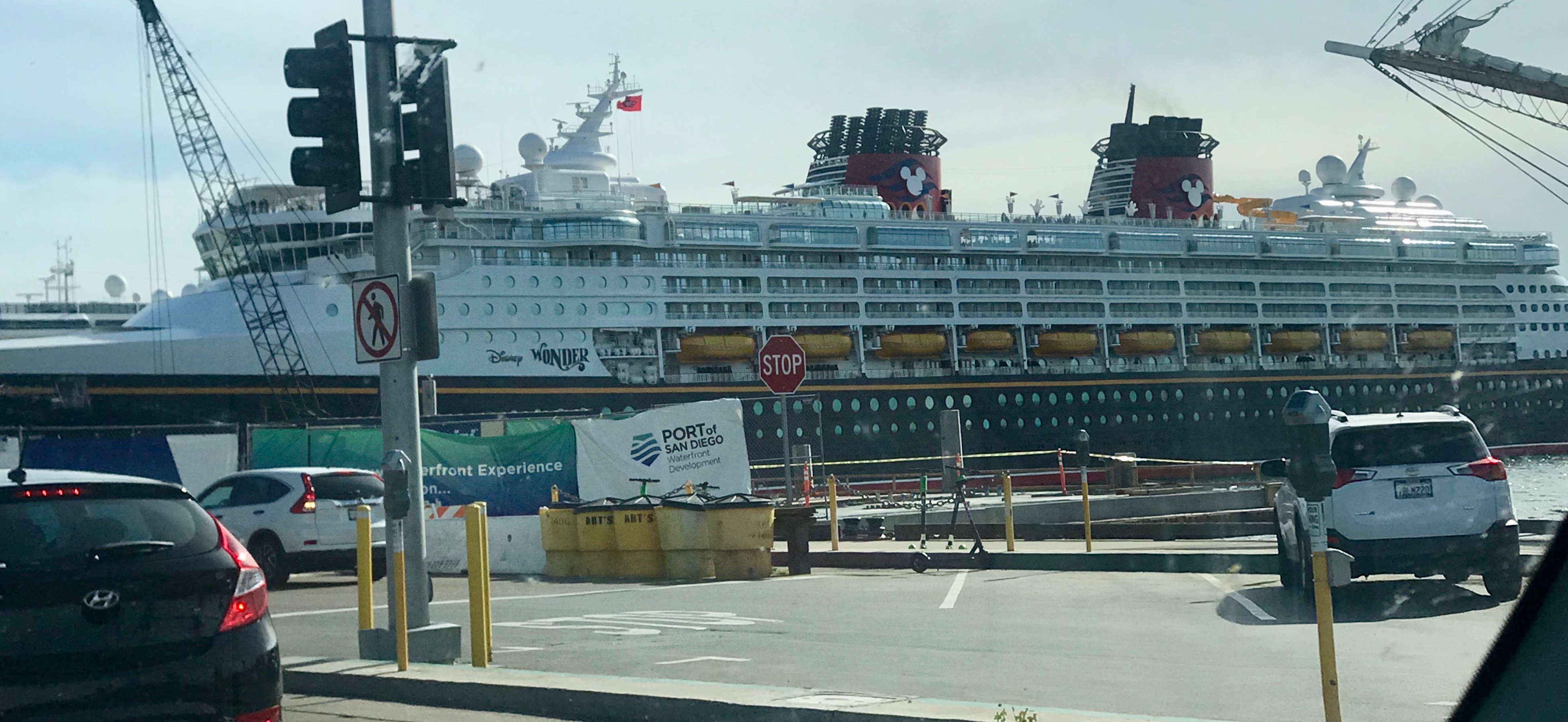
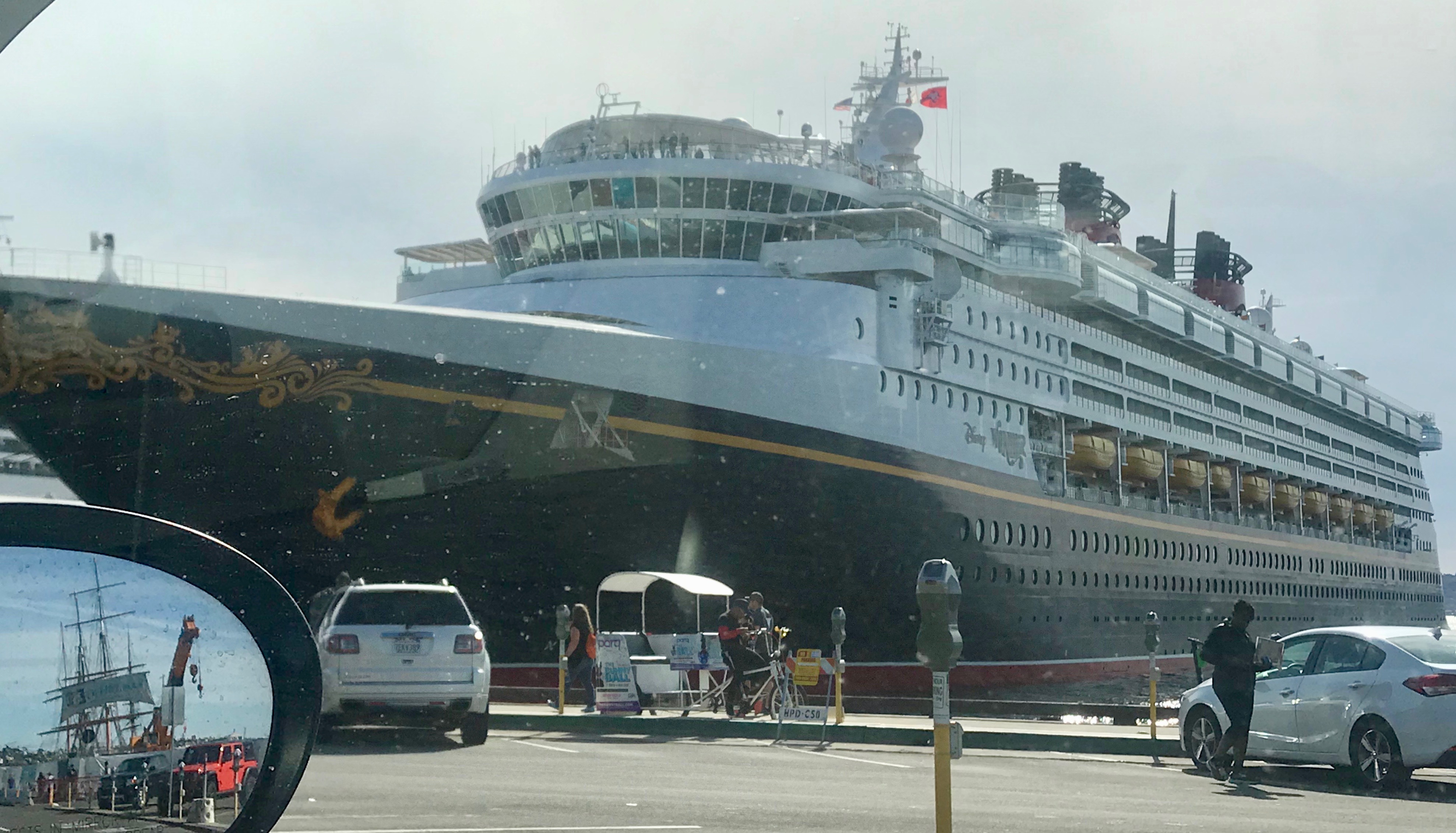
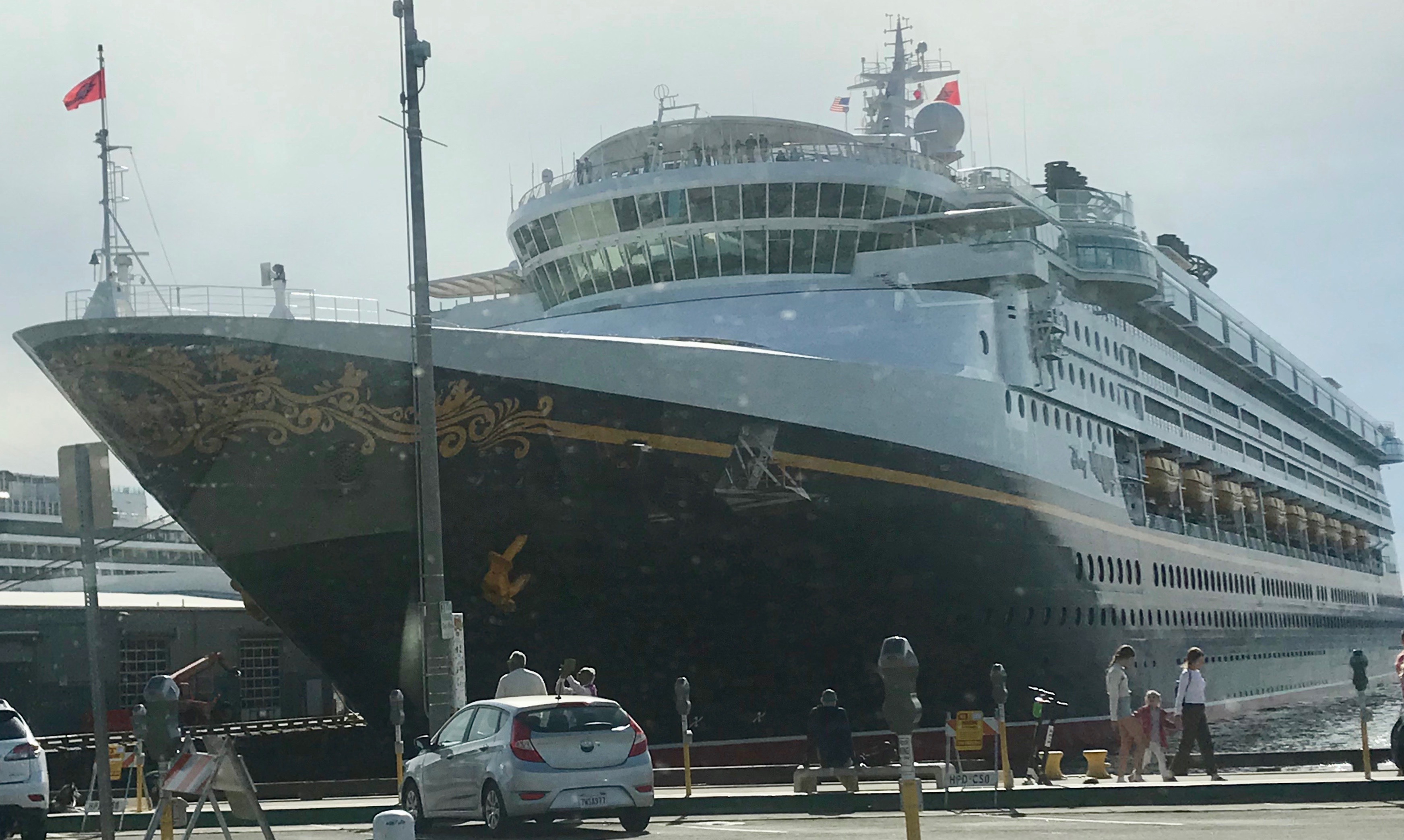
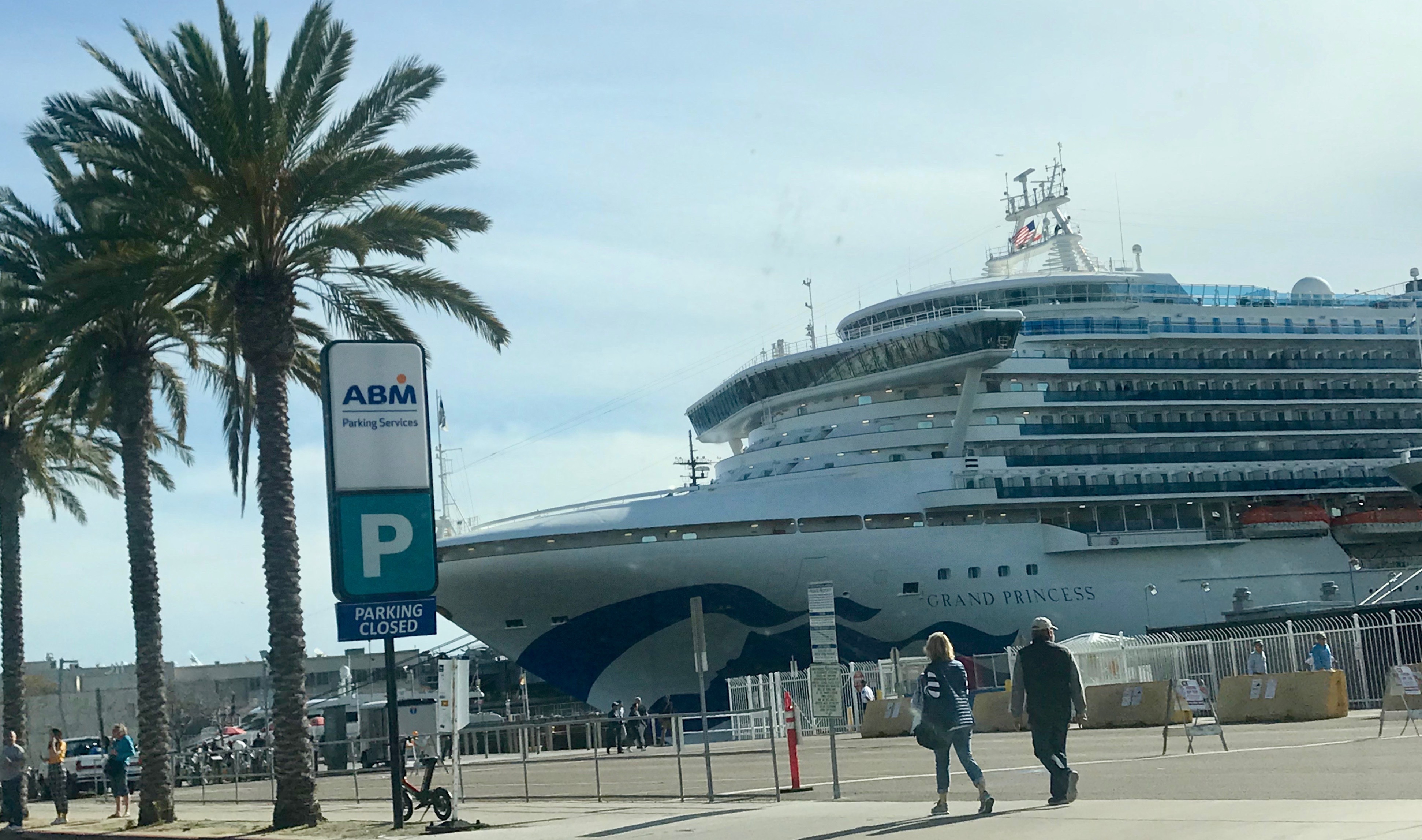
I wasn’t planning on stopping. I wasn’t planning on rubbernecking. I definitely wasn’t planning on doing the kind of thing you’re explicitly warned not to do in driver’s ed. But there I was, rolling along the San Diego waterfront, when two floating cities casually appeared in my peripheral vision and my brain made an executive decision without consulting safety, common sense, or my insurance deductible. Cruise ships. Big ones. Parked. Gleaming. Practically posing.
If you’ve ever driven near a port city, you know the moment. One second you’re thinking about traffic lights and lane merges, and the next you’re staring at a structure so large it seems less “boat” and more “geographical feature.” Cruise ships don’t ease into your awareness. They arrive like a surprise skyline. And on this particular drive, the Disney Wonder and the Grand Princess were sitting there like they owned the place, daring passersby not to stare.
Naturally, I stared. Naturally, I slowed down. Naturally, I did the very unsafe thing and snapped photos while driving, because apparently my self-preservation instincts short-circuit in the presence of absurdly large floating objects. This wasn’t tourism. This was reflex. This was awe mixed with a little bit of “how is that thing even allowed to float?”
San Diego is one of those cities where the water and the city live in constant conversation. The waterfront isn’t hidden away behind industrial walls or distant harbors. It’s right there, woven into daily life. Joggers, commuters, tourists, and people walking dogs all share space with naval ships, cargo vessels, and, occasionally, cruise liners that look like they wandered in from a different scale entirely. On most days, it’s routine. On some days, though, the ships steal the show.
The Disney Wonder has a way of doing that. Even docked, even silent, it doesn’t feel inactive. Its bright accents, iconic funnel colors, and unmistakable design practically hum with brand energy. You don’t just see a ship; you see a promise. Somewhere inside that floating structure are themed restaurants, character meet-and-greets, families buzzing with anticipation, and kids who believe with absolute certainty that magic is a scheduled activity. Even sitting still, it feels like it’s in motion, emotionally at least.
There’s something fascinating about how cruise ships compress entire worlds into steel and glass. The Disney Wonder isn’t just transportation; it’s an experience machine. It’s designed to make the journey itself the destination. That idea becomes especially striking when you see it parked against a real city skyline. San Diego’s palm trees, mid-rise buildings, and coastal haze feel almost understated next to something that contains Broadway-style shows, pools, dining rooms, and thousands of people in a self-contained universe.
And then there was the Grand Princess, elegant in a completely different way. Where the Disney ship leans into whimsy and spectacle, the Grand Princess projects quiet confidence. Its lines are clean, its scale immense but restrained, like it doesn’t need to shout about what it offers. This is a ship that suggests long dinners, ocean views, and conversations that stretch late into the night. It feels grown-up without being stuffy, luxurious without being flashy.
Seeing the two ships side by side was like watching two philosophies of travel politely coexist. One promises wonder, fantasy, and childhood nostalgia. The other promises relaxation, refinement, and the simple pleasure of watching the horizon slide by. Both are valid. Both are enormous. Both made me forget, briefly, that I was piloting a vehicle in traffic.
There’s a strange intimacy to seeing cruise ships docked. At sea, they’re abstract ideas, distant silhouettes against endless water. Docked, they’re tangible. You can see lifeboats, balconies, service doors. You can imagine the logistics humming beneath the surface: supplies being loaded, crew members rotating shifts, schedules being checked and rechecked. These ships don’t just sail; they operate. They’re floating cities that require constant orchestration.
That’s part of what makes them so compelling to photograph, even impulsively, even recklessly. You’re capturing a moment where scale and stillness collide. A machine built to cross oceans is momentarily at rest, borrowing space from a city that goes on about its business. Cars pass. People walk dogs. Someone eats lunch on a bench. Meanwhile, a structure taller than nearby buildings waits patiently to move again.
San Diego is particularly good at this juxtaposition. Naval vessels are a familiar sight here, gray and angular, purposeful in a way that feels serious and restrained. Cruise ships, by contrast, feel indulgent. They’re about leisure, escape, and time deliberately spent not being productive. Seeing them in the same harbor underscores how many different stories the water can tell at once.
As I drove, slowed, snapped photos, and probably annoyed the drivers behind me, I had the fleeting thought that cruise ships are one of the last remaining spectacles that don’t require context. You don’t need to know where they’re going or who’s onboard to be impressed. The mere fact of their existence is enough. They are feats of engineering that double as social experiments. Thousands of strangers agree to share space, meals, entertainment, and corridors for days or weeks, all in the name of seeing the world glide by from a balcony.
There’s also something comforting about them being docked. It’s a pause. A breath. A reminder that even massive things stop. They wait. They prepare. In a world that feels increasingly frantic, seeing something so large temporarily still feels oddly grounding. It’s like watching a giant animal resting, conserving energy before moving on.
I didn’t know where either ship was headed next. I didn’t know how long they’d been there or how long they’d stay. That information felt secondary. The moment wasn’t about itineraries. It was about presence. About noticing something extraordinary in the middle of an ordinary drive and letting it interrupt your routine, even if it meant committing a small traffic sin.
By the time I pulled away from the waterfront, photos secured and heart rate normalized, the ships receded into my rearview mirror. Traffic resumed its usual rhythm. The city reclaimed my attention. But the image lingered. Two massive vessels, each carrying its own version of escape, waiting patiently at the edge of a city that thrives on movement.
Later, looking at the photos, the moment felt even more surreal. Cruise ships have a way of doing that. They’re real, solid, unmistakable, and yet they feel slightly fictional, like something dreamed up by someone who asked, “What if a hotel could go places?” Seeing them up close reminds you that human ambition doesn’t always express itself quietly. Sometimes it floats into port, blocks your view, and makes you reach for your camera even when you really shouldn’t.
I don’t recommend snapping photos while driving. Let’s be clear about that. But I do recommend paying attention when the extraordinary drifts into your line of sight. Sometimes, the best stories start with a moment you didn’t plan for, a brief lapse in discipline, and two cruise ships reminding you that wonder doesn’t always announce itself. Sometimes it just docks, gleaming in the sun, daring you not to look.
And if you happen to look a little too long, well, at least you’ll have the photos to prove it.