
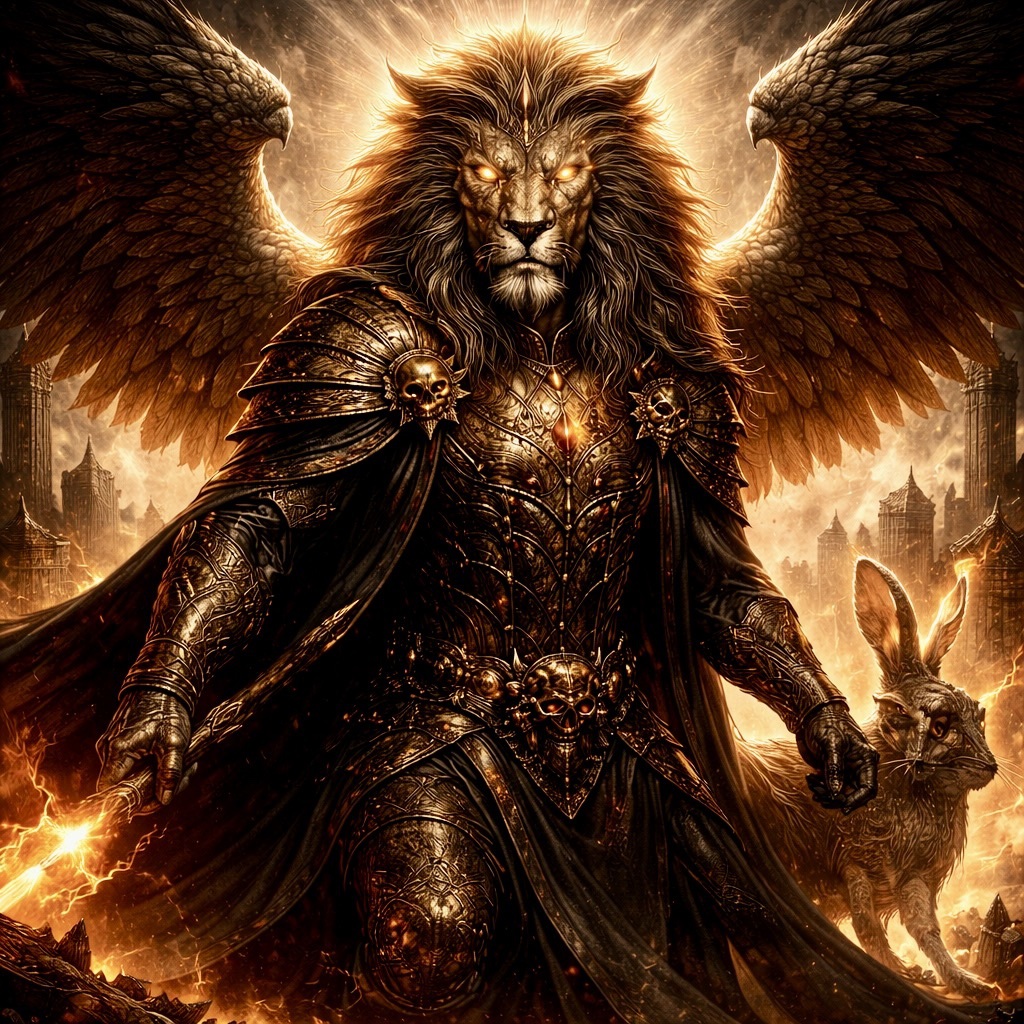
Ipos is a demon who unsettles not through cruelty or chaos, but through certainty. In the Ars Goetia, he is named as both a Prince and an Earl of Hell, commanding thirty-six legions and appearing in a form that seems deliberately contradictory: the head of a lion, the body of an angel, and the tail of a hare or rabbit. This strange hybrid is not decorative mythology. It is a psychological blueprint. Ipos embodies courage, clarity, and truth delivered without comfort.
Unlike many demons who manipulate through illusion or desire, Ipos governs knowledge of the past, present, and future. He does not predict in riddles or half-truths. He answers plainly. That is what makes him dangerous. People often believe they want truth, but what they usually want is reassurance. Ipos offers neither reassurance nor protection from consequence. He offers accuracy.
The lion’s head represents courage, authority, and dominance. Lions do not question their place in the hierarchy. They act with confidence rooted in instinct and experience. Ipos channels this quality not as aggression, but as certainty. He teaches how to stand firm in knowledge even when that knowledge is unpopular or isolating. Under Ipos, courage is not bravado. It is endurance.
The angelic body is equally important. Angels symbolize order, message-bearing, and alignment with higher structure. Ipos’s angelic form reinforces that his knowledge is not chaotic or deceptive. It is structured. He does not fabricate futures. He observes trajectories. His insights feel less like prophecy and more like inevitability explained.
The rabbit or hare tail introduces a jarring contrast. Hares are prey animals, associated with vulnerability, speed, and survival through awareness rather than strength. This aspect of Ipos represents the awareness that courage and knowledge do not make one invincible. Even those who see clearly remain exposed. Ipos does not deny fragility. He integrates it.
Together, these elements form a demon who understands time not as mystery, but as momentum. Ipos sees how decisions compound, how patterns repeat, and how outcomes harden long before they arrive. He does not intervene to change them. He reveals them.
In demonological texts, Ipos is said to make men bold and witty, and to answer questions regarding all things—past, present, and future. This wit is not humor. It is sharpness of understanding. Under Ipos, intelligence becomes decisive. Hesitation fades not because fear disappears, but because ambiguity does.
Psychologically, Ipos represents the part of the human mind that recognizes when denial has run its course. He is the internal voice that says, “You already know how this ends.” He does not comfort that realization. He demands response.
Unlike demons who thrive on manipulation, Ipos does not need leverage. He speaks plainly. This makes him unsettling in a culture accustomed to spin and narrative padding. Under Ipos, excuses evaporate. There is no ambiguity to hide behind.
Ipos’s dual rank as Prince and Earl is significant. Princes govern influence and direction. Earls govern territory and structure. Ipos controls both the conceptual and the practical. He understands ideas and how they manifest materially over time. This gives his insights weight. They do not remain abstract.
Courage under Ipos is not heroic fantasy. It is the willingness to act with full awareness of consequence. He does not teach fearlessness. He teaches resolve. Fear is acknowledged, not denied. Action proceeds anyway.
The lion symbolism reinforces this. Lions do not eliminate risk. They accept it as the cost of survival. Ipos teaches the same principle. Knowledge does not remove danger. It clarifies it.
The angelic aspect of Ipos also carries an important implication. Angels are messengers, not decision-makers. They deliver information. What is done with that information is not their concern. Ipos functions similarly. He does not guide choices. He informs them.
This makes Ipos deeply uncomfortable for those seeking validation. He will not tell you that you are right, only that you are accurate or inaccurate. He will not praise intention, only outcome.
In modern symbolic terms, Ipos resembles data-driven forecasting, strategic analysis, and brutal honesty delivered without emotional cushioning. He is present wherever people are forced to confront realities they would rather soften.
Ipos is also associated with bold speech. He grants the ability to speak with confidence and clarity, even in hostile environments. This does not mean persuasive charm. It means conviction rooted in understanding. Under Ipos, speech is not ornamental. It is declarative.
There is a quiet loneliness embedded in Ipos’s domain. Seeing clearly often isolates. Those who understand outcomes early are rarely thanked for saying so. Ipos does not resolve this isolation. He normalizes it.
Unlike demons associated with madness or excess, Ipos is stable. He does not escalate emotion. He dampens it. His presence feels cold, not cruel. He removes hope when hope is dishonest, and leaves it intact when it is earned.
The hare tail reminds us that even with knowledge and courage, vulnerability remains. Speed, awareness, and adaptability matter as much as strength. Ipos teaches when to stand and when to move quickly. He does not confuse bravery with stubbornness.
Ipos endures in demonology because humans struggle with foresight. We want to believe that clarity will make things easier. Often, it makes them harder. Ipos embodies that burden.
To engage with Ipos symbolically is to accept responsibility for what you already understand. He does not allow ignorance as refuge once insight is gained.
Ipos is not the demon of fate. He is the demon of recognition. He does not lock futures in place. He shows how tightly they are already set.
In the end, Ipos represents the cost of truth delivered without anesthesia. He does not wound. He exposes.
What you do after that exposure is no longer his concern.