
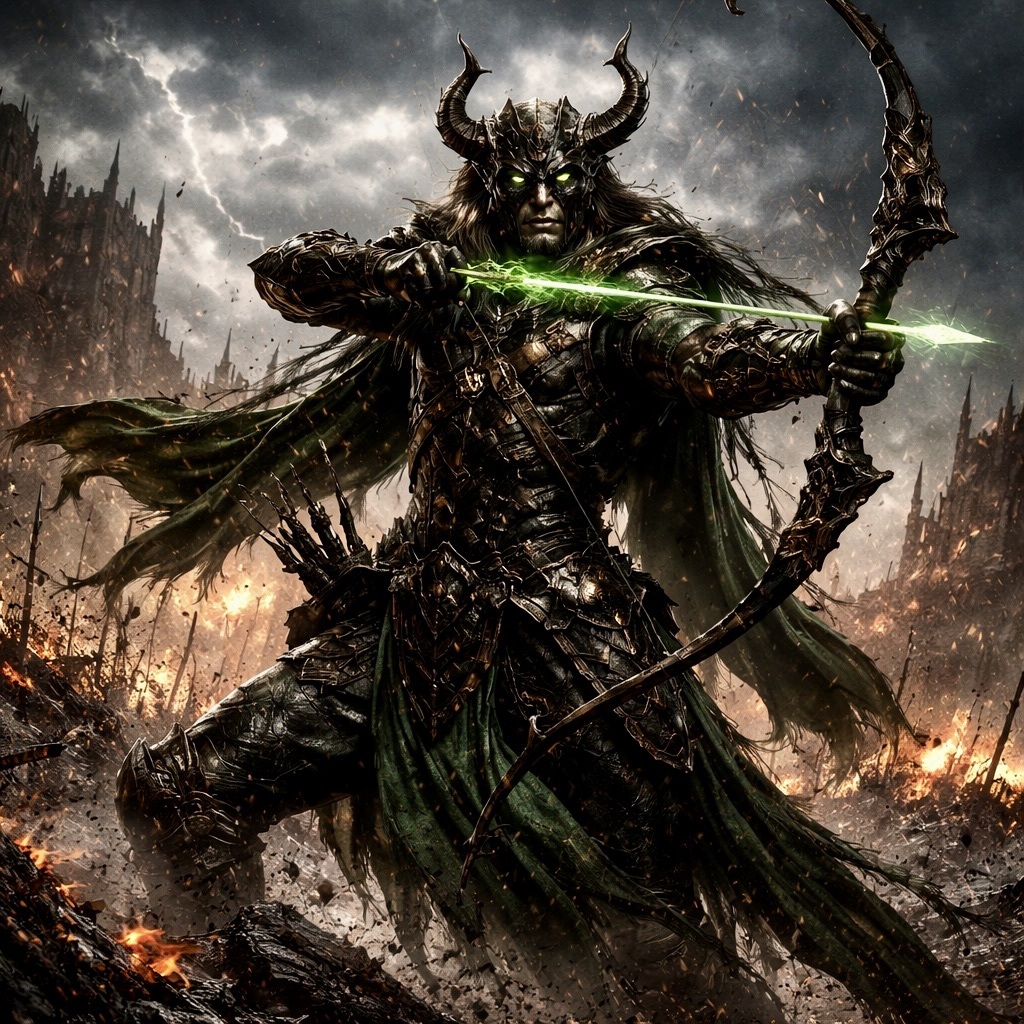
Among the many spirits cataloged in the ancient grimoires of demonology, few evoke imagery as vivid and unsettling as Leraje. His name appears in the Ars Goetia, the famous first section of the seventeenth-century grimoire The Lesser Key of Solomon, a text that attempts to catalog seventy-two infernal spirits believed to exist within a structured hierarchy beneath the rulers of Hell. Each demon in this strange and fascinating catalog is assigned a rank, a number of legions under command, and a specific domain of influence over the human world. Some demons reveal knowledge of hidden treasures, others teach philosophy or astronomy, while many influence emotions, relationships, or the forces of nature. Leraje, however, represents something far more dangerous and immediate. He is the archer of the infernal hierarchy—the spirit who inspires conflict, ignites disputes, and wounds both body and pride with supernatural precision.
In the grimoires, Leraje is described as a Great Marquis of Hell commanding thirty legions of spirits. He appears in the form of a handsome archer dressed in green, carrying a bow and arrows. His appearance is not monstrous in the way many demons are described; instead, he resembles a skilled hunter or soldier. This subtlety is part of what makes Leraje’s symbolism so powerful. War does not always arrive as a roaring beast or terrifying monster. Sometimes it arrives quietly, carried by a single arrow.
The arrow is one of humanity’s oldest weapons, and its symbolism runs deep through mythology and history. Unlike the sword, which requires direct confrontation, the bow allows distance between attacker and target. It represents calculated action, patience, and strategy. Archers must wait, observe, and strike at precisely the right moment. In demonological symbolism, this makes Leraje less a brute force of destruction and more a strategist of discord.
The grimoires state that Leraje has the power to cause great battles and disputes among people. He is said to make wounds that fester and refuse to heal, especially wounds caused by arrows. While this description might appear literal on the surface, it also carries deep metaphorical significance. Conflicts between individuals or nations often begin with small provocations—an insult, a misunderstanding, a rumor whispered in the wrong ear. These small “arrows” can strike the pride of a person or group and create injuries that linger long after the initial moment has passed.
Throughout history, wars have begun over seemingly minor incidents. A single assassination in Sarajevo in 1914 ignited the First World War. A dispute over territory or honor has sparked countless battles across centuries. The mythology of Leraje captures this truth with eerie precision. Conflict rarely emerges suddenly from nothing. It begins with something small, something precise, something that hits exactly where it hurts.
In many ways, Leraje embodies the psychology of conflict itself. Human beings possess a deep sensitivity to perceived threats and insults. Evolutionary psychologists suggest that this sensitivity developed because early human societies depended heavily on reputation and social standing for survival. An insult or humiliation could damage one’s position within the group, potentially threatening access to resources or allies. As a result, humans evolved to react strongly to perceived slights.
Leraje’s arrows symbolize these emotional triggers. A single word spoken at the wrong moment can provoke anger that spreads through entire communities. Rumors can inflame tensions between families, tribes, or nations. The demon archer therefore becomes a mythological representation of the invisible forces that escalate disagreements into full-scale conflict.
The green clothing associated with Leraje in the grimoires is another intriguing detail. Green has long carried multiple symbolic meanings across cultures. It is the color of nature, growth, and vitality, but it is also associated with envy and jealousy. In literature and art, the phrase “green with envy” has been used for centuries to describe the corrosive emotion of jealousy.
By dressing Leraje in green, the grimoires may be hinting that many conflicts arise from envy or resentment. When one individual perceives another as more successful, powerful, or admired, bitterness can grow quietly beneath the surface. That resentment becomes fertile ground for the arrows of conflict to strike.
Demonology often served as a symbolic language through which people attempted to understand human behavior. Rather than viewing demons purely as external supernatural beings, many modern scholars interpret them as representations of psychological or social forces. From this perspective, Leraje becomes the embodiment of rivalry, resentment, and provocation.
Yet the mythology surrounding him also reflects the worldview of the Renaissance period in which the grimoires were compiled. The seventeenth century was an era of constant warfare in Europe. Religious conflicts, territorial disputes, and political rivalries frequently erupted into violence. The Thirty Years’ War alone devastated large portions of the continent, leaving millions dead and reshaping the political landscape.
In such an environment, war was not an abstract concept but a daily reality. People sought explanations for why conflict seemed so inevitable. Demonology provided a framework through which these destructive patterns could be interpreted. If demons like Leraje influenced human behavior, then perhaps the seemingly endless cycle of violence had a supernatural cause.
The hierarchy of Hell described in the Ars Goetia mirrors the political structures of Renaissance Europe. Kings, princes, dukes, and marquises ruled over legions of spirits in much the same way earthly nobles governed armies and territories. Leraje’s rank as a Marquis suggests a commander responsible for strategic operations within the infernal order.
In historical terms, a marquis governed frontier regions that were vulnerable to invasion or conflict. These border territories were often the first places where wars began. The title therefore carries an interesting symbolic connection to Leraje’s domain. He operates at the boundaries where peace breaks down and conflict emerges.
The idea that Leraje causes wounds that do not heal is particularly striking. Physical wounds from arrows were indeed dangerous in medieval warfare. Arrowheads could introduce infection deep into the body, leading to injuries that lingered for weeks or months. But the grimoires likely intended a broader meaning as well.
Emotional wounds can persist far longer than physical ones. Words spoken in anger may be remembered for decades. Betrayals can fracture friendships and families permanently. Nations sometimes carry grievances across generations, passing resentment from parents to children.
Leraje’s arrows therefore symbolize injuries that strike not only the body but also the memory. They create scars within relationships that resist healing.
Across mythology and literature, archers often represent forces that influence destiny from afar. The Greek god Apollo was an archer whose arrows could bring sudden death or plague. Artemis used her bow to punish those who violated sacred boundaries. Cupid, perhaps the most famous mythological archer, shot arrows that caused people to fall in love.
Leraje’s arrows are different. They do not inspire love or divine judgment. They ignite rivalry and hostility.
Yet even this destructive role reflects an important truth about human society. Conflict has shaped civilization just as much as cooperation has. Wars have redrawn borders, toppled empires, and accelerated technological advancement. The same drive that fuels competition in warfare also fuels ambition in art, science, and politics.
Some philosophers argue that conflict is an unavoidable part of human nature. Competition for resources, status, and influence creates tensions that occasionally erupt into open confrontation. Demonology personifies these tensions through figures like Leraje, transforming abstract social dynamics into mythological characters.
In modern psychological terms, Leraje might represent the phenomenon of escalation. When two individuals or groups become locked in conflict, each action by one side provokes a stronger reaction from the other. What begins as a minor disagreement can spiral into intense hostility.
Social scientists refer to this pattern as a “conflict spiral.” Each step increases the stakes until resolution becomes increasingly difficult. The arrow fired by Leraje is the first moment in that spiral—the spark that ignites the chain reaction.
Interestingly, the grimoires also note that Leraje’s wounds are caused specifically by arrows. This detail reinforces the idea of distance and precision. Unlike chaotic violence, which erupts suddenly, Leraje’s influence operates through deliberate targeting.
In social terms, this resembles the way propaganda, rumors, or strategic insults can destabilize communities. A carefully crafted lie can provoke anger between groups that might otherwise coexist peacefully. Political leaders throughout history have exploited these dynamics, using rhetoric to inflame tensions and consolidate power.
The mythology of Leraje therefore anticipates many modern understandings of psychological warfare.
Even in everyday life, small provocations can escalate rapidly. A disagreement between coworkers becomes a workplace feud. A misunderstanding between neighbors turns into years of resentment. Families fracture over disputes that begin with a single careless remark.
These moments feel strangely precise, as though someone has fired an invisible arrow into the heart of the situation.
In literature, characters who embody conflict often serve as catalysts for the story’s central drama. Without conflict, narratives lack tension and transformation. Heroes are defined by the obstacles they overcome. Rivalries drive character development and reveal hidden motivations.
Leraje, as the infernal archer, represents that catalytic force within the mythological landscape of demonology.
Yet the grimoires also imply that knowledge of such spirits could allow magicians to counteract their influence. Rituals for summoning demons often involved compelling them to reveal secrets or obey commands. In theory, a skilled practitioner could force Leraje to stop provoking conflict or to explain the hidden causes of disputes.
Whether or not such rituals were believed to work literally, the concept carries symbolic meaning. Understanding the mechanisms of conflict is the first step toward preventing it.
Historians, diplomats, and mediators perform a similar role in modern society. By studying the causes of war and analyzing patterns of escalation, they attempt to prevent future violence.
In that sense, the mythology of Leraje also contains an implicit lesson. Conflict may appear mysterious or inevitable, but it often follows recognizable patterns. By identifying the arrows—those initial provocations—people can intervene before disputes spiral out of control.
Across cultures, myths about supernatural agents of conflict remind societies to remain vigilant about the forces that divide them. Whether those forces are interpreted as demons, psychological impulses, or political manipulation, their effects are real.
Leraje stands as a reminder that the most destructive events in history often begin quietly. A single arrow released into the air may seem insignificant in the moment it leaves the bow. Yet once it strikes, its consequences can spread far beyond the original target.
The archer of the infernal hierarchy does not need armies or storms to cause devastation. All he needs is a clear aim and a moment of opportunity.
And in the silence before conflict begins, when tensions hang unnoticed in the air, one might almost imagine the faint sound of a bowstring being drawn somewhere beyond sight—Leraje preparing to release another arrow into the fragile balance of human relationships.