
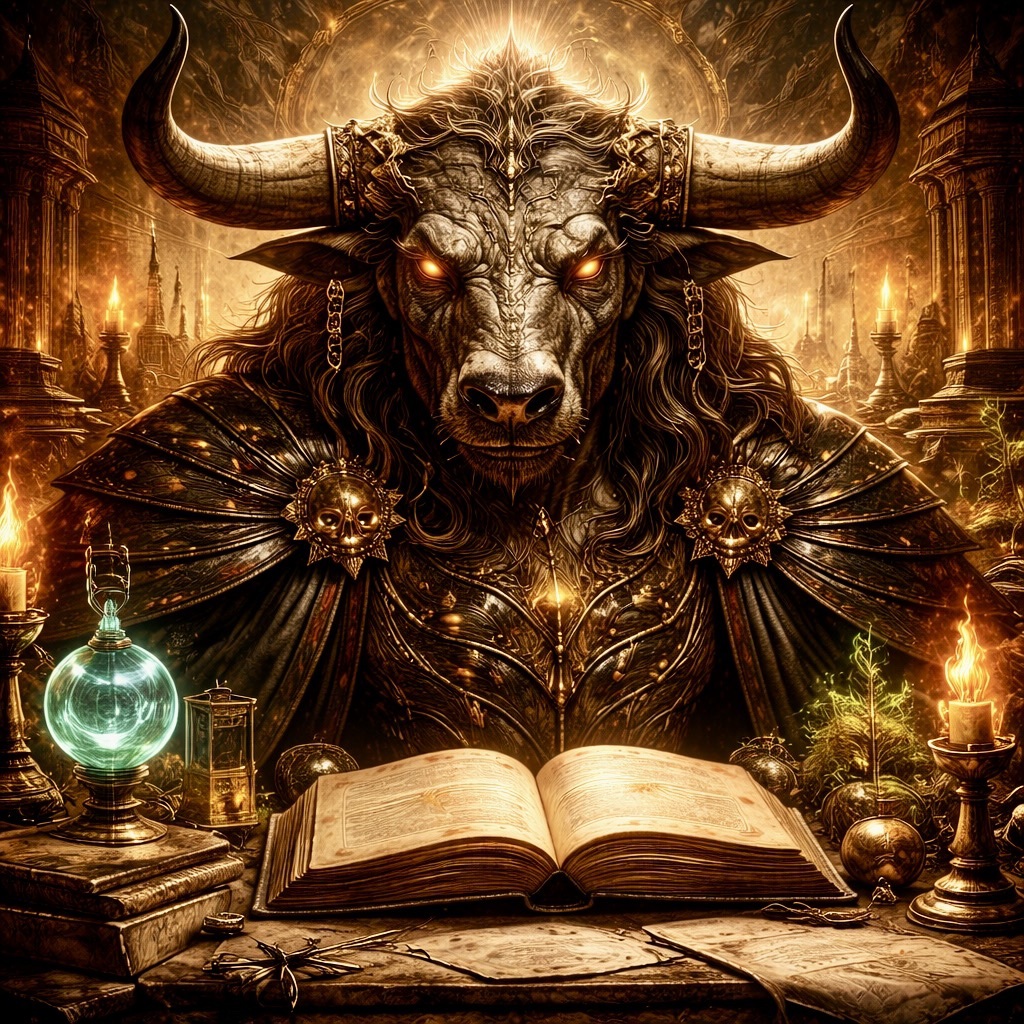
Marax, also known as Morax in the Ars Goetia, is a demon whose power does not announce itself with fire, violence, or spectacle. Instead, it settles quietly into the mind and stays there. He is listed as a Great President and Earl of Hell, commanding thirty-six legions, and he most often appears in the form of a mighty bull, sometimes with a human face. This form alone tells you nearly everything about his nature. Marax is not a destroyer. He is a bearer of weight. He carries knowledge the way a bull carries burden—steadily, patiently, and without concern for whether the load is wanted.
Marax governs astronomy, liberal sciences, the virtues of herbs and stones, and, most importantly, memory. He teaches truths that do not dazzle but endure. In a hierarchy crowded with demons of desire, destruction, and domination, Marax stands apart as a custodian of foundational understanding. He does not chase power. He preserves it in usable form.
The bull imagery associated with Marax is deeply symbolic. Bulls represent strength, persistence, fertility, and grounded reality. They do not move quickly, but they move decisively. Marax’s knowledge works the same way. It does not overwhelm all at once. It settles in, changes how a person thinks, and reshapes perception over time. Once learned, it is difficult to forget.
Marax is said to teach astronomy, but not in the romantic sense of stargazing or prophecy. Under Marax, astronomy is structure. It is understanding cycles, order, and position. He teaches how celestial bodies move not to inspire wonder, but to reinforce the idea that the universe operates according to patterns whether humans approve or not. Marax’s astronomy is humbling rather than mystical.
His association with the liberal sciences reinforces this. Liberal sciences are not indulgent knowledge. They are foundational disciplines—logic, mathematics, structure, and reasoning. Marax teaches how systems fit together, how principles apply across domains, and how understanding one structure allows comprehension of many others. Under Marax, intelligence becomes cumulative.
One of Marax’s most important attributes is his command over memory. This is not the theatrical manipulation of recollection seen in some mythic figures. Marax does not erase memories or implant false ones. He strengthens retention. He ensures that what is learned remains accessible. This makes him uniquely dangerous and uniquely valuable. Knowledge granted by Marax is difficult to discard.
Psychologically, Marax represents the part of the mind that refuses to let go of understanding once it has been achieved. He is the demon of “now you know, and you can’t unknow it.” This makes him deeply unsettling to those who prefer ignorance or ambiguity. Marax does not permit selective memory.
The virtues of herbs and stones also fall under Marax’s domain. This knowledge is practical, grounded, and ancient. He teaches how natural materials interact with the body and environment, not through superstition, but through observation and accumulation of experience. Under Marax, nature is not mystical chaos. It is a system of properties waiting to be understood.
Unlike demons associated with excess, Marax is restrained. He does not promise shortcuts. He does not inflate ego. His teachings require patience, repetition, and respect for process. This makes him unappealing to the impulsive and invaluable to the disciplined.
Marax’s dual rank as President and Earl is significant. As a President, he governs instruction and dissemination of knowledge. As an Earl, he governs territory and structure. Marax controls both learning and the environments in which learning persists. He understands that knowledge does not survive without institutions, memory, and continuity.
The bull’s presence reinforces stability. Bulls are often used in agriculture, ritual, and labor. They are essential but rarely celebrated. Marax’s knowledge functions the same way. It supports everything else but rarely draws attention to itself. Those who rely on it often forget where it came from.
Marax does not tempt through desire or fear. He tempts through usefulness. His knowledge solves problems, answers questions, and clarifies confusion. The danger is not corruption. The danger is overreliance. When knowledge becomes absolute, humility disappears. Marax does not prevent this outcome. He enables it.
In modern symbolic terms, Marax resembles foundational science, institutional memory, and the quiet power of expertise. He is present wherever systems persist because someone remembers how they work. He is the demon of engineers, archivists, scholars, and those who maintain rather than disrupt.
Marax’s teachings also carry a subtle burden. Memory can be heavy. Remembering everything makes forgiveness harder. Understanding systems makes innocence impossible. Marax does not soften this burden. He assumes that those who seek knowledge are prepared to carry it.
Unlike demons associated with madness or illusion, Marax is stabilizing. His presence calms rather than agitates. This calm, however, can feel oppressive. There is no escape into fantasy under Marax. Reality asserts itself clearly.
Marax endures in demonology because civilization depends on memory. Knowledge lost must be rediscovered at great cost. Knowledge preserved shapes the future quietly. Marax governs that preservation.
To engage with Marax symbolically is to accept that learning is irreversible. Once you understand how something works, you are responsible for that understanding. Ignorance is no longer an option.
Marax is not the demon of revelation. He is the demon of retention. He does not dazzle. He stays.