
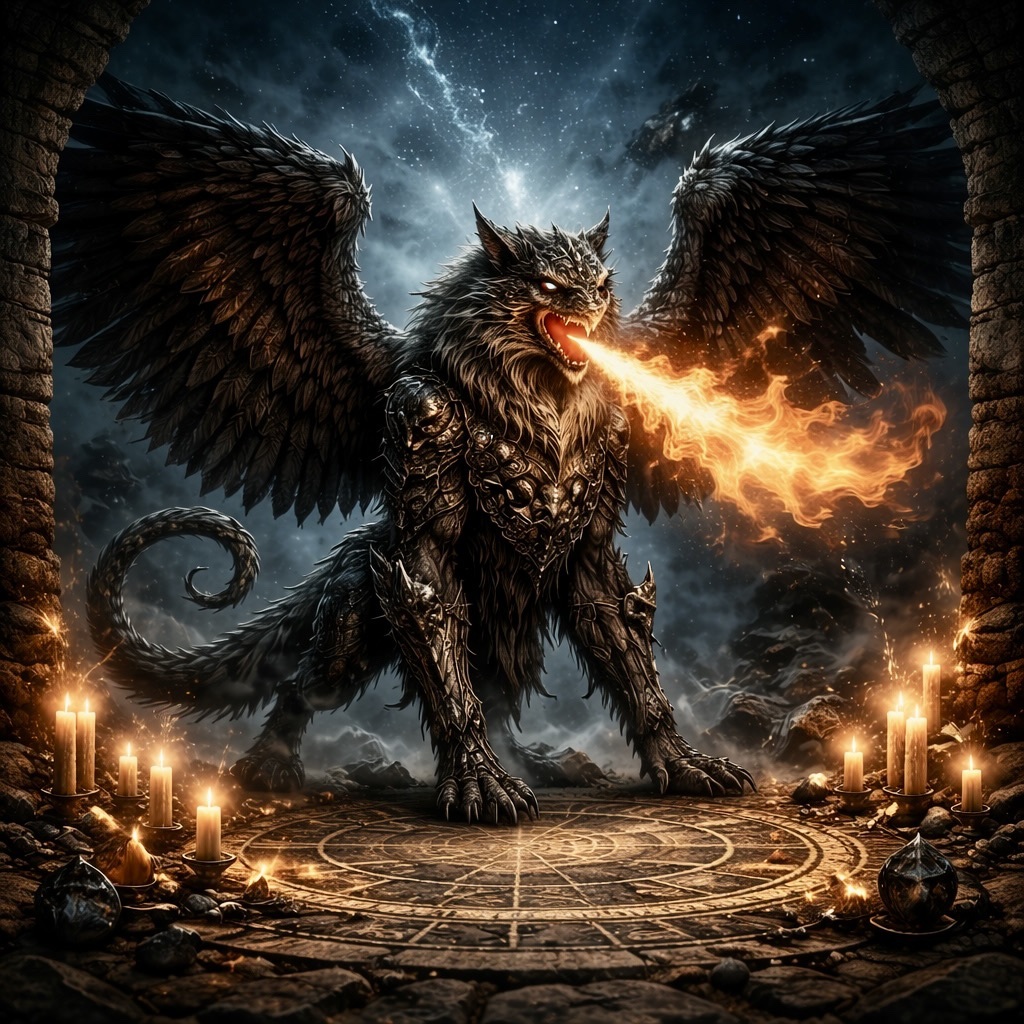
There are demons in the old grimoires who whisper secrets, some who promise wealth, others who twist desire into obsession. And then there is Marchosias — a being who arrives not as a shadow in the corner of the room, but as a blaze in the doorway. If Stolas feels like the scholar of the infernal court, Marchosias feels like its soldier. He is movement, heat, tension drawn like a bowstring. He is the sound of something breaking through the underbrush at night.
Marchosias appears in the Lesser Key of Solomon, specifically within the Ars Goetia, where he is listed as a Great Marquis of Hell commanding thirty legions of spirits. His description is vivid and difficult to forget: he manifests as a wolf with a griffin’s wings and the tail of a serpent, breathing fire from his mouth. When commanded by the magician, he can take the shape of a man. Unlike some spirits whose demeanor is ambiguous, Marchosias is described as strong and faithful to the conjurer. There is even a strange note of regret attached to him — the text claims he hopes to return to the Seventh Throne after 1,200 years.
That single detail changes everything.
In a tradition that often frames demons as purely rebellious or malicious, Marchosias carries something like longing. It is subtle, easily overlooked, but powerful. The idea that a spirit of Hell desires restoration suggests a fracture not just between Heaven and Hell, but within the fallen themselves. Marchosias is not merely a monster. He is a former being of higher order, reshaped by rebellion.
His form reflects this tension. The wolf is primal instinct, hunger, ferocity. Wolves symbolize loyalty as much as savagery; they move in packs, operate within structure, understand hierarchy. To combine a wolf with griffin wings introduces nobility and mythic elevation. The griffin, in medieval symbolism, represented vigilance and divine guardianship. Add the serpent tail — ancient emblem of cunning, temptation, and cyclical rebirth — and the composite creature becomes something layered and volatile.
Fire completes the image. Fire purifies and destroys. It warms and consumes. When Marchosias breathes flame, it is not random chaos; it is controlled force. He is not described as deceitful or manipulative. He is described as a fighter.
In fact, the grimoire states that he answers truthfully to the magician and is strong in battle. That honesty stands out. Many Goetic spirits are associated with trickery or illusion. Marchosias is framed almost as a warrior bound by oath.
The rank of Marquis also matters. In the infernal hierarchy laid out in the Ars Goetia, titles mirror earthly nobility. Kings, Dukes, Princes, Marquises, Earls — each with authority over legions. Thirty legions is no small number. The symbolism of legions, borrowed from Roman military organization, implies disciplined regiments rather than chaotic hordes. Marchosias does not rule anarchy. He commands order within rebellion.
That paradox defines him.
The 17th century, when the Lesser Key of Solomon circulated in manuscript form, was an era steeped in structured cosmology. Even Hell was imagined with hierarchy. Rebellion did not erase rank; it reorganized it. Marchosias becomes a reflection of this worldview — a fallen noble who retained command, strength, and discipline even after exile.
And that exile matters.
The brief note about his hope to return to the Seventh Throne has sparked speculation among occult scholars. The “Seventh Throne” is never elaborated upon in the grimoire, but it implies celestial hierarchy. In Christian angelology, thrones are among the higher orders of angels. If Marchosias once belonged to such a rank, his fall was not minor. It was catastrophic.
There is something deeply human in that detail. The idea of a warrior who longs for restoration, who fights fiercely yet carries a memory of what was lost. It echoes archetypes found across myth — the fallen knight, the exiled prince, the general who once stood on holy ground.
In ceremonial magic, Marchosias is invoked within protective circles inscribed with divine names. The magician stands at the center, commanding the spirit to appear, to answer questions, to demonstrate obedience. The ritual language emphasizes authority over the spirit, yet the interaction itself suggests a dialogue.
What does one ask a wolf-winged marquis of Hell?
Traditionally, practitioners sought protection, strength in battle, or assistance in conflict. Marchosias’ martial nature made him attractive to those who felt embattled — whether literally or symbolically. In a world fraught with political upheaval, religious wars, and shifting loyalties, the image of a powerful, faithful warrior spirit carried psychological weight.
Yet the fire and claws are not the whole story.
Modern interpretations of Marchosias, especially in contemporary occult and psychological frameworks, often treat him less as an external entity and more as an archetype. In this lens, Marchosias represents disciplined aggression — the capacity to fight without losing structure. He becomes the embodiment of righteous anger, controlled force, and loyalty under pressure.
The wolf form reinforces this idea. Wolves are not mindless killers. They are strategic hunters. They protect their own. They operate within clear hierarchy. The griffin wings elevate this instinct to something mythic, almost celestial in origin. The serpent tail hints at transformation — the shedding of skin, the possibility of change.
And then there is that longing for the Seventh Throne.
When I sit with the image of Marchosias, what strikes me most is not fear but intensity. He feels like a storm held in muscle and bone. He feels like the moment before impact. But he also feels aware — aware of what he was and what he became.
In many ways, demonology serves as a mirror for human psychology. The spirits cataloged in the Ars Goetia reflect facets of ambition, fear, desire, rage, curiosity. Marchosias reflects our relationship with power and regret. The part of us that fights fiercely yet wonders if we chose the wrong side. The part that remains loyal even after falling from grace.
The fire he breathes could be destruction, yes. But fire also illuminates. It exposes. It transforms metal into stronger forms. Perhaps that is why the grimoires emphasize his honesty. A being of flame who does not lie is a powerful symbol.
It would be easy to reduce Marchosias to spectacle — a monstrous hybrid fit for fantasy illustration. But the old texts are rarely that simple. They encode moral tension in symbolic form. Marchosias is not chaos incarnate. He is disciplined rebellion.
In popular culture, demonic figures are often flattened into villains or antiheroes. Marchosias resists that simplicity. He is described as faithful to the conjurer. He fights well. He answers truthfully. And he hopes for restoration. That hope complicates everything.
Hope implies memory. Memory implies loss.
And loss implies that once, there was something worth having.
The more I think about Marchosias, the more he feels like a study in loyalty under exile. Thirty legions follow him. He commands without hesitation. Yet somewhere beneath the wolf’s snarl and the serpent’s coil lies the echo of a throne he once knew.
There is something profoundly tragic in that.
In ceremonial traditions today, practitioners who work symbolically with Marchosias often focus on inner strength and disciplined will. They see him as an ally in overcoming adversity — not by soft persuasion, but by standing firm. By breathing fire when necessary. By refusing to retreat.
But they also acknowledge the cost of living in constant battle. The longing for the Seventh Throne becomes the longing for reconciliation — for wholeness restored.
Perhaps that is why Marchosias continues to captivate. He embodies the warrior who has not forgotten heaven. The wolf who still remembers flight.
In the end, Marchosias is not merely a name in a 17th-century manuscript. He is a figure carved from fire and contradiction. A marquis of Hell who speaks truth. A beast who commands legions. A fallen being who still hopes.
And if there is a lesson hidden within his flames, it may be this: strength without reflection becomes destruction, but strength tempered by memory becomes transformation.