
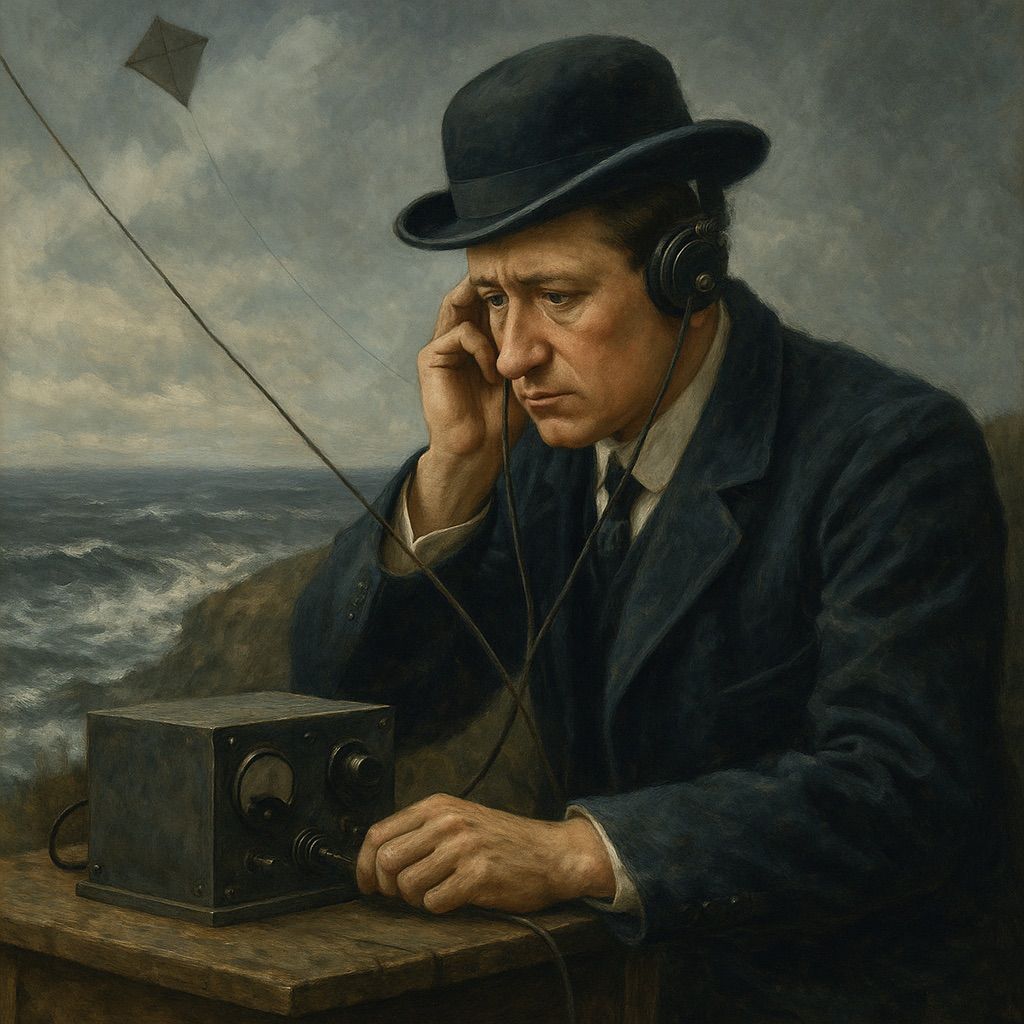
On December 12, 1901, Guglielmo Marconi stood on the wind-scoured cliffs of Cape Cod with the Atlantic stretching before him like a vast, silent barrier. For centuries, that ocean had symbolized distance—geographical, political, psychological. It separated continents, cultures, and empires. Messages took days or weeks to cross it, carried by ship through unpredictable seas. But Marconi believed he could make the ocean do something no one had ever thought possible: carry a whisper of electricity from one side to the other, a whisper that spelled out the letter S in Morse code, repeated again and again, faint but unmistakably human. That whisper would change the world.
Marconi’s journey to this moment started decades earlier in Bologna, where he was a restless child more interested in wires and batteries than schoolwork. He would spend hours experimenting in his attic, tapping keys, stretching wires across rooms, sending crude signals from one floor of his home to the next. His teachers called his ideas fanciful. His neighbors called them impossible. But young Marconi cared only about questions, especially the one that consumed him: Could invisible waves carry messages through the air, farther and farther, someday even beyond the horizon?
At the University of Bologna, Marconi immersed himself in the groundbreaking theories of James Clerk Maxwell and the experiments of Heinrich Hertz. Maxwell had predicted the existence of electromagnetic waves; Hertz confirmed them. But neither man believed those waves could be harnessed for long-distance communication. Hertz famously claimed his discovery was “of no practical use whatsoever.” Marconi disagreed. He saw not limits—but opportunity.
By the time he reached his early twenties, Marconi had refined his first working wireless transmitter. It could send signals across a garden, then across a field, and eventually over several miles. This might seem insignificant today, but at the time, miles were revolutionary. The world took notice. Governments, navies, and scientific societies leaned in with sudden interest. The first wireless company was formed. Stations began appearing across Europe. Ships at sea began to carry Marconi devices. The dream of wireless communication was no longer science fiction—it was becoming a business, a tool, a necessity.
But Marconi wanted more. He wanted the Atlantic.
Every expert told him it was impossible. Radio waves, they insisted, travel only in straight lines. The Earth curves. The ocean would swallow the signal. Distance, weather, sunspots, atmospheric noise—every factor seemed designed to thwart his ambition. But Marconi believed the atmosphere itself could carry signals farther than anyone imagined. He believed that if he could build a powerful enough transmitter and pair it with an antenna tall enough to lasso the sky, the waves would travel beyond the horizon, bouncing along the ionosphere like a skipping stone.
So he built. And built big.
By 1901, he had constructed two massive stations: one in Poldhu, Cornwall, for transmitting, and one in Cape Cod for receiving. They were not simple outposts but technological cathedrals—great wooden towers draped with copper wire, humming with generators, pulsing with energy. Engineers worked through storms, failures, and electrical fires. The towers collapsed twice. Workers rebuilt them. Money ran thin. Marconi pressed on.
Then came December 12.
The winds on Cape Cod battered the receiving station, icy and relentless. Marconi and his assistant set up a simple receiver connected to a wire antenna raised by a kite—one of the many improvisations required in a place where the weather seemed determined to make history as inconvenient as possible. At 8:20 p.m., through the static and wind, a faint, rhythmic pattern emerged. Three short clicks. The letter S. Again. And again.
Marconi froze. He listened. His assistant leaned in, wide-eyed. The signal was delicate but undeniable. Against the predictions of scientists, against the limits of technology, against the very curvature of the Earth, a message sent from England had crossed 2,100 miles of open ocean and arrived on American shores in a whisper of electromagnetic waves.
For the first time in human history, the Atlantic Ocean had been conquered not by ships, but by light.
Word spread across the world almost immediately. Newspapers hailed it as an epoch-making achievement. Governments scrambled to assess the implications. Military strategists realized a new age of naval communication had begun. Businesses imagined transoceanic markets linked in real time. Ordinary citizens were stunned by the idea that the world had suddenly become smaller, faster, more connected.
But no one felt the moment more deeply than Marconi. He knew instantly that this was not just a technological triumph; it was the birth of global communication. It was the bridge that would lead to radio broadcasting, radar, satellite communication, GPS, Wi-Fi, and every invisible wave that now threads through modern life. His invention did not just shrink the world—it rewired it.
Still, the journey ahead was far from smooth. Many scientists doubted the authenticity of the transatlantic signal. Some accused Marconi of fraud. Others insisted it must have been an atmospheric accident. But Marconi didn’t waste time arguing. He focused on proving it undeniably—and commercially.
He built more stations, refined his transmitters, expanded his networks. Ships at sea soon carried wireless sets as standard equipment. Messages that once took weeks now took seconds. Lives were saved when wireless distress calls enabled rapid rescue during maritime disasters. Information flowed faster than ever before. Empires, economies, and cultures began to shift around the newfound speed of communication.
In 1909, Marconi won the Nobel Prize in Physics for his contributions to wireless telegraphy. And he continued pushing the boundaries—experimenting with shortwave radio, directional antennas, and long-distance broadcasting. By the 1920s, radio had become a global force, carrying news, music, political speeches, and entertainment into homes around the world. The age of wireless communication—born on that cold December night—had fully arrived.
Yet perhaps the most profound impact of Marconi’s achievement was the psychological one. For the first time, humanity understood that distance was no longer an insurmountable barrier. The world could speak to itself. Borders could not stop a signal. The sky had become a highway for information.
As we stand today in an era of instantaneous global communication, it’s easy to take this miracle for granted. We send messages across continents without thinking. We stream live videos from one hemisphere to another with the tap of a finger. But every text, every radio broadcast, every satellite transmission, every Wi-Fi connection owes a debt to the spark Marconi ignited.
The cliffs of Cape Cod are quiet now, the old towers long gone. But if you stand there at dusk and listen to the wind, you might imagine—just for a moment—the faint clicking of Morse code drifting across the Atlantic. The sound of the world becoming smaller. The sound of possibility. The sound of humanity’s first whisper across the void.
And in that whisper, the future began.