
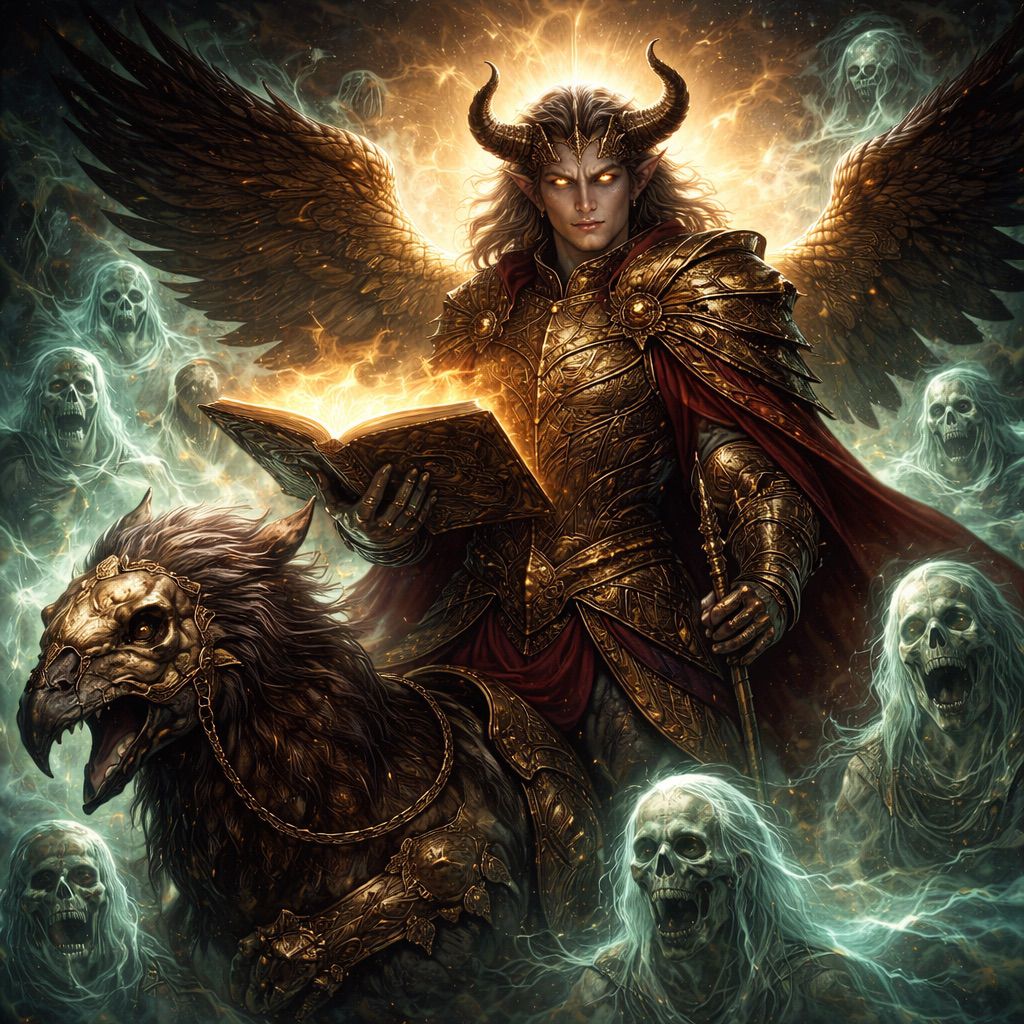
Murmur is not a demon of spectacle. He does not rely on fire, seduction, or chaos to announce his presence. Instead, he arrives with the weight of inevitability, accompanied by the quiet authority of something that has already outlasted life itself. In the Ars Goetia, Murmur is described as both a Duke and a Count of Hell, a dual title that immediately signals layered authority. He appears as a soldier riding a vulture or griffin, accompanied by a procession of the dead, and his domain is necromancy, philosophy, and the knowledge of spirits. But these labels only hint at what Murmur truly represents. He is not the demon of death itself. He is the demon of what death remembers.
The name Murmur is deceptively gentle. A murmur is not a scream or a command. It is a low sound, barely audible, something that persists in the background. This is exactly how Murmur operates. He governs the voices that never fully fade, the knowledge that lingers after bodies are gone, the truths that survive when emotion and urgency have burned away. Murmur is not loud because he does not need to be. Everything he governs already carries weight.
Murmur’s association with necromancy is often misunderstood as a fixation on corpses or gore. In reality, necromancy in its original sense was about communication, not animation. It was the art of speaking with the dead to gain wisdom, context, and understanding unavailable to the living. Murmur presides over this exchange. He does not raise the dead for spectacle. He allows them to speak.
The soldier imagery attached to Murmur is crucial. Soldiers represent discipline, hierarchy, and obedience to structure rather than impulse. Murmur’s dead do not wander aimlessly. They march. They are ordered. This reflects Murmur’s deeper nature. He does not rule chaos. He rules what comes after chaos has ended. When passions are spent and ambitions extinguished, Murmur remains.
The vulture or griffin he rides reinforces this symbolism. Vultures are creatures of aftermath. They do not kill. They arrive when killing is done. They clean, reduce, and transform what remains. The griffin adds a layer of guardianship and authority, suggesting that Murmur stands watch over the boundary between life and death, ensuring that what crosses it does so in order.
Murmur teaches philosophy, not in the abstract sense of debate or speculation, but in its oldest form: contemplation of mortality, meaning, and consequence. His philosophy is not hopeful, but it is clarifying. Under Murmur, illusions fall away. Death strips narratives to their core, and Murmur governs what is left when stories can no longer lie.
Unlike demons who manipulate the living through desire or fear, Murmur operates through perspective. He reveals how small most conflicts become when viewed from the grave. This does not make him kind. It makes him indifferent. Murmur does not comfort the living. He contextualizes them.
One of Murmur’s most unsettling traits is his ability to compel spirits to answer truthfully. The dead, under Murmur, do not embellish. They do not justify. They recount. This makes Murmur dangerous to those who rely on mythologized versions of themselves or others. Under Murmur’s influence, legacy becomes accurate rather than flattering.
Psychologically, Murmur represents the voice of long-term consequence. He is the part of the mind that asks how actions will be remembered once emotion is gone. He is the demon of the historical record, stripped of bias and sentiment. Under Murmur, reputation is not managed. It is revealed.
Murmur’s dual rank as Duke and Count suggests authority over both territory and administration. He governs the realm of the dead not as a tyrant, but as a custodian. He ensures order, hierarchy, and memory. In this sense, Murmur resembles a librarian of endings, cataloging what has been done and what it meant.
Unlike demons who promise power over others, Murmur offers power over understanding. He grants insight into spirits, death, and the hidden mechanics of mortality. But this insight is heavy. Knowledge of death is not energizing. It is sobering. Murmur does not grant ambition. He grants perspective.
In modern symbolic terms, Murmur feels like the embodiment of historical truth. He is present wherever narratives are revisited, archives opened, and long-buried facts surface. Murmur does not care who is embarrassed by truth. He cares that it is preserved accurately.
The processions of the dead associated with Murmur are not threats. They are reminders. Every living system eventually becomes a record. Murmur governs that transition. He ensures that nothing truly disappears, even when it is no longer visible.
Unlike demons associated with cruelty, Murmur is often described as calm and measured. He does not rush. Death has no deadline. This patience makes Murmur deeply unsettling. He will outlast everything that opposes him. There is no need for urgency.
Murmur’s necromancy also carries an implicit warning. To speak with the dead is to invite accountability. The dead cannot be intimidated or bribed. They have nothing left to gain. Under Murmur, truth becomes unavoidable.
This is why Murmur is often associated with silence. Silence is not emptiness under Murmur. It is space for truth to surface. He strips away noise, distraction, and justification. What remains speaks for itself.
In demonology, Murmur is not feared because he kills. He is feared because he remembers. He remembers accurately. He remembers impartially. He remembers forever.
Symbolically, Murmur represents the end of self-deception. He is the demon of the moment when all explanations fail and only facts remain. He does not punish. He records.
Murmur endures because death endures. Every action eventually becomes history, and history belongs to someone. Murmur is that someone.
To encounter Murmur symbolically is to accept that nothing is truly forgotten, and that silence is not absence, but patience.