
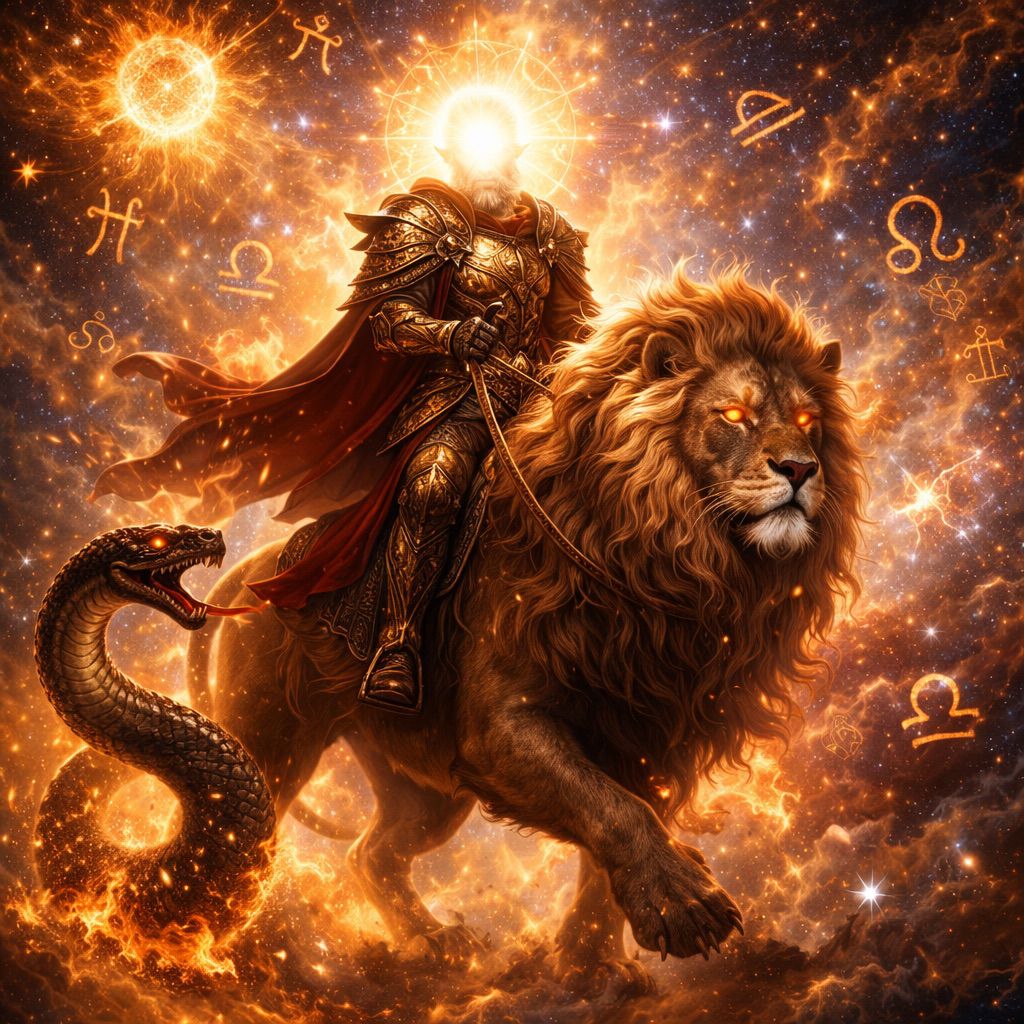
Orias is not a demon of brute force or theatrical menace. He does not roar, threaten, or dominate through fear. Instead, he moves through the margins of power, altering trajectories quietly but decisively. In the Ars Goetia, Orias is named as a Great Marquis of Hell, appearing as a lion riding a powerful horse, with the tail of a serpent. This image is not meant to terrify. It is meant to signal mastery—over identity, over movement, and over the hidden forces that shape reputation and fate.
Orias governs transformation, but not the kind that destroys and rebuilds from rubble. His transformations are social, symbolic, and internal. He teaches the virtues of the stars, grants dignity and favor, alters a person’s form or status, and reveals how celestial influences bend human behavior without announcing themselves. Orias does not push. He redirects. He does not break structures. He adjusts the angles until outcomes change on their own.
The lion form associated with Orias is about authority that is recognized rather than imposed. Lions do not need to prove dominance constantly; their presence is enough. The horse represents movement, status, and momentum—how power travels through systems. The serpent tail introduces a final layer: subtlety, adaptability, and the ability to shed one skin and take on another. Orias is the demon of strategic reinvention.
In occult lore, Orias is associated with astrology, dignity, and transformation of self. He teaches how planetary influences shape temperament, opportunity, and timing. This is not fortune-telling in a simplistic sense. It is pattern recognition. Orias understands that people move differently under different skies, that reputation rises and falls in cycles, and that knowing when to act is often more important than knowing how.
What makes Orias compelling is that he does not promise raw power. He promises positioning. He offers the knowledge of how to stand in the right place when the moment arrives. Those who seek Orias are often not desperate; they are stalled. They sense that something about their identity, their image, or their trajectory is misaligned. Orias teaches how to realign without open conflict.
Orias’s ability to grant dignity and honor is especially telling. Dignity is not strength. It is recognition. It is how others perceive you before you speak. Orias understands that in most systems, perception precedes authority. He alters the lens through which a person is seen, and the world responds accordingly. This is not illusion. It is recalibration.
The serpent tail is crucial here. Serpents are not symbols of chaos in this context; they are symbols of renewal. They shed skins to grow. Orias embodies this process socially and psychologically. He teaches how to discard outdated roles, reputations, and identities without drawing attention. Transformation under Orias is meant to look natural in hindsight.
Astrology under Orias is not mystical escapism. It is timing. It is understanding when systems are receptive to change and when resistance will be strongest. Orias does not override fate; he navigates it. He teaches how to move with cycles rather than against them, which is why his influence often appears effortless.
In modern terms, Orias feels uncannily relevant. Branding, reputation management, career pivots, and social reinvention all echo his domain. He is the demon of the quiet pivot—the person who seems to rise smoothly while others burn out. Orias does not chase attention. He attracts alignment.
Unlike demons associated with deception, Orias does not falsify reality. He reframes it. He teaches how to emphasize certain traits, mute others, and let the environment do the rest. This is not lying. It is curation. And curation, when done well, is invisible.
Psychologically, Orias represents the human ability to adapt identity without losing core selfhood. He is not about becoming someone else entirely. He is about becoming the version of yourself that fits the moment. This can be empowering or corrosive depending on intent, but Orias himself does not judge.
His rank as a Marquis reinforces this. A marquis governs borders and transitions, not capitals. Orias rules the spaces between states: before recognition and after, before opportunity and after. He is most active where movement is possible but direction is unclear.
Orias also teaches the virtues of the stars, which in traditional astrology include traits like discipline, charisma, restraint, and timing. These are not supernatural gifts; they are cultivated behaviors aligned with larger patterns. Orias teaches how to cultivate them deliberately.
What makes Orias dangerous is also what makes him attractive. He does not force accountability. He enables reinvention. Used carelessly, this can hollow out identity. Used strategically, it can rescue someone from stagnation. Orias does not choose which outcome occurs.
In demonology, Orias is not feared like Andras or Haures. He is respected. His power does not announce itself through destruction. It announces itself through results that look inevitable after the fact. Promotions that “just made sense.” Reputation shifts that felt overdue. Opportunities that arrived “at the right time.”
Orias endures because human life is not static. People change roles, statuses, and identities constantly. Some do it clumsily. Others do it with grace. Orias governs the difference.
To invoke Orias symbolically is to accept that who you are seen to be matters as much as who you are. He does not teach deception; he teaches alignment. But alignment requires honesty about ambition.
Orias is the demon of the well-timed step, the well-chosen mask, and the quiet transformation that reshapes a life without ever making noise.