
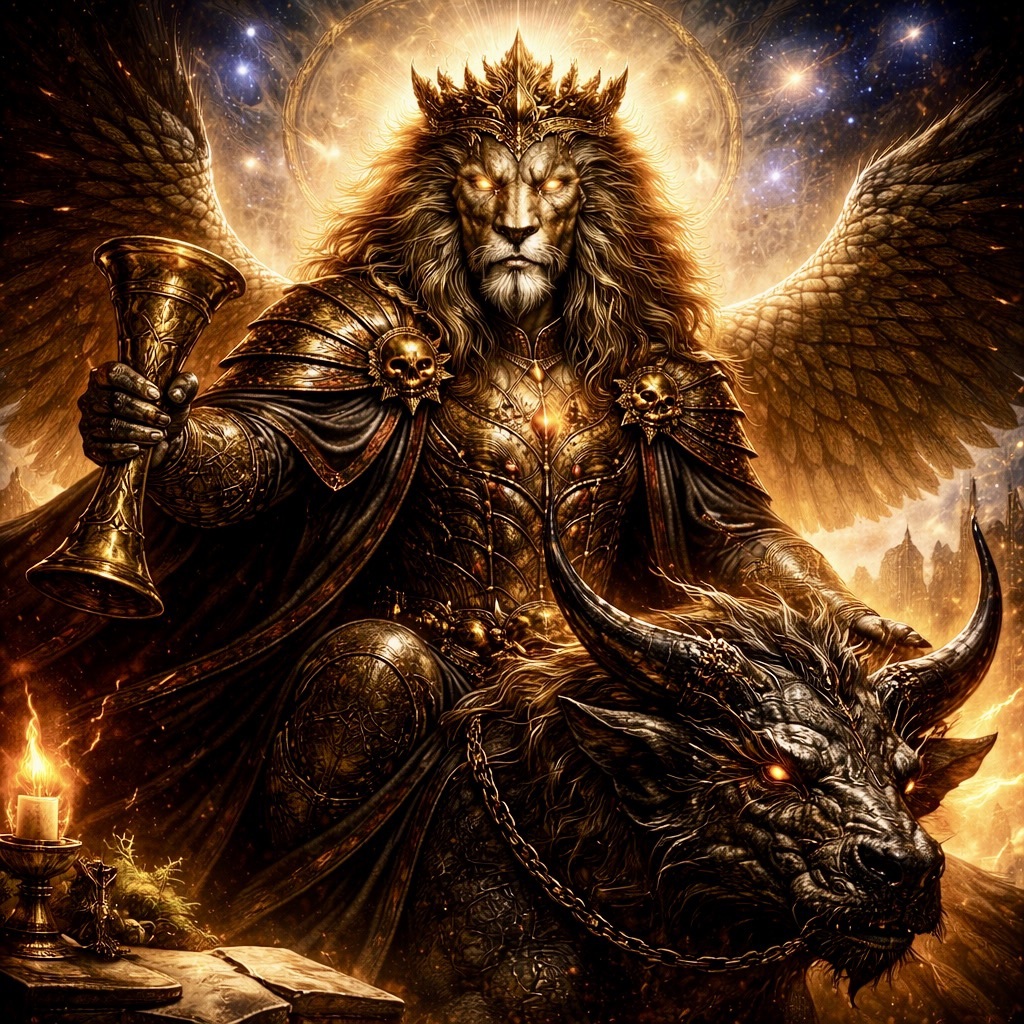
Purson is a demon whose authority does not rely on fear, violence, or spectacle, but on revelation. In the Ars Goetia, Purson is named as a Great King of Hell, commanding twenty-two legions and often appearing with the face of a man and the body of a lion, sometimes riding a fierce beast and crowned to signify his rank. This form is deliberate and symbolic. Purson is not a servant, a trickster, or a destroyer. He is a sovereign of knowledge, and what he governs is the act of uncovering.
Purson’s defining power is his ability to reveal hidden things. He answers questions about the past, present, and future, exposes secrets long buried, and reveals truths that others have worked very hard to conceal. Unlike demons who manipulate perception, Purson removes it. He does not distort reality. He clarifies it, often to devastating effect.
The lion body associated with Purson represents authority, confidence, and dominance over territory. Lions do not sneak. They occupy space openly. Purson’s revelations work the same way. When he exposes something, it cannot be quietly reburied. Once known, it becomes part of the landscape. The human face, by contrast, represents consciousness, judgment, and moral awareness. Purson knows what he is revealing and understands the consequences of that knowledge.
This combination makes Purson uniquely unsettling. He does not plead ignorance. He does not claim inevitability. He reveals truth with full awareness that truth is not always welcome, healing, or safe.
Purson is also associated with astrology and the movements of celestial bodies. This connection reinforces his role as a revealer rather than a manipulator. He does not invent futures. He observes patterns already in motion. His knowledge feels less like prophecy and more like exposure of momentum. Under Purson, fate is not mystical destiny. It is accumulated consequence.
Psychologically, Purson represents the human drive to know what lies beneath appearances, even when knowing carries risk. He governs curiosity that refuses to be satisfied with surface explanations. Under Purson, secrets become intolerable. Silence becomes suspicious. The unknown demands illumination.
Unlike demons who trade in desire or fear, Purson trades in certainty. He gives answers that remove ambiguity. This is both a gift and a curse. Ambiguity provides comfort. It allows hope, denial, and flexibility. Purson strips that away. What remains is clarity—and responsibility.
Purson’s status as a King is important. Kings rule domains that persist. Purson’s domain is not a single emotion or act, but an enduring process: the exposure of truth. He governs not just the moment of revelation, but the aftermath. Once something is known, systems reorganize around it. Relationships change. Power shifts. Purson understands this ripple effect and does not intervene to soften it.
In demonological texts, Purson is said to speak with a clear and pleasant voice. This detail is critical. His truths are not screamed or forced. They are spoken calmly, even gently. This makes them harder to dismiss. Purson does not sound like an enemy. He sounds like someone who assumes you are ready to know.
Purson also reveals hidden treasures. This trait is often interpreted materially, but it carries a deeper meaning. Treasure is anything of value that has been concealed—knowledge, leverage, memory, or truth. Under Purson, buried value resurfaces. What was hidden for safety or advantage is brought into the open.
There is an ethical tension embedded in Purson’s power. Revelation is not inherently good. Secrets exist for reasons. Some protect the vulnerable. Some preserve stability. Purson does not evaluate motive. He reveals regardless. This makes him dangerous in environments where exposure causes harm alongside clarity.
In modern symbolic terms, Purson resembles investigative journalism, whistleblowing, intelligence gathering, and radical transparency. He is present wherever hidden systems are exposed and the public is forced to confront realities it would rather ignore. Like Purson, these forces often claim neutrality while triggering upheaval.
Purson does not incite rebellion or chaos directly. He allows truth to do the work. This is more effective. People react more strongly to exposed reality than to imposed change. Purson understands that once knowledge enters a system, control dissolves.
The beast Purson rides reinforces dominance over revelation. He is not overwhelmed by what he reveals. He commands it. Secrets do not frighten him. He treats them as assets, not dangers. This composure distinguishes him from demons who thrive on panic.
Purson’s association with time—past, present, and future—makes his revelations comprehensive. He does not isolate events. He contextualizes them. Under Purson, patterns emerge. Lies unravel not individually, but structurally.
There is no comfort in Purson’s truth. He does not promise resolution, forgiveness, or peace. He assumes that knowing is its own justification. What follows is the responsibility of those who now see clearly.
Purson’s endurance in demonology reflects a deep human contradiction. People crave truth and fear it simultaneously. They demand transparency and recoil from its consequences. Purson embodies that tension without apology.
To engage with Purson symbolically is to accept that some knowledge cannot be unlearned and some doors cannot be closed once opened. He does not warn you away. He assumes consent in the act of asking.
Purson is not the demon who creates secrets. He is the demon who ends them.
Once he speaks, the silence never returns.