
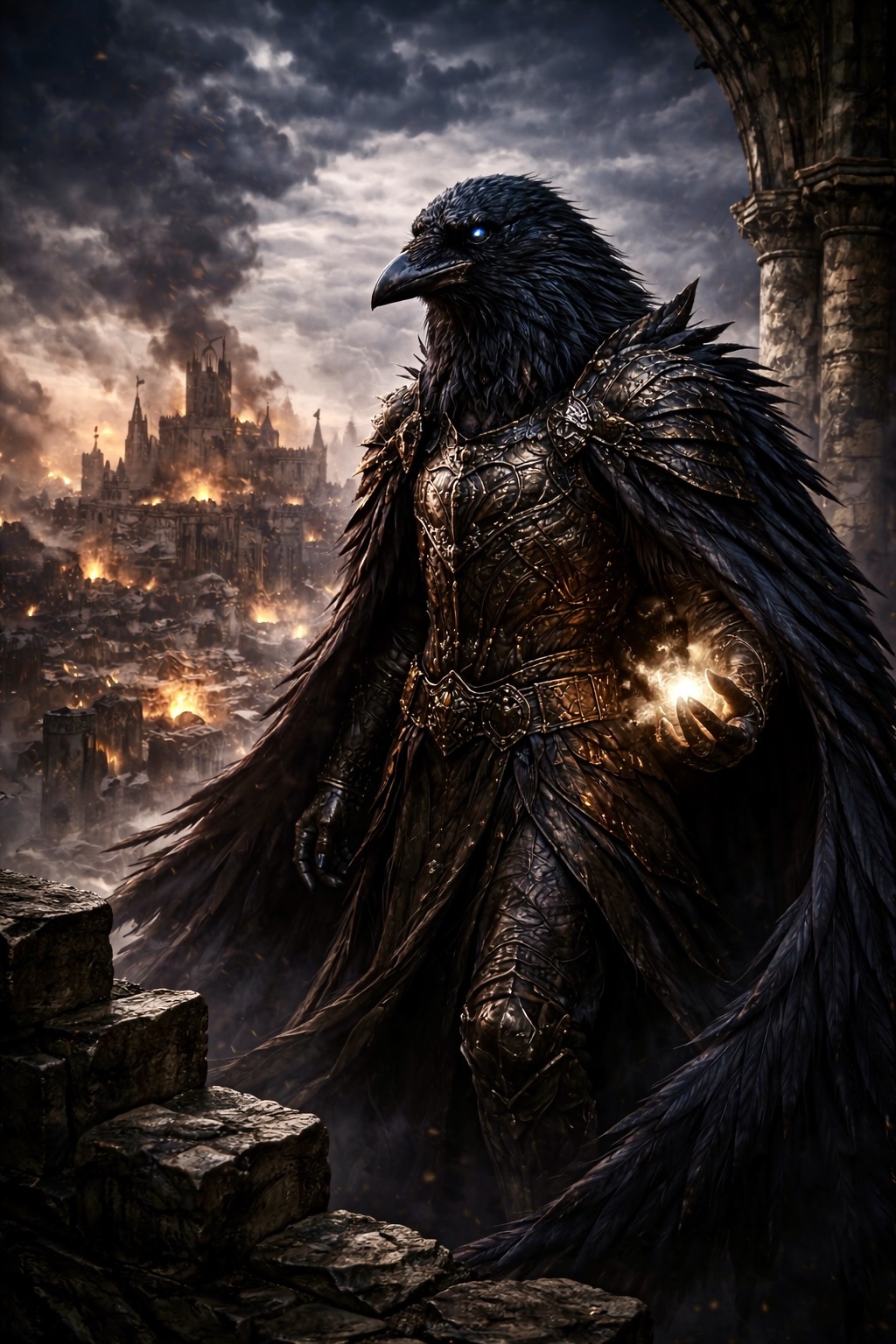
There is something unsettling about a raven that does not merely watch, but remembers. Throughout history, ravens have been omens—perched on battlefield banners, circling above fallen kings, lingering on the edges of human catastrophe. In the shadowed catalog of spirits found within the Lesser Key of Solomon, that ominous bird takes shape as Raum, a Great Earl of Hell who commands thirty legions of spirits and appears in the form of a raven before assuming human shape at the magician’s command.
Raum’s entry in the Ars Goetia is brief yet loaded with implication. He steals treasures from kings’ houses, carries them wherever commanded, destroys cities and dignities, reveals past, present, and future, and reconciles friends and foes. Few demons in the Goetia straddle such seemingly contradictory roles. He is both destroyer and diplomat, thief and revealer, omen and architect of political upheaval.
Earlier demonological traditions, including the Pseudomonarchia Daemonum compiled by Johann Weyer, preserve Raum’s identity as a spirit of disruption and revelation. Across these texts, certain elements remain constant: the raven form, the theft of royal wealth, the overthrow of structures, and the peculiar ability to restore harmony between enemies.
The raven is no accidental symbol. In European folklore, ravens are intelligent, opportunistic, and eerily observant. They gather around battlefields not because they cause death, but because they anticipate it. In Norse mythology, Odin’s ravens—Huginn and Muninn—flew across the world gathering knowledge. The bird thus became associated not only with death but with insight. To depict Raum as a raven is to embed him within that lineage of ominous intelligence.
Raum’s ability to steal from kings is more than literal burglary. Kings represent authority, order, stability. To rob a king is to undermine sovereignty itself. In medieval Europe, the idea of royal treasure symbolized the health of the kingdom. Gold was not just currency; it was legitimacy. For a demon to infiltrate that sanctum and remove wealth was to shake the foundation of governance.
And yet, Raum does not merely steal—he destroys cities and dignities. That phrasing carries weight. Cities are centers of culture and commerce. Dignities represent titles, honors, hierarchies. Raum’s domain is structural collapse. He topples institutions as easily as he empties vaults.
But here lies the fascinating paradox: he also reconciles friends and foes. In a catalog filled with spirits that inflame conflict, Raum can restore harmony. It suggests that destruction and reconciliation are not opposites but parts of a cycle. Sometimes structures must fall for alliances to be remade. Sometimes the theft of power exposes corruption and makes reconciliation possible.
Psychologically, Raum can be understood as the archetype of radical truth. Ravens do not avert their gaze. They consume what others refuse to look at. In human terms, Raum embodies the force that exposes hidden decay within institutions. He tears down facades. He reveals uncomfortable truths. And in doing so, he destabilizes.
The fact that he reveals past, present, and future further aligns him with the raven’s reputation for watchfulness. Knowledge across time is destabilizing. When illusions are stripped away, dignities fall. Raum’s revelation is not gentle enlightenment; it is disruptive clarity.
There is something deeply political about Raum’s mythology. He moves within courts and cities, within treasuries and alliances. Unlike elemental spirits who command wind or sea, Raum commands the structures humans build. He is not nature’s chaos; he is civilization’s fault line.
The ritual tradition surrounding Raum emphasizes control and authority. Like many Goetic spirits, he obeys when properly constrained within sacred boundaries. That detail underscores a central theme in demonology: chaos is harnessed through structure. The magician’s circle mirrors the city’s walls. Without boundaries, disruption spreads unchecked.
The raven form also invites reflection on transformation. Ravens are scavengers but also problem-solvers. They adapt. Raum’s ability to shift from raven to human shape at command suggests fluidity between omen and actor. He observes and then intervenes.
In modern interpretation, Raum may symbolize whistleblowers, reformers, or disruptive innovators—forces that dismantle established systems while revealing deeper truths. The destruction he causes is not necessarily nihilistic; it may clear space for new alliances.
Yet the darker undertone remains. To destroy a city is to bring suffering. To strip dignities is to humiliate. Raum’s power is not inherently benevolent. It is destabilizing. Whether that destabilization leads to renewal or ruin depends on context.
The number of legions he commands—thirty—places him among influential earls within the Goetic hierarchy. Thirty suggests scale and reach. Raum’s influence extends beyond isolated acts. He is systemic disruption.
The raven’s cry has long been associated with foreboding. Hearing it at dawn on a battlefield would chill even hardened soldiers. Raum carries that chill into the political sphere. When institutions grow complacent, when kings hoard wealth and ignore decay, the raven appears.
In literature and art, ravens often symbolize memory and prophecy. They are creatures of the threshold—between life and death, order and collapse. Raum inhabits that threshold. He does not merely tear down; he signals transition.
The ability to reconcile enemies is perhaps his most intriguing trait. It suggests diplomacy born of disruption. When structures collapse, individuals must negotiate anew. Raum clears the old stage so new dialogue can begin.
There is something hauntingly contemporary about him. In a world of shifting power structures, economic instability, and institutional mistrust, Raum feels less medieval and more symbolic of ongoing cycles. Systems rise, grow rigid, collapse, and reform.
And perhaps that is why his legend endures. He is not simply a demon of theft. He is the raven that watches empires falter. He is the whisper in the throne room that power is not permanent. He is the shadow over the treasury door.
To imagine Raum perched atop a crumbling tower is to visualize inevitability. No structure stands forever. No dignity is immune to scrutiny. Yet from ruin comes renegotiation. From exposed truth comes reconciliation.
Raum is both omen and outcome. He is the collapse that precedes renewal and the revelation that forces uncomfortable growth. In the end, he reminds us that stability without vigilance invites decay—and that sometimes the raven must fly before the kingdom remembers its fragility.