
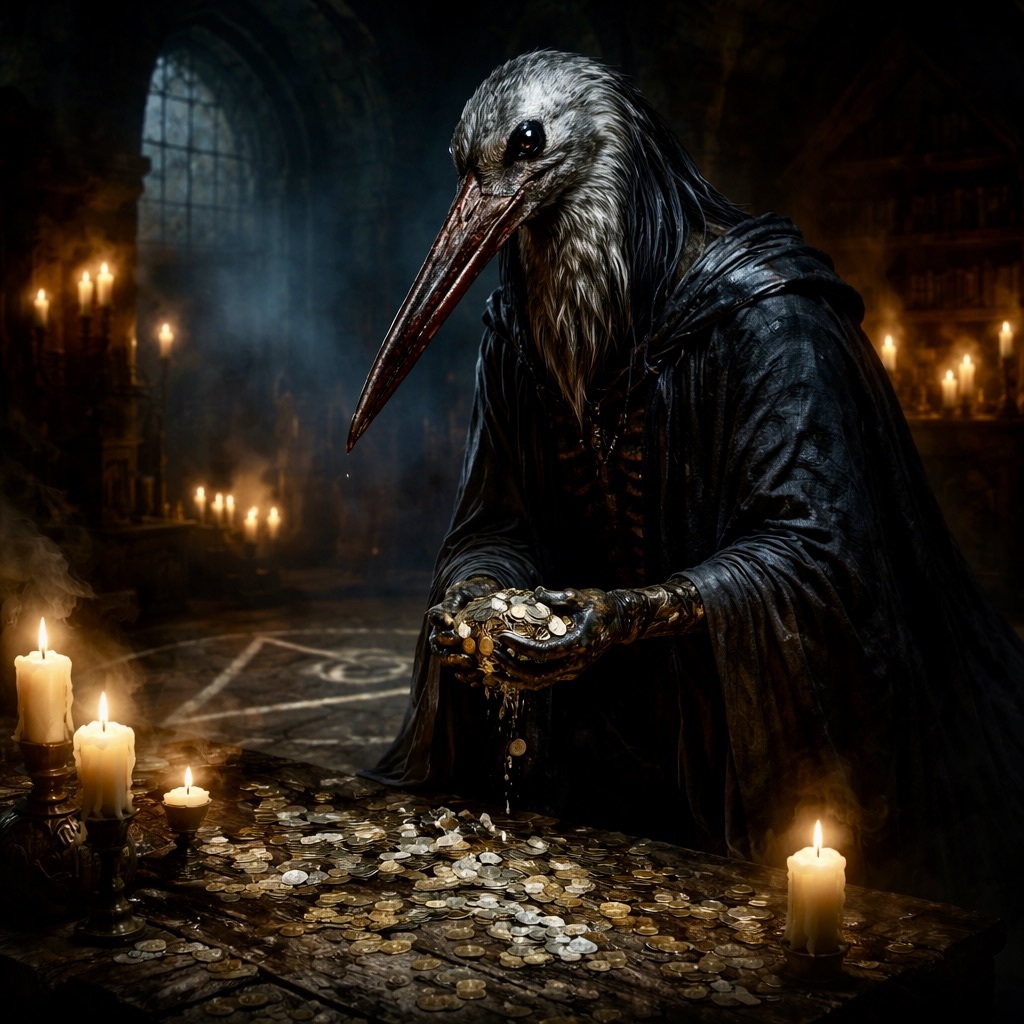
There is something uniquely unsettling about a demon who does not rage, does not roar, and does not promise kingdoms or forbidden love—but instead slips quietly into the world to steal what you thought was secure. Shax is not the lord of fire or the master of storms. He is subtler than that. In the old grimoires, especially within the pages of the Lesser Key of Solomon, Shax appears as a Great Marquis of Hell, commanding thirty legions of spirits. His description is brief but chilling: he steals money from kings, carries it away to distant lands, and—perhaps most disturbingly—takes away sight, hearing, and understanding from those he deceives.
Unlike the grander figures of infernal mythology, Shax does not seduce through power. He destabilizes through absence. He removes. He subtracts. He empties vaults, clouds perception, and erodes certainty. In a world that values accumulation and clarity, Shax represents the terror of loss and confusion.
In the Ars Goetia, Shax is depicted as appearing in the form of a stork, speaking with a hoarse and subtle voice. The image itself is strange—why a stork? The stork has long associations with migration, distance, and silent observation. It stands motionless before striking with precision. That symbolism aligns perfectly with Shax’s reputation. He is not chaotic. He is deliberate. He waits. He watches. Then he takes.
Earlier references to Shax appear in the Pseudomonarchia Daemonum, compiled by Johann Weyer. Weyer’s work, though skeptical in tone, preserved many of the demonological hierarchies that later grimoires expanded upon. In these writings, Shax’s abilities are emphasized not as theatrical displays of hellfire but as calculated acts of theft and deception. He steals horses. He steals money. He removes hearing and sight unless constrained by ritual authority.
What makes Shax particularly compelling in modern interpretation is how psychological he feels. In medieval Europe, literal theft of treasure and livestock was catastrophic. To lose a horse meant losing transportation, livelihood, perhaps survival. To lose gold meant instability and disgrace. But to lose sight and hearing? That implied something more insidious: a stripping away of perception itself. In a symbolic sense, Shax embodies cognitive distortion. He clouds judgment. He fosters misunderstanding. He makes people certain of falsehoods.
If one reads between the lines of the old texts, Shax is not merely a supernatural burglar; he is the archetype of misdirection. He is the voice that convinces a king his treasury is secure while quietly emptying it. He is the influence that assures someone they see clearly when, in fact, they have been blinded by their own assumptions.
The rituals associated with summoning Shax in the grimoires are precise and cautious. Practitioners are warned that he is deceptive and may lie unless constrained within a proper magical triangle. This emphasis on containment speaks volumes. Even within demonological systems—where manipulation is expected—Shax is flagged as particularly unreliable. He does not simply obey; he misleads. He promises what he does not intend to deliver.
This trait distinguishes him from demons whose domains are more transactional. Shax is not a straightforward bargain-maker. He is closer to a trickster. His power lies in exploiting trust. In that sense, he reflects a universal human anxiety: the fear that what we rely upon—our senses, our savings, our understanding—can quietly vanish.
There is also an economic undertone to Shax’s mythology that feels strikingly modern. The idea of wealth disappearing into distant lands echoes contemporary concerns about financial instability, hidden transactions, and unseen hands manipulating markets. In the medieval imagination, that uncertainty became personified. It became Shax. Rather than abstract systems, people envisioned a marquis of Hell quietly relocating riches across borders.
And yet, like many Goetic spirits, Shax is not entirely malevolent in all interpretations. When properly commanded, he is said to reveal hidden things and return stolen goods. That duality is fascinating. The same force that obscures can clarify. The same entity that steals can restore. It suggests that Shax’s domain is not merely theft, but the control of access. He governs who sees and who does not, who possesses and who loses.
From a psychological lens, Shax can be understood as the embodiment of internal sabotage. We all experience moments when clarity vanishes. We misplace important things. We misunderstand people we love. We act against our own interests. The medieval world externalized those experiences into demons. Shax became the explanation for the inexplicable loss, the sudden confusion, the inexplicable drain of resources.
The stork form adds another layer of symbolism. Storks migrate great distances, disappearing with the seasons and returning without warning. They are creatures of transition. To envision Shax as a stork suggests movement—wealth traveling, perception shifting, certainty migrating away. The hoarse voice described in the grimoires evokes something whispering at the edge of awareness, not commanding but suggesting.
There is something deeply unsettling about a demon who does not need spectacle. Shax operates in quiet erosion. He undermines foundations without dramatic collapse. By the time you notice, the vault is empty. The senses are dulled. The understanding is gone.
And yet, perhaps that is precisely why Shax endures in modern occult discussions. He represents an anxiety that has never faded. We fear losing what we cannot immediately replace. We fear being deceived without realizing it. We fear blindness more than darkness, because blindness implies something has been taken.
In contemporary demonology circles, Shax is sometimes approached as a spirit of revelation through inversion. By confronting the archetype of loss, practitioners seek to sharpen awareness. If Shax clouds understanding, then awareness becomes the defense. If Shax steals wealth, then vigilance becomes the shield. In this way, the demon becomes a mirror—reflecting our vulnerabilities.
Whether one interprets Shax as literal spirit, psychological archetype, or symbolic narrative, his presence in the Goetia stands as a reminder of fragility. Wealth can disappear. Perception can falter. Certainty can dissolve. The medieval magicians who wrote of him were not merely cataloging monsters; they were articulating fears that remain painfully relevant.
Shax is not the loudest name in demonology. He does not command legions of pop culture fascination like Lucifer or Asmodeus. But there is something more intimate about him. He lingers in the spaces where confidence meets complacency. He waits where assumption replaces scrutiny.
And perhaps that is why his legend persists. Because somewhere, in every era, someone opens a ledger and finds it lacking. Someone realizes too late that they misunderstood what stood before them. Someone discovers that what they trusted has quietly slipped away.
Shax is the whisper that precedes that discovery.