
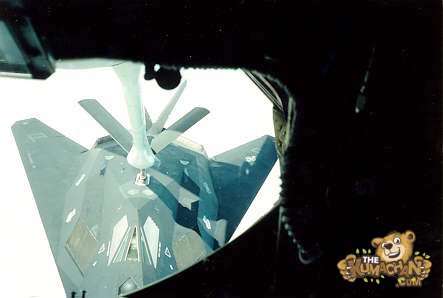
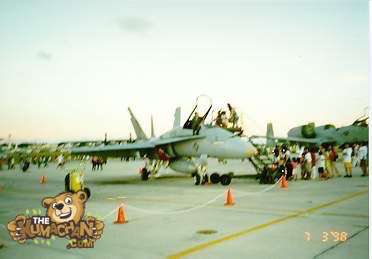
There’s something awe-inspiring about the sight of a fighter jet up close. The roar of engines, the sleek lines that seem sculpted for speed, the feeling of raw power wrapped in metal and advanced engineering — all of it combines to create a sense of wonder, intimidation, and admiration. For many, fighter jets are not only machines of war but symbols of human ambition and ingenuity, proof that mankind is willing to push technology to the very edge of what’s possible in order to dominate the skies. I remember two moments in particular that captured this spirit. The first was a photograph of an Air Force F-117 stealth fighter, taken during an aerial refueling. The perspective, looking out the back of a KC-135 tanker, shows the Nighthawk’s sharp, angular body — a machine designed not for beauty but for invisibility. Its black skin swallows the sunlight as it connects with the boom, a surreal ballet performed miles above the earth where any mistake could mean disaster. The second moment was far more grounded, but no less striking. At Kadena Air Base in Okinawa, Japan, I stood among families and festivalgoers at the annual “Friendship Festival.” There on the tarmac was a Navy F-18 Hornet, gleaming in the sun as children climbed onto their parents’ shoulders to get a better view. Static displays may not have the adrenaline of an in-flight performance, but they offer something just as valuable: the chance for ordinary people to stand a few feet away from the aircraft that define modern air combat, to marvel at their size, precision, and presence. These two images — one in the air, one on the ground — reflect the dual nature of fighter jets. They are machines of war, sharpened to lethal efficiency, but they are also ambassadors of technology, culture, and power. To understand fighter jets is to look at history, innovation, and humanity itself.
Fighter jets didn’t spring into existence fully formed. They are the descendants of the first fragile biplanes of World War I, where pilots strapped machine guns to wooden frames covered in canvas. Back then, the “knights of the sky” engaged in dogfights that were as much about daring as they were about strategy. Technology was primitive, but the concept was clear: controlling the skies meant controlling the battlefield. After World War II, with the introduction of the jet engine, everything changed. Aircraft that once maxed out at 300 mph could now surpass 600 mph, and within a decade, they were breaking the sound barrier. The world had entered the jet age, and the definition of what a fighter could do had to be rewritten. The Cold War supercharged fighter jet development. The United States and the Soviet Union poured billions into building aircraft that could out-fly, out-fight, and out-last one another. The F-86 Sabre and MiG-15 clashed over Korea, showcasing the first large-scale jet-to-jet dogfights. Later, the F-4 Phantom II and MiG-21 defined Vietnam’s aerial battles. Each encounter was a test not only of pilot skill but of the technological edge held by their nations.
Out of this competition came advances in radar, missiles, and stealth. The U.S. bet heavily on electronics and avionics, creating aircraft that were not just faster but smarter. The Soviets, meanwhile, emphasized ruggedness and maneuverability. This divergence created iconic aircraft on both sides — from the American F-14 Tomcat and F-15 Eagle to the Soviet Su-27 Flanker and MiG-29 Fulcrum. When the F-117 Nighthawk appeared in the 1980s, it looked like something out of science fiction. All flat panels and jagged edges, it wasn’t built to look sleek but to scatter radar waves. The idea was revolutionary: make the jet hard to see, and you control the fight before it even begins. The Nighthawk proved itself in combat during the Gulf War, slipping through defenses to strike targets with precision. Though retired now, it marked the beginning of a new era. Stealth became the standard, leading to aircraft like the F-22 Raptor and F-35 Lightning II — jets designed to dominate not only through speed and firepower but by vanishing into the electronic fog of modern warfare.
One of the often-overlooked aspects of fighter operations is aerial refueling. Without it, even the most advanced fighter is tethered to its home base. The photo of the F-117 connecting with a KC-135 is a reminder that every sortie depends on a network of support. Refueling is an art form — precise, dangerous, and essential. It’s easy to romanticize the lone fighter soaring through the skies, but the truth is no jet operates alone. Tankers, AWACS, and maintenance crews form the backbone of airpower. The jet may get the glory, but it’s the system around it that makes the mission possible. Despite all the technology, fighter jets are only as good as the pilots who fly them. These men and women endure grueling training, learning not only to master complex systems but to handle the physical punishment of high-G maneuvers. At nine times the force of gravity, even breathing becomes a challenge. Pilots often describe their first solo supersonic flight as life-changing. The world blurs, the cockpit shakes, and for a moment they are riding on the edge of human capability. It’s no wonder fighter pilots hold a special place in both military and popular culture.
Movies like Top Gun aren’t just entertainment — they’re reflections of the awe that society feels toward those who strap themselves into jets that can climb like rockets and turn tighter than the human body was ever meant to endure. Beyond the battlefield, fighter jets serve as powerful symbols. When a formation screams overhead during a national holiday or an airshow, it’s not just about entertainment. It’s a statement of pride, strength, and identity. Nations invest in these displays because they know the sight of a jet pulling a vertical climb or breaking the sound barrier leaves an impression no speech could match. The F-18 at Kadena’s Friendship Festival wasn’t just a machine on display. It was a reminder of the alliance between the U.S. and Japan, a symbol of trust, and an opportunity for ordinary people to connect with extraordinary technology. Children pointing at the jet with wide eyes aren’t thinking about geopolitics — they’re dreaming about possibility.
As technology marches forward, the fighter jet continues to evolve. The F-35 represents the current cutting edge: stealth, advanced sensors, and data fusion that turns the pilot into more of a conductor than a trigger-puller. Drones are entering the picture too, raising questions about whether the age of the human fighter pilot might one day end. Yet even as automation grows, the fighter jet remains a symbol that resonates. It represents daring, speed, and the eternal desire to dominate the skies. Whether piloted by humans or controlled remotely, fighter aircraft will continue to define the boundaries of military and technological power.
From the fragile wood-and-canvas biplanes of World War I to the stealthy, sensor-laden jets of today, the evolution of fighter aircraft tells the story of humanity’s quest to push boundaries. They embody both the destructive power of war and the inspirational power of innovation. For me, the memory of the F-117 refueling high above the earth and the F-18 gleaming at Kadena’s Friendship Festival encapsulates this duality. One image speaks of secrecy, power, and precision; the other of openness, community, and wonder. Together, they remind us that fighter jets are more than machines — they are experiences, symbols, and stories written across the sky.