
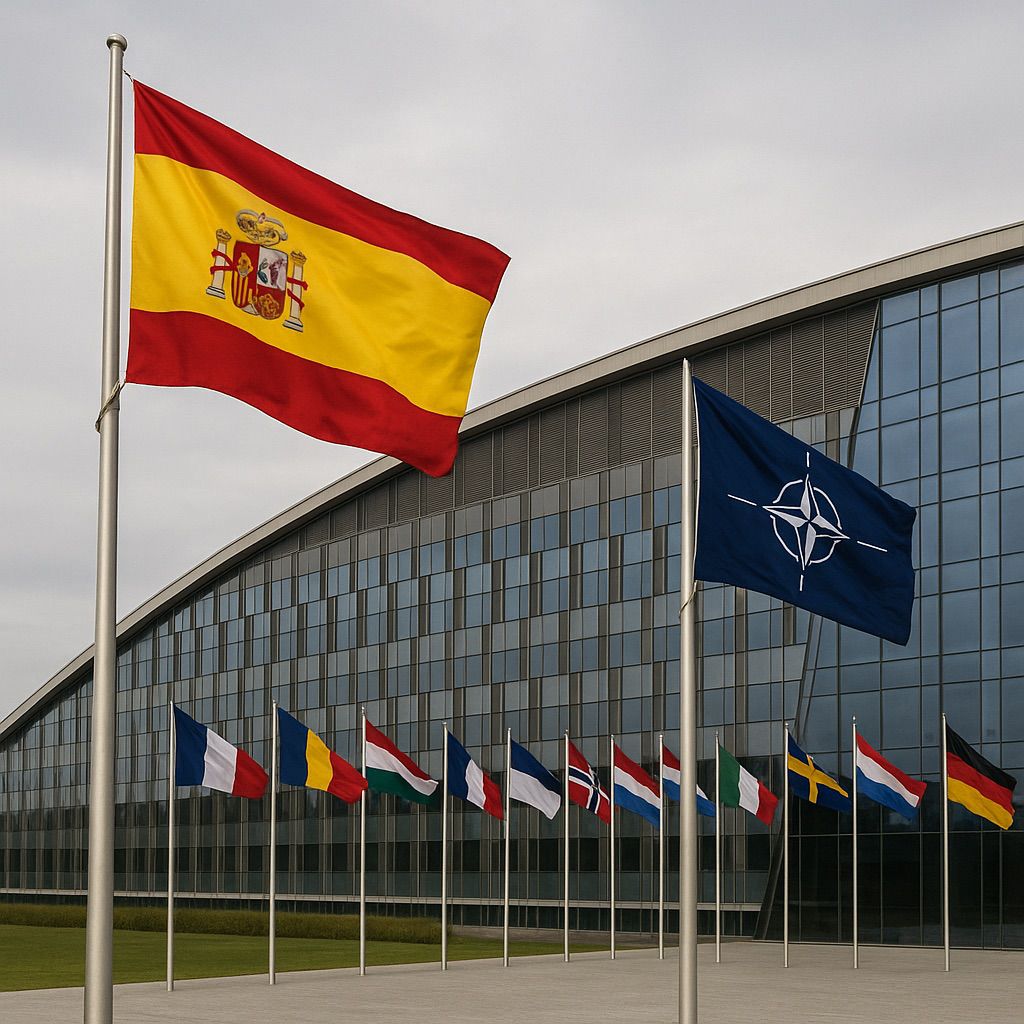
When Spain formally joined NATO on May 30, 1982, it marked far more than a diplomatic shift or a treaty signature. It was a moment when a country emerging from decades of dictatorship finally stepped onto the world stage ready to claim its place among modern democracies. For Spain, NATO membership symbolized legitimacy, stability, and a new identity—one rooted not in isolation but in cooperation, not in authoritarianism but in partnership, and not in fear but in collective security. It was the culmination of years of transformation, political courage, and public debate, and it reshaped the nation’s relationship with Europe, the United States, and its own future.
To understand the weight of Spain’s NATO entry, one must remember the Spain that existed before. For nearly forty years, the country had been under the rule of Francisco Franco, whose regime kept Spain politically isolated and ideologically distant from Western alliances. While much of Western Europe rebuilt through cooperation, trade blocs, and defense treaties after World War II, Spain stood apart—connected economically in some places, culturally in others, but strategically estranged. Franco’s Spain maintained a complex relationship with the United States, hosting American bases but remaining outside the defense structures of Europe. The North Atlantic Treaty Organization, founded in 1949 to defend the democratic West from Soviet expansion, represented a world that Spain could observe but not enter.
Everything changed after Franco’s death in 1975. The country embarked on what would become one of the most peaceful, ambitious democratic transitions in modern history. The political landscape was transformed by free elections, a new constitution, the restoration of civil liberties, and the birth of a multiparty parliamentary system. But democracy, fragile as it was in those early years, required international reinforcement. It needed external signals of legitimacy. And NATO membership offered exactly that.
Still, the idea of joining NATO sparked fierce debate across Spain. Many Spaniards were wary of entangling the country in Cold War alliances after so many years of authoritarian rule. Others feared that NATO membership would drag Spain into foreign conflicts or compromise its sovereignty. Left-wing parties, newly empowered after decades underground, campaigned against the idea. The center-right government, however, argued that joining NATO would anchor Spain within the Western democratic community and stabilize civil-military relations, which were still delicate after a failed coup attempt in 1981.
As political leaders argued, diplomats negotiated. The United States and Western European countries strongly supported Spanish membership. They saw Spain as strategically vital—a nation positioned at the gateway between the Atlantic and the Mediterranean, controlling maritime passages essential to NATO’s defensive posture. For the alliance, admitting Spain meant strengthening southern European security. For Spain, joining NATO meant stepping confidently into an international role that had been denied for generations.
When the announcement finally came in 1982, it reflected years of planning, persuasion, and perseverance. Spain would become the sixteenth member of NATO. The news sent ripples across Europe. Leaders in Brussels and Washington applauded. European newspapers debated the implications. Spanish citizens reacted with a mix of pride, concern, relief, and resistance. It was a decision that reshaped political alliances within the country and set the stage for a national referendum to reaffirm membership four years later.
But on May 30, 1982, what mattered most was what the moment represented. After decades of isolation, Spain was no longer an outsider. It stood shoulder to shoulder with nations that valued democracy, defense cooperation, and shared responsibility for peace. Inside government buildings, diplomats celebrated quietly as Spain’s flag was raised alongside those of other NATO members. In military academies, officers studied new protocols and prepared for integration with allied forces. In households across the country, citizens debated what this would mean for their sons, their taxes, and their country’s future.
The path forward wasn’t smooth. NATO membership continued to spark passionate political arguments in Spain, culminating in the 1986 referendum in which the public narrowly voted to remain in the alliance under specific conditions. The decision, though close, confirmed that Spain viewed its future as part of Europe, not apart from it. Over the next decades, Spain would modernize its armed forces, participate in NATO missions, and eventually join the European Union in 1986. Each step reinforced the geopolitical shift that had begun the day Spain entered NATO.
The country found itself increasingly involved in missions that reflected evolving global challenges: peacekeeping in the Balkans, humanitarian operations, counterterrorism efforts, and cooperative defense planning. These engagements helped redefine Spain’s military identity, shifting from a defensive posture rooted in dictatorship to a professional, modern, internationally integrated force.
Spain’s NATO membership also helped reforge its diplomatic relationships. Ties with Portugal strengthened. Relations with France deepened. Cooperation with the United Kingdom and Germany expanded. The partnership with the United States, already strong due to existing military bases, took on new dimensions of joint training, intelligence sharing, and strategic planning. Spain became not a passive participant but an active contributor to collective defense.
Looking back, it’s remarkable how much of Spain’s modern identity can be traced to that pivotal moment in 1982. NATO membership accelerated Spain’s political stabilization after the transition to democracy. It provided external reassurance against instability. It showcased Spain’s commitment to international cooperation. And it offered a framework through which the country could reshape its role in Europe and the Atlantic world.
For a nation emerging from decades of authoritarian rule, joining NATO was not merely a defensive decision. It was a declaration: Spain chose democracy. Spain chose partnership. Spain chose the future.
Today, Spain remains a committed NATO member, contributing to alliance missions, hosting critical infrastructure, and participating in joint operations worldwide. The concerns of 1982 have not vanished, but they have evolved. Spaniards now debate global security, cyber defense, European strategic autonomy, and NATO’s future role—conversations unimaginable during Franco’s era.
When Spain joined NATO, it stepped out of the shadow of isolation and into the bright, complicated arena of international responsibility. It marked the beginning of a new chapter—one defined not by fear or inwardness, but by connection, cooperation, and a willingness to stand with democratic allies in defending shared values.
On that day in 1982, when Spain’s flag rose among the banners of democracies committed to collective defense, a nation that had endured suppression, transition, and uncertainty finally took its place in the world—not as an observer, but as a partner.
It was more than a signature.
It was a transformation.