On November 22, 1963, the world seemed to slow its breath, as if instinctively sensing that something irreversible was about to occur. President John Fitzgerald Kennedy—young, charismatic, endlessly symbolic of a new American era—arrived in Dallas that morning with the kind of optimism that had become synonymous with his administration. The sun shone brightly on the motorcade route, the crowds leaned in with genuine enthusiasm, and there was a kind of electricity in the air that politicians dream of but rarely capture. Kennedy’s presence had that effect: he was at once familiar and larger than life, carrying with him not just policy goals or diplomatic ambitions, but the high-voltage energy of a nation that believed it could reinvent itself at any moment. No one lining the streets that day believed that before lunchtime, the country’s course would be jolted into one of the darkest chapters of its history—one that would be revisited, reanalyzed, and re-felt for generations.
The President’s trip to Texas had been, in many ways, just another political necessity in a country built on perpetual campaign cycles. Kennedy knew he needed stronger unity in the Democratic Party ahead of the coming election season, and Texas—with its complex blend of political factions and performance-driven expectations—was both an opportunity and a challenge. But if Kennedy felt any pressure, it never showed on his face. Photographs from the morning at Love Field capture him smiling with a sincerity that still stings the modern viewer, because we know what he didn’t. Jackie Kennedy, elegant in her now-iconic pink suit and pillbox hat, stands beside him with that quiet grace she carried so naturally, unaware that her life was just hours away from being violently rewritten.
Those first moments of the motorcade were almost idyllic. As the limousine rolled through Dallas, people waved American flags, children perched on the shoulders of their parents, and strangers cheered with a warmth that contradicted the city’s reputation for simmering political tensions. Kennedy waved back, sometimes leaning in as if to draw from the crowd’s energy. The President loved these moments—he often said he felt closest to the American people when he was out among them rather than behind a podium or inside a government office. His staff knew this well; they watched him with a careful mix of pride and protective worry, though nothing in that early afternoon hinted at the disaster that lay ahead.
As the motorcade approached Dealey Plaza—the now-infamous convergence of Elm Street, Main Street, and Houston Street—the crowds thinned slightly, and the cheering softened. It was a momentary lull, the kind that naturally occurs as a caravan transitions from one gathering point to another. No one noticed the open windows above street level, or if they did, they thought nothing of them. People in office buildings often paused to watch the President go by. A passing curiosity. A harmless tradition. And maybe that’s one of the cruelest truths of that day: so many details now seen as ominous were, in real time, utterly ordinary.
The first shot was confusing. Witnesses later described it in terms that contradict one another—some said it sounded like a firecracker, others like a motorcycle backfiring, still others like a whip cracking in the air. Sound behaves oddly in an open space surrounded by buildings, and Dealey Plaza was a kind of acoustic trap. But whatever that initial noise was, it caught people’s attention without yet causing panic. Even Secret Service Agent Roy Kellerman, seated in the front of the limousine, initially struggled to identify the source.
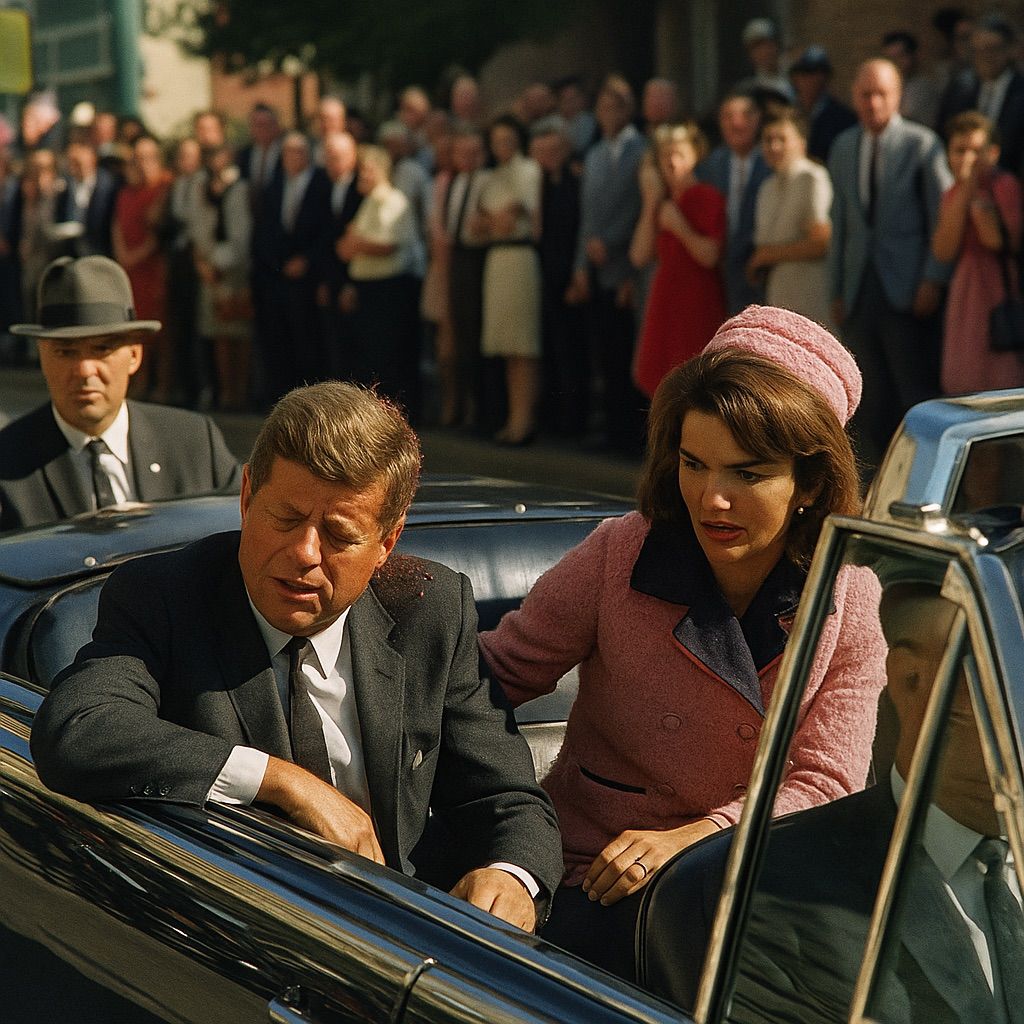
The second shot shattered the illusion that this was anything other than deliberate violence. A visible reaction rippled through the crowd; some people ducked immediately, others froze in terror. Jackie Kennedy turned toward her husband in confusion at the exact moment the third and fatal shot struck him. The brutality of that moment—the suddenness, the violence, the irreversible nature of it—has been replayed so many times in footage and retellings that we risk forgetting the raw humanity of it. The President of the United States, a man who had just moments earlier been waving to families and smiling at children, had been struck down in front of his wife, his staff, and his citizens.
And yet Jackie Kennedy, in that horrific moment, showed a level of composure and instinct that became its own heartbreaking legend. She reached out, not fully understanding what she was doing, driven only by an instinct to protect or to hold onto something that was slipping away. Secret Service Agent Clint Hill sprinted onto the limousine, throwing himself across the President and First Lady as the car accelerated toward Parkland Memorial Hospital. It was too late, but Hill’s actions were the embodiment of duty—an instinctive sacrifice, a desperate attempt to shield what remained.
At Parkland, chaos met urgency. Doctors and nurses rushed to the trauma bay with the full force of medical training and human hope, but the wound was beyond saving. When Kennedy was pronounced dead at 1:00 p.m., it was more than a medical statement; it was a rupture in American identity. A nation that had built so much of its self-image around Kennedy’s youth, optimism, and promise suddenly found itself drifting in uncertainty.
The ripple effect of the announcement was immediate and overwhelming. Across the country, radios interrupted broadcasts, televisions cut to emergency bulletins, and everyday life ground to a halt. People cried openly in the streets. Businesses paused operations. Schools lowered flags. There was a shared sense of disbelief that crossed demographics, regions, and ideologies. Even those who had been critical of Kennedy found themselves shaken by the news, because political disagreements were one thing—but the assassination of a sitting president was an attack on the country’s stability itself.
Then came the second shock of the day: Lee Harvey Oswald, the man identified as the alleged assassin, was arrested not long after the shooting. Oswald was a complex figure—ideologically tangled, personally volatile, and deeply unpredictable. His rapid arrest didn’t bring clarity; if anything, it opened the floodgates for questions, conspiracies, and permanent fractures in the public’s trust. What did he believe? Was he acting alone? Was there a larger plan? These questions still echo through American culture, and each theory reflects not just a curiosity about the facts, but a collective attempt to make sense of a tragedy that has never fully settled into certainty.
But there was no time to unpack those questions that afternoon. Vice President Lyndon B. Johnson, suddenly thrust into the highest office, was sworn in aboard Air Force One just hours after the assassination. Jackie Kennedy stood beside him, still wearing the blood-stained suit she refused to change out of. “I want them to see what they’ve done,” she reportedly said—one of the most haunting statements in American political history. The photograph of the swearing-in, taken inside the cramped cabin of the aircraft, is one of the most instantly recognizable images of the 20th century. It captures not only a constitutional transition, but the emotional shock of a country that had just experienced trauma on a national scale.
Kennedy’s body was flown back to Washington, where preparations began for what would become a funeral reminiscent of those of fallen leaders from centuries past. The procession through the capital was solemn, meticulous, and deeply symbolic. Black horses, muffled drums, rows of military honor guards, and the image of John F. Kennedy Jr.—still a young child—saluting his father’s casket created an emotional tableau that would define the national memory of that era. Jackie Kennedy, in widow’s black, walked with a dignity that both inspired and devastated those who witnessed it.
The funeral drew world leaders from across the globe, reflecting the international impact Kennedy had in his short presidency. Representatives from allies and adversaries alike stood side by side, a reminder that even in Cold War tension, Kennedy had managed to carve out a unique position on the world stage. He was a statesman who believed profoundly in diplomacy, in dialogue, and in the possibility of a more peaceful future. His death, therefore, was not just an American tragedy—it sent shockwaves through foreign capitals, disrupting delicate geopolitics and altering relationships in ways that historians still dissect today.
In the years that followed, the assassination became a defining moment in American cultural and political psychology. It symbolized the end of the post-war era of innocence, the beginning of a more skeptical, fractured time. The idealism of the early 1960s gave way to the turbulence of Vietnam, civil unrest, political assassinations, and distrust in government institutions. Kennedy’s death wasn’t just a single event—it was the spark that ignited a cascade of national introspection.
Yet JFK’s legacy also endured in surprisingly resilient ways. His speeches, famously eloquent and forward-looking, continued to inspire new generations. His encouragement to “ask what you can do for your country” became a touchstone for those who believed in civic duty. His commitment to the space program propelled the United States toward the moon landing in 1969, fulfilling a dream he articulated before it seemed remotely possible. And perhaps most poignantly, his belief in public service sparked millions to pursue work they felt could improve the world around them.
Today, more than six decades after the tragedy in Dallas, the memory of November 22 still lingers as an emotional fault line in the American story. It is a day that historians analyze, filmmakers revisit, archivists continually reinterpret, and citizens of all ages learn about as a turning point that reshaped the nation. It is a day marked by grief, confusion, and a collective sense of vulnerability. But it is also a day that reminds us of the fragility of leadership, the unpredictability of history, and the profound impact one individual can have on the soul of a country.
The legacy of John F. Kennedy is complex—an intersection of idealism, political challenges, personal flaws, and soaring vision. But despite the tragedy of his death, his influence never fully faded. Instead, his contributions, his charisma, and the hope he inspired remain woven into the fabric of American identity. His life, though cut short, continues to resonate. And his death, though devastating, remains a potent reminder of how quickly history can turn, how deeply a nation can feel loss, and how long a memory can endure.