
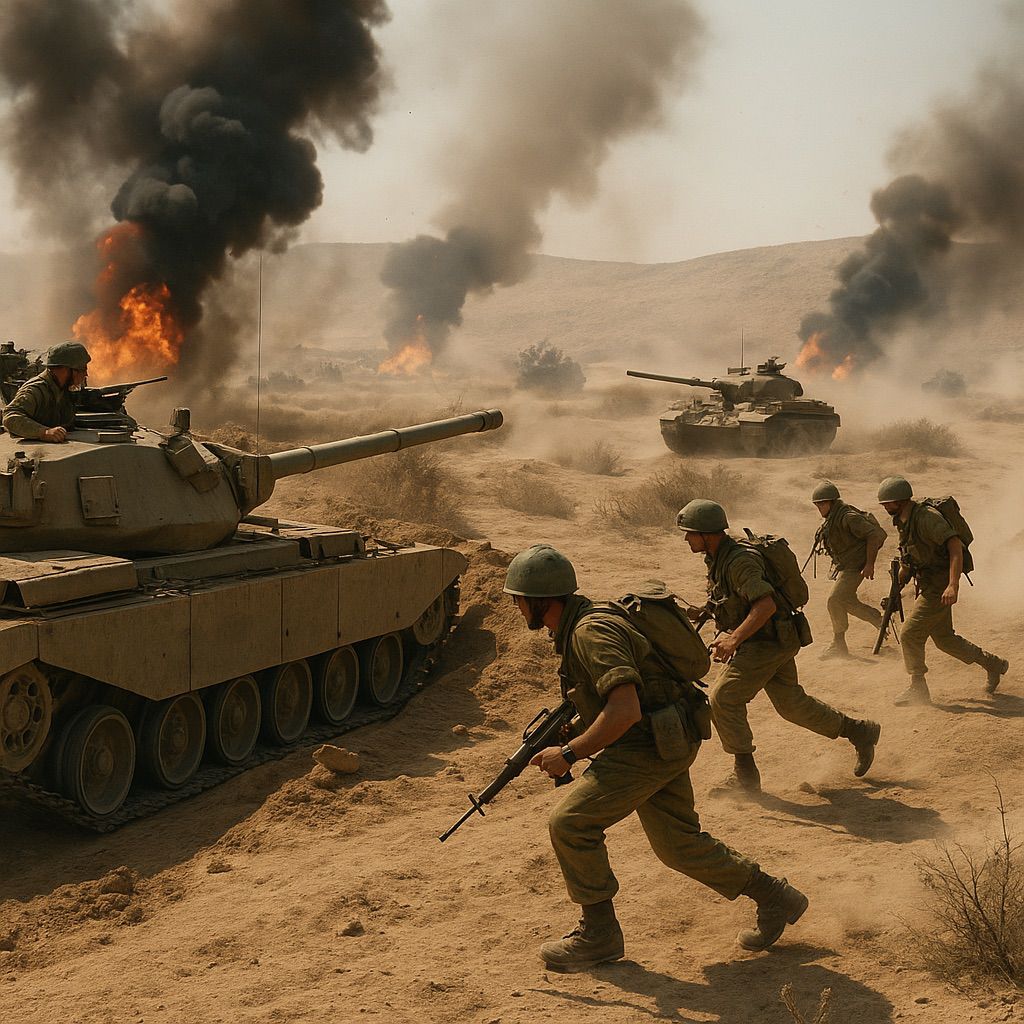
On October 6, 1973, while much of Israel stood in solemn silence for Yom Kippur—the holiest day in the Jewish calendar—the sound of shofars in synagogues was drowned out by the roar of jet engines, tank treads, and artillery fire. It was a day that began in fasting and prayer but descended into chaos and terror. The armies of Egypt and Syria, backed by allies across the Arab world, launched a coordinated surprise attack on Israel. For three weeks, the Middle East burned in one of the most brutal and consequential conflicts of the 20th century. The war would redraw not just battle lines but political realities, leaving scars that remain visible today.
The Yom Kippur War—known as the Ramadan War in the Arab world, as it coincided with the holy month of fasting—was unlike anything Israel had faced before. The timing was as devastating as the force. Yom Kippur is a day when the streets of Israel fall still, shops close, and people reflect inwardly on their faith and mortality. Military readiness was minimal; soldiers were home with families, generals at prayer. The Arab coalition, led by Egyptian President Anwar Sadat and Syrian President Hafez al-Assad, knew the symbolism of striking at such a vulnerable moment. It wasn’t just strategy—it was psychological warfare.
For Israel, the first hours were catastrophic. Egyptian forces stormed across the Suez Canal, overwhelming the thin Israeli defenses along the Bar Lev Line, a sand-and-concrete barrier that had seemed invincible. On the Golan Heights, Syrian tanks rolled across the plateau, threatening to break through and pour into northern Israel. For a nation only 25 years old, surrounded by hostile neighbors and haunted by the memory of the Holocaust, it felt as though the very existence of the state was on the brink.
The war was fueled by the ghosts of the Six-Day War of 1967, when Israel had stunned the Arab world by defeating multiple armies in less than a week, seizing Sinai, Gaza, the Golan Heights, and the West Bank. That humiliation burned in Arab memory. Egypt, in particular, longed to reclaim Sinai, and Sadat was determined to restore Arab pride, even if it meant gambling everything. Assad, ruling Syria with an iron hand, saw his chance to avenge the loss of the Golan. Together, they plotted carefully, coordinating with Soviet support in weapons and training, while the United States, Israel’s ally, watched warily from afar.
In those opening days, the world saw an Israel that bled, staggered, and nearly broke. Soldiers rushed from synagogues to battlefields, often without proper equipment or preparation. Casualties mounted at a terrifying pace. Families sat glued to radios, waiting for word of sons and daughters at the front. For the first time since its founding, Israel faced the terrifying prospect of defeat.
Yet Israel’s response was as fierce as it was desperate. Within days, its forces regrouped. On the Golan Heights, vastly outnumbered Israeli tank crews fought with tenacity, holding off wave after wave of Syrian armor in what became known as the “Valley of Tears.” At the Suez, after initial failures, Israeli counterattacks began to claw back territory. The war turned into a brutal stalemate, with both sides suffering immense losses.
It was also a war fought in the shadow of superpowers. The Soviet Union supplied Egypt and Syria, while the United States launched a massive resupply airlift to Israel. The two global titans teetered dangerously close to direct confrontation. Nuclear alerts were raised. For a terrifying moment, the Middle East threatened to drag the entire world into catastrophe.
As the days wore on, the war shifted. Israeli forces, under the command of General Ariel Sharon, crossed the Suez Canal in a daring maneuver, encircling Egypt’s Third Army and threatening Cairo. On the northern front, Israeli troops pushed Syrians back beyond the pre-war lines. By late October, a ceasefire brokered by the United Nations came into effect, leaving both triumph and tragedy in its wake.
The cost was staggering. Israel lost over 2,600 soldiers—an unbearable toll for such a small nation. Egypt and Syria’s losses were even greater, with tens of thousands dead and wounded. Civilians across the region bore the trauma of bombings, shortages, and fear. Yet amid the ashes, something remarkable emerged. Sadat, though unable to fully defeat Israel, proved his point: Egypt could fight and regain dignity. This opened the door to diplomacy, culminating in the historic Camp David Accords of 1978, where Egypt became the first Arab nation to make peace with Israel.
The Yom Kippur War was thus not just a clash of armies—it was a crucible of change. It reshaped alliances, humbled leaders, and showed that the Middle East could never be the same again. For Israelis, it was a painful reminder that survival was never guaranteed, that vigilance and resilience were as essential as prayer. For Arabs, it was proof that humiliation could be redeemed, that even in loss, dignity could be reclaimed. For the world, it was a sobering lesson in how quickly local conflicts could escalate into global crises.
And beyond politics and strategy lay the human heart of the war. Imagine a young Israeli soldier clutching his rifle on the Golan Heights, exhausted but refusing to yield. Picture an Egyptian crossing the Suez on makeshift bridges, carrying not just a weapon but decades of national humiliation. Picture families on both sides mourning sons lost to a war neither started nor truly understood. Behind the headlines, behind the maps and speeches, it was a war of human beings—ordinary men and women caught in the firestorm of history.
October 6, 1973, remains etched in memory as a day when faith met fire, when prayer was shattered by gunfire, and when the fragility of peace was laid bare for all to see. The Yom Kippur War was a tragedy, a turning point, and a paradox—born of hate, but eventually opening a path, however narrow, toward peace.