
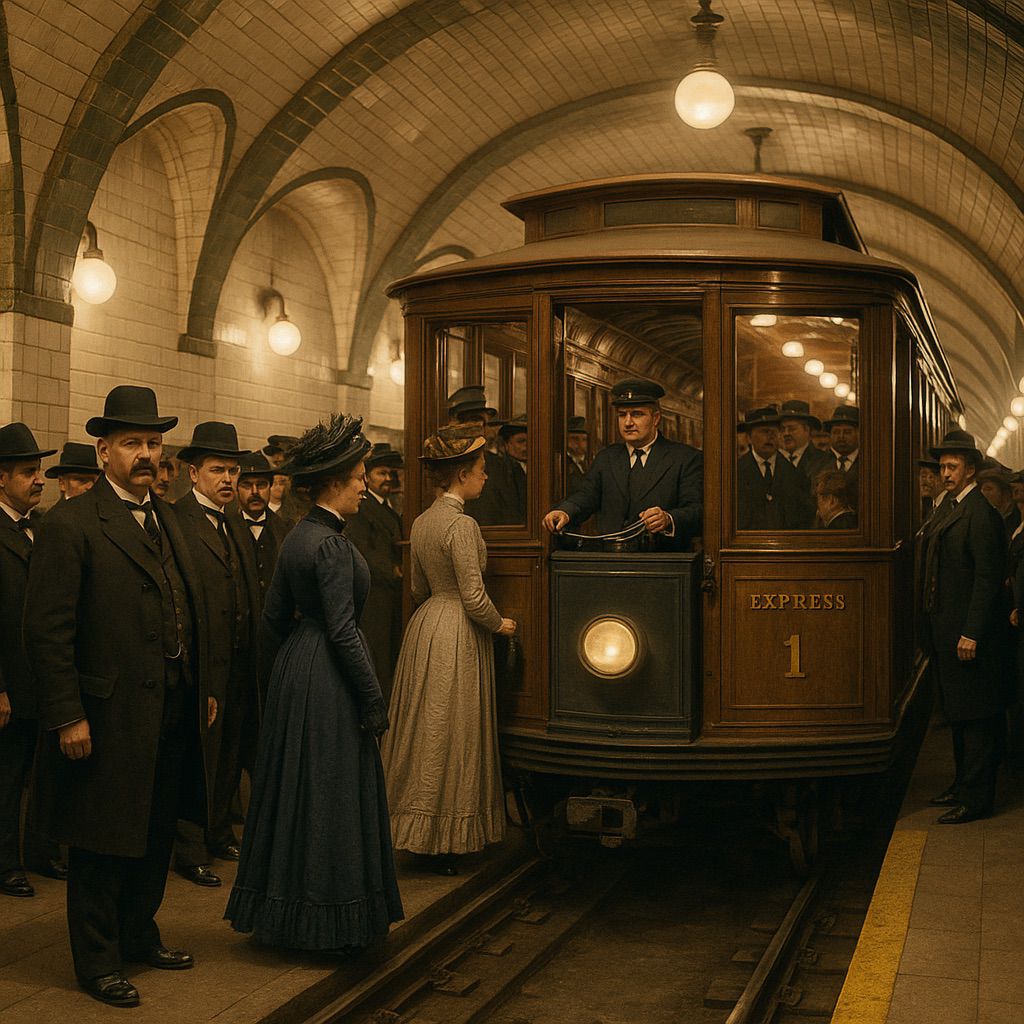
On October 27, 1904, New York City changed forever. That evening, with fanfare and excitement, the city opened its very first underground subway line, ushering in a new era of speed, mobility, and modernity. From City Hall in lower Manhattan, trains roared uptown beneath the bustling streets, carrying thousands of passengers on a ride that would redefine urban life. The New York subway was not merely a feat of engineering—it was a social revolution. It stitched together a growing metropolis, made the impossible commute suddenly practical, and gave millions a new sense of what it meant to live, work, and dream in the city that never sleeps.
At the dawn of the 20th century, New York was bursting at the seams. Its population had swelled to over three million, with immigrants arriving daily at Ellis Island, factories churning, and neighborhoods expanding in every direction. Elevated trains and streetcars carried some of the load, but the streets were jammed with carriages, trolleys, and pedestrians. Something radical was needed to break the gridlock. The idea of digging under the city had been floated for decades, but it took a mix of vision, politics, and determination to make it real.
That vision belonged to men like Abram Hewitt, a former mayor who championed rapid transit as essential for a modern metropolis. Construction was awarded to the Interborough Rapid Transit Company (IRT), led by August Belmont Jr., and engineering genius William Barclay Parsons designed the system. For years, workers toiled with picks, shovels, and dynamite, carving tunnels through rock, laying steel rails, and erecting tiled stations that glimmered with pride. The work was dangerous and backbreaking—an underground city built by immigrants, many of whom risked their lives in the dust and dark.
When the subway finally opened, the excitement was electric. At precisely 7 p.m., Mayor George B. McClellan Jr. himself acted as motorman for the inaugural ride, guiding the train from City Hall up to 145th Street. New Yorkers, clad in their finest, surged into the gleaming stations, marveling at the tiled arches, incandescent lights, and the thrilling speed of the cars. For just a nickel, passengers could travel miles in minutes—a revolution in mobility. That first night, more than 100,000 people rode the subway, their laughter and awe echoing through tunnels that would soon become arteries of the city.
But the story of the subway is not only about engineering and politics. It is about people. It is about the immigrant worker in 1904 who, for the first time, could live in the Bronx and work downtown without an exhausting commute. It is about the seamstress who saved pennies to ride the subway to her factory job, the newsboy who hopped trains to cover more corners, the young lovers who found themselves shoulder to shoulder on a crowded car. The subway was not just infrastructure—it was intimacy. Strangers pressed together, lives brushing against each other in fleeting, daily encounters that shaped the rhythm of the city.
The subway transformed New York into the city we know today. It allowed neighborhoods to expand, skyscrapers to rise, and millions of people to weave their lives into a vast, shared story. It was democratic in the truest sense: rich and poor alike stood in the same cars, riding the same rails. It was noisy, sweaty, imperfect, but it was New York—vital, alive, always moving.
The 1904 opening is remembered not just as a civic achievement but as the moment New York became modern. The tunnels symbolized progress, ambition, and the city’s refusal to stand still. Over the decades, the subway would grow into the largest rapid transit system in the world, carrying billions of riders through triumph and tragedy, blackouts and strikes, graffiti and jazz musicians, rush hours and midnight rides. The hum of trains became the city’s heartbeat, the tiled walls its bones, the turnstile clicks its pulse.
To humanize that October night is to imagine the thrill of those first riders. The child clutching her mother’s hand as the train lurched into motion. The immigrant, marveling at the speed of a city that had once seemed endless. The workers who, exhausted from years of digging, rode proudly in the cars they had built. The mayor, grinning as he steered history forward on steel rails. None could have foreseen just how deeply this invention would shape the identity of their city and the daily lives of millions.
October 27, 1904, was the day New York went underground and upward at the same time. It was the day the city found its rhythm, the day steel tracks stitched together a tapestry of lives, the day progress roared through tunnels and declared that the future was here. The subway was more than trains—it was the soul of New York in motion.