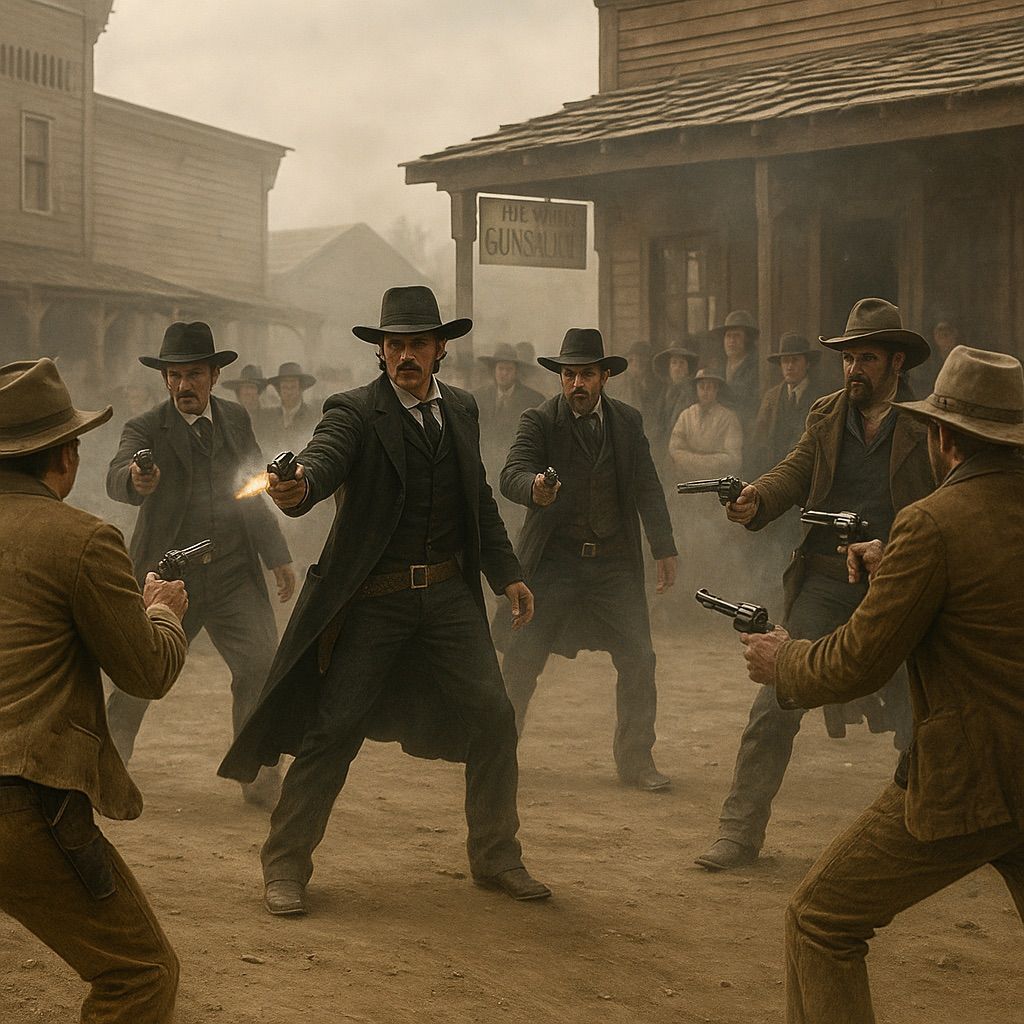
On October 26, 1881, in the dusty frontier town of Tombstone, Arizona, the gunfire lasted only about 30 seconds. Yet in that half a minute of smoke, shouting, and bullets, a legend was born. The shootout at the O.K. Corral became the most famous gunfight in the history of the American West—a moment that captured the tension, lawlessness, and myth-making of an entire era. Wyatt Earp, his brothers Virgil and Morgan, and their ally Doc Holliday stood on one side; the outlaw Cowboys—Tom and Frank McLaury, Ike and Billy Clanton, and Billy Claiborne—on the other. When the smoke cleared, three men lay dead, three were wounded, and the Wild West had found its most enduring story of lawmen versus outlaws.
Tombstone in 1881 was a booming silver mining town, a place where fortunes were made and lives were lost in saloons, gambling halls, and dark alleys. It was also a place teetering between law and chaos. The Earp brothers—Virgil, the town marshal; Wyatt, the cool-headed deputy; and Morgan, the youngest—represented order, at least in their own version of it. Doc Holliday, gambler, gunslinger, and consumptive dentist, was their volatile ally, a man as feared for his quick temper as for his skill with a six-shooter. Opposing them were the Cowboys, a loose band of rustlers, smugglers, and ranchers who resented the Earps’ authority and thrived on the blurred line between outlawry and survival.
Tensions had been simmering for months. Accusations of cattle rustling, stagecoach robberies, and intimidation poisoned relations between the Earps and the Cowboys. Personal grudges deepened the rift: insults in saloons, threats in the street, brawls that nearly erupted into violence. On the morning of October 26, things came to a head. Ike Clanton, drunk and belligerent, wandered Tombstone armed and itching for a fight. Disarmed by Virgil and mocked by Wyatt, he swore vengeance. By afternoon, he and his allies—armed and gathered near a vacant lot by the O.K. Corral—waited for confrontation.
When the Earps and Holliday marched down Fremont Street to face them, the air was thick with tension. Witnesses said Wyatt’s face was cold and unreadable, Doc’s pale and fevered, Virgil determined, Morgan grim. Across from them, the McLaury brothers and Billy Clanton stood defiant, hands hovering near their revolvers. Ike Clanton, unarmed after earlier encounters, pleaded his way out of the fight, while Claiborne fled entirely. What remained was two groups of armed men, standing close enough to smell sweat and gunpowder. Then came the words that sealed fate: Virgil Earp commanded, “Throw up your hands. I want your guns.” Instead of surrender, gunfire erupted.
The exchange was furious and chaotic. Bullets cracked in the air, smoke billowed, horses panicked. Doc Holliday fired his shotgun at Tom McLaury, mortally wounding him. Wyatt Earp, steady as stone, shot Frank McLaury in the stomach. Morgan and Virgil were both wounded but kept fighting. Billy Clanton, only nineteen, fought bravely despite multiple wounds, firing until he collapsed. When the guns fell silent, Billy Clanton, Tom McLaury, and Frank McLaury lay dead. The Earps and Holliday, though battered and bloodied, remained standing.
The gunfight lasted half a minute. Its legend has lasted centuries.
In the days that followed, controversy erupted. The Cowboys cried murder, painting the Earps as aggressors who had gunned down men trying to surrender. Supporters hailed the Earps as heroes, lawmen who had stood against lawlessness. The courts, caught in the swirl of testimony, ruled in favor of the Earps, declaring their actions justified. Yet in the larger mythology of the West, the truth remained slippery. Were the Earps noble lawmen or self-serving enforcers? Were the Cowboys outlaws or victims of frontier justice? The ambiguity only deepened the legend.
What makes the O.K. Corral endure is not simply the gunfight but what it represents. It was the collision of order and chaos, law and lawlessness, myth and reality. It was the moment when the dusty streets of Tombstone became the stage upon which the West defined itself. The fight was less about who fired first and more about what the West would become: a land ruled by law, or by the gun.
To humanize the gunfight is to see beyond legends and caricatures. Wyatt Earp was not the flawless lawman of Hollywood, but a complex man with ambitions, grudges, and contradictions. Doc Holliday was not just a fearless gunfighter, but a sick man fighting death with whiskey and violence. Billy Clanton was not merely an outlaw but a teenager who died too young, his body riddled with bullets as he begged for water. Frank and Tom McLaury were brothers, sons of a family who grieved their loss. Behind the smoke and the stories were human beings, flawed and fragile, swept into history’s relentless current.
The O.K. Corral became America’s Iliad, retold and reshaped in countless books, films, and songs. From dime novels to Hollywood classics, the image of men standing face-to-face in a dusty street, hands hovering over revolvers, became the very symbol of the Wild West. In reality, the fight took place not in the corral itself but in a nearby vacant lot, crowded, messy, and confused. But myths are not built on precision; they are built on meaning. The O.K. Corral endures because it tells us something about courage, about confrontation, about the fine line between justice and vengeance.
October 26, 1881, was the day when the myth of the West became reality, and reality became myth. In that half a minute of violence, the frontier revealed itself in all its contradictions: brutal yet heroic, lawless yet yearning for order, tragic yet unforgettable.