
There are demons in grimoires who whisper, demons who tempt, demons who deceive, and then there are those whose presence feels less like a secret and more like a natural disaster. Vine belongs firmly to the latter category. Among the seventy-two spirits cataloged in the Ars Goetia, Vine stands apart not merely because of rank—though he is counted among kings and earls—but because of what he represents. Vine is not subtle corruption or quiet manipulation. Vine is upheaval. Vine is force. Vine is revelation delivered with thunder rather than suggestion.
To understand Vine is to step into the worldview of medieval demonology itself, where spiritual entities were believed to influence the physical world directly. These spirits were not abstract metaphors to those who recorded them; they were intelligences capable of reshaping fate, altering perception, and even influencing war and weather. Vine’s domain reflects this belief perfectly. He is described as commanding storms, discovering hidden things, destroying walls, and revealing enemies—powers that blur the boundary between supernatural insight and catastrophic intervention.
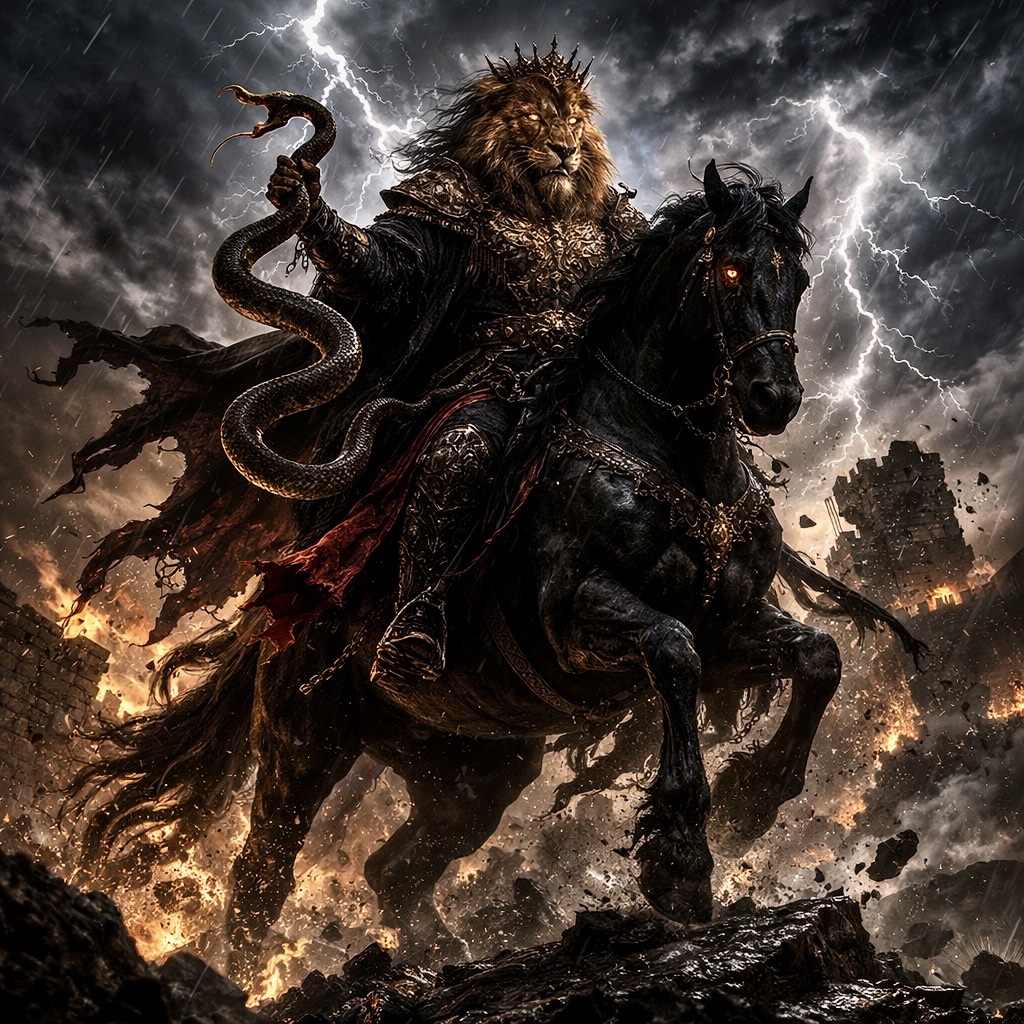
In traditional descriptions drawn from seventeenth-century occult manuscripts, Vine appears as a lion riding upon a black horse while holding a serpent in his hand. The imagery is striking and deliberate. Every element communicates authority and danger. The lion symbolizes dominance and sovereignty, the black horse evokes unstoppable momentum, and the serpent suggests knowledge—particularly knowledge that coils beneath appearances waiting to strike. Vine is not chaos for chaos’s sake. He represents controlled devastation, destruction guided by awareness.
The grimoires classify him as both King and Earl of Hell, commanding thirty-six legions of spirits. Titles in demonology were never ornamental. They reflected hierarchy modeled after earthly monarchies, suggesting that infernal realms mirrored human political structures. Kings commanded strategy. Earls oversaw execution. Vine therefore occupies a fascinating dual role: planner and enforcer, intelligence gatherer and battlefield commander. His abilities reinforce this interpretation. He reveals hidden things, exposes sorcerers, uncovers secrets, and protects or destroys fortifications depending on the will of the summoner.
What makes Vine especially compelling is how closely his mythology aligns with humanity’s ancient fear of unseen threats. Across history, civilizations have worried less about visible enemies than concealed ones—betrayal, espionage, conspiracy, hidden intentions. Vine becomes the supernatural answer to paranoia. Invoke him, the texts promise, and concealed truths will surface. Lies crumble. Enemies reveal themselves. The invisible becomes undeniable.
This association with revelation explains why Vine appears repeatedly in occult traditions concerned with knowledge rather than temptation. Unlike demons linked to pleasure or wealth, Vine’s power revolves around exposure. He forces reality into the open. In many ways, he resembles a cosmic investigator, albeit one whose methods involve storms and shattered defenses.
Storm imagery surrounding Vine deserves particular attention. Medieval thinkers viewed weather not as random but as morally or spiritually influenced. Tempests were interpreted as divine punishment or supernatural warfare. Vine’s ability to command storms therefore symbolized dominion over instability itself. Lightning and thunder represented sudden truth—the moment illusion ends. A storm strips away comfort. It reveals structural weakness. Roofs collapse, defenses fail, and what once seemed permanent proves fragile.
Psychologically, Vine embodies moments in human life when certainty collapses. Entire belief systems can crumble overnight under new information. Relationships dissolve after hidden truths emerge. Nations fall when secrets surface. Vine’s mythology reflects this universal experience: revelation often arrives violently.
The serpent he carries deepens this symbolism. In Western tradition, serpents occupy an ambiguous role—agents of wisdom and danger simultaneously. Knowledge liberates, but it also destroys innocence. Vine’s serpent suggests mastery over forbidden understanding. Those who sought him were rarely looking for pleasant truths. They wanted answers regardless of consequence.
Historical practitioners of ceremonial magic approached spirits like Vine with elaborate ritual protections. Circles were drawn, divine names invoked, and strict procedures followed. These rituals reveal something important about how Vine was perceived. He was not considered easily controlled. Summoners believed that without authority grounded in sacred power, the spirit’s destructive nature could overwhelm the operator. This fear underscores Vine’s character as a force rather than merely an entity.
Interestingly, Vine is also described as capable of building towers as well as destroying them. This duality mirrors the broader demonological principle that infernal powers reflect human intention. The same force that demolishes can construct. Storms devastate landscapes yet renew ecosystems. Fire destroys forests yet enables regrowth. Vine represents transformational energy—the breaking down required before rebuilding becomes possible.
Modern interpretations often frame such figures psychologically rather than literally. From this perspective, Vine becomes an archetype of disruptive awareness. Every person encounters moments when denial becomes impossible. Evidence accumulates. Truth intrudes. Internal defenses collapse much like the walls Vine is said to tear down. The experience can feel catastrophic, yet it frequently precedes growth.
Carl Jung’s exploration of shadow integration resonates strongly here. The shadow contains truths individuals avoid acknowledging about themselves. Encountering it is rarely gentle. It dismantles identity structures constructed around illusion. Vine’s mythology parallels this process almost perfectly: revelation, destruction of false defenses, emergence of hidden reality.
Even outside psychological interpretation, Vine’s legend speaks to humanity’s enduring fascination with power over uncertainty. Weather, war, betrayal, and secrecy remain among the most destabilizing aspects of existence. The promise of commanding such forces—even symbolically—holds immense appeal. Medieval magicians lived in unpredictable worlds shaped by disease, invasion, and political intrigue. A spirit capable of exposing enemies or controlling storms represented security in an insecure age.
Descriptions of Vine’s temperament vary, but many sources emphasize obedience when properly constrained. This reinforces the ritual worldview in which authority determines outcome. Power itself is neutral; intention shapes its manifestation. Vine does not inherently deceive or corrupt. He executes.
That neutrality distinguishes him from more manipulative demons. Vine does not seduce; he reveals. He does not persuade; he acts. The fear surrounding him arises from consequence rather than trickery. Truth uncovered cannot easily be hidden again.
The lion imagery reinforces regal inevitability. Lions do not negotiate dominance—they embody it. A lion riding a horse creates layered symbolism: raw strength directing momentum. The black horse often signifies death, war, or unstoppable advance in European symbolism. Together they portray authority moving forward with irreversible force.
One can imagine why Renaissance occultists found Vine compelling. Europe during this period experienced religious upheaval, scientific discovery, and political revolution. Old certainties shattered rapidly. Figures like Vine symbolized both terror and empowerment amid transformation. Knowledge expanded faster than tradition could contain it. Entire worldviews were under siege.
Interestingly, Vine’s powers include discovering witches and sorcerers. This reflects anxieties of the era when accusations of hidden magical influence were widespread. The idea of a spirit revealing secret practitioners mirrors societal obsession with identifying concealed threats. Demonology often acted as a mirror reflecting collective fears rather than inventing them.
In contemporary culture, Vine’s symbolism remains surprisingly relevant. Modern societies grapple with misinformation, concealed agendas, and unseen systems shaping daily life. Data breaches, hidden algorithms, intelligence operations—all echo ancient fears of invisible influence. Vine becomes an archetype of exposure within an information age defined by secrecy and revelation.
The destructive aspect of his mythology also carries philosophical weight. Structures—whether psychological, social, or political—often resist change until external pressure forces collapse. Vine represents that pressure. He is the storm that arrives when stagnation persists too long.
Some occult traditions suggest that working with Vine required clarity of purpose above all else. Ambiguous intent could produce unintended outcomes. This aligns with broader magical philosophy emphasizing alignment between desire and action. To summon revelation without readiness for truth invites chaos.
The enduring fascination with figures like Vine reveals something deeply human. People simultaneously crave truth and fear it. We seek clarity yet construct elaborate defenses against uncomfortable realities. Vine’s legend dramatizes this tension. He is both liberator and destroyer because truth itself holds both qualities.
Stories surrounding Vine often emphasize dramatic manifestation—violent winds, sudden insight, overwhelming presence. Whether literal or symbolic, these descriptions capture how transformative realization feels. Life rarely changes gradually at moments of profound understanding. Instead, perception shifts abruptly, like thunder breaking silence.
Across centuries, demonology has functioned as a language for grappling with forces beyond control. Vine’s association with storms situates him among humanity’s oldest fears. Before meteorology, storms represented divine or infernal will. Their unpredictability mirrored existence itself. By personifying storms in a being like Vine, people imposed narrative upon chaos.
Yet Vine is not merely destruction incarnate. His ability to build suggests mastery over transition. Creation frequently follows collapse. Old walls must fall before new structures rise. In this sense, Vine embodies necessary endings—the difficult transformations enabling renewal.
Artists and occult scholars continue to reinterpret Vine through modern lenses, depicting him as a sovereign of revelation rather than a monster. This shift reflects changing attitudes toward darkness and knowledge. What earlier ages feared as demonic disruption may now be understood as confrontation with truth.
Even skeptics can appreciate the symbolic richness of Vine’s mythology. Whether viewed as literal spirit, psychological archetype, or cultural artifact, he encapsulates a universal experience: the moment when hidden reality breaks through illusion and demands acknowledgment.
Perhaps that explains why Vine persists in occult imagination while lesser spirits fade into obscurity. He represents something fundamental. Empires collapse when truths emerge. Personal identities transform when denial ends. Storms arrive regardless of preparation.
And when they pass, the landscape—internal or external—is never quite the same.
Vine stands therefore not simply as a demon king of infernal hierarchy, but as a narrative embodiment of revelation itself. He reminds humanity that knowledge carries consequence, that power disrupts stability, and that truth rarely arrives quietly. In mythic form, he asks an unsettling question: if every hidden thing were revealed, what structures in our lives would survive the storm?
The answer, as generations of occultists suspected, may be both terrifying and liberating.