
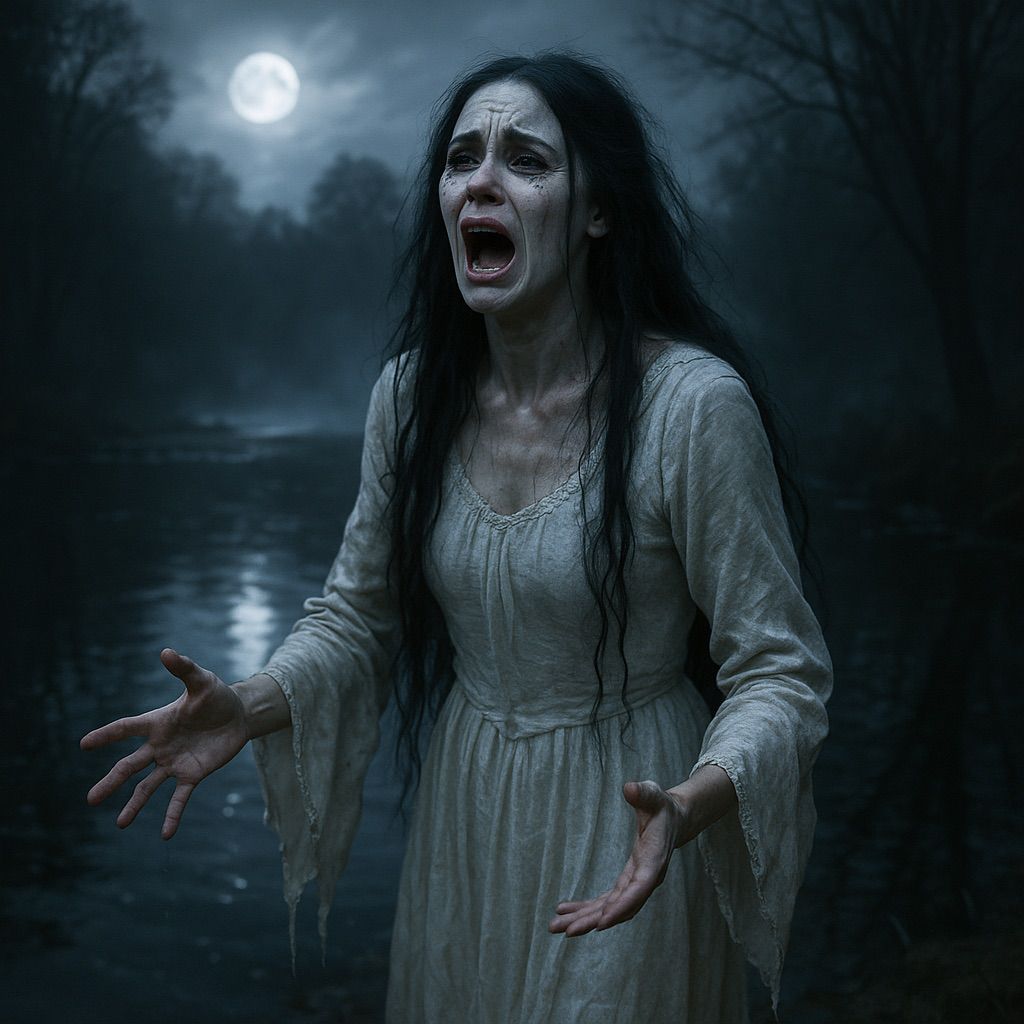
On quiet nights along Mexico’s rivers and canals, when the moonlight shimmers across black waters and the wind carries whispers through the reeds, there is said to be a sound that chills the blood of anyone who hears it. It is not the call of an owl, nor the rustle of branches, but a woman’s cry, long, drawn-out, and filled with a grief so deep it cuts through time itself. “Ay, mis hijos!”—“Oh, my children!”—the voice wails, echoing across villages and cities alike, reminding everyone of the story they learned as children: the tale of La Llorona, the Weeping Woman, cursed to wander eternally, mourning the children she drowned with her own hands. For generations, her legend has haunted Mexico and spread across Latin America, blending folklore, morality tale, and ghost story into one of the most powerful cultural myths ever told. To hear her cry is to know terror, not only because it foretells doom but because it carries the weight of sorrow too vast for the living to bear.
La Llorona’s story begins with heartbreak, but its roots stretch into the complex soil of history, blending Indigenous legend, colonial reality, and centuries of retelling. The most common version is simple yet devastating: once, there was a beautiful woman, often said to be Indigenous or of mixed heritage, who fell in love with a wealthy Spanish man. Their love produced children, but he betrayed her, abandoning her for a woman of higher status. In a moment of rage and despair, she drowned her children in the river, only to realize too late the horror of what she had done. Overcome with grief, she took her own life—or, in some versions, was punished by Heaven itself. Denied entrance to the afterlife, she was cursed to roam the earth for eternity, searching for her children and wailing her regret into the night.
This narrative, at its core, is both deeply personal and profoundly cultural. The story reflects the wounds of colonization, where Indigenous women often faced betrayal, exploitation, and abandonment by Spanish men. La Llorona is more than a mother who killed her children—she is a symbol of broken promises, of love poisoned by inequality, of families shattered by conquest. Her eternal wandering is a metaphor for a people caught between two worlds, forever searching for what was lost. And yet, she is also universal, embodying grief, regret, and the terrible truth that sometimes our own actions become our greatest curses.
The legend is not told in whispers of sympathy alone. In households across Mexico, parents use La Llorona as a cautionary tale for children. “Don’t wander near the river at night, or La Llorona will take you.” “Behave, or she will come for you.” In this way, the story becomes both a ghost story and a tool of discipline, weaving morality into myth. For children, the terror is real—the idea of a crying woman appearing out of the mist, arms reaching, voice echoing with otherworldly sorrow. For adults, the tale carries layers of cultural memory, warning of betrayal, despair, and the thin line between passion and destruction.
Her cry itself is the most important element of the legend. People describe it as piercing, mournful, inhuman in its intensity. It is not simply a scream, but a lament, filled with anguish that seeps into the soul. The cry is said to announce death, like the Irish banshee, or to lure the unwary into danger, like sirens of the sea. To hear it close by means she is far away; to hear it faintly in the distance means she is near. This paradox makes the sound even more terrifying, a trick of folklore that ensures no one ever feels safe if they hear it. And those who do claim to have heard her never forget it—the sound becomes an echo that stays in memory long after the night ends.
What makes La Llorona unique is that she is both feared and pitied. She is a murderer, yes, but she is also a mother destroyed by her own choices, trapped in an endless loop of grief. Her punishment is not flames or torment, but eternal sorrow—an agony that humanizes her even as it horrifies. People do not only fear La Llorona; they mourn her too, seeing in her a reminder of how thin the line is between love and despair, between humanity and monstrosity. Her story resonates because it is not about a distant, inhuman demon—it is about a woman who made a terrible choice and now lives forever with its consequences.
The historical depth of La Llorona’s legend cannot be ignored. Some scholars trace her origins to the Aztec goddess Cihuacóatl, who was said to wander at night, weeping for her children, foretelling doom before the Spanish conquest. In this way, La Llorona is not only a colonial tale but also an Indigenous one, an echo of an older myth transformed by history. Her story evolved as cultures collided, becoming a hybrid tale that reflects Mexico itself: a blending of the old and the new, the Indigenous and the Spanish, the personal and the political. Every time her story is told, it carries within it centuries of cultural layering, a palimpsest of grief.
In modern times, La Llorona has transcended folklore to become a global figure. She appears in films, from Mexican horror classics to Hollywood adaptations. She is the subject of songs, poems, and plays, her wail woven into art across generations. Yet even as she becomes entertainment, the core of her legend remains intact. People still avoid rivers at night, still tell children to beware, still shiver at the thought of her cry. The persistence of her myth proves its power. Ghost stories fade when they stop speaking to something essential, but La Llorona endures because her story touches the most universal fears: the fear of losing children, the fear of betrayal, the fear of eternal regret.
To humanize La Llorona is to see her not just as a ghost, but as a reflection of humanity’s darkest emotions. Who among us has not felt regret? Who has not cried for something lost, even if we did not cause it ourselves? La Llorona magnifies those emotions, turning them into eternal punishment, but in her suffering, we recognize ourselves. That is why her story is told not only in whispers of fear but in tones of sorrow. She frightens us, yes, but she also breaks our hearts.
Imagine, for a moment, standing on a riverbank at midnight. The water moves slow, silver under the moon, and the reeds rustle in the breeze. Then, from somewhere—everywhere—comes a sound. A woman’s voice, crying, wailing, filled with such pain that your chest tightens. You cannot see her, but you know she is there. That is the essence of La Llorona: the fear that grief itself is alive, walking beside us, reaching out with cold hands. She is more than a ghost—she is grief personified, and grief never dies.
La Llorona will always be with us, wandering rivers, echoing through time. She is the weeping mother, the broken lover, the cursed soul. She reminds us of betrayal and regret, but also of the universality of sorrow. She is not confined to Mexico alone—her story has traveled wherever grief travels, which is everywhere. And as long as humans lose what they love, as long as rivers run, her cry will echo. “Ay, mis hijos!” The sound is not only hers—it is ours. It is the cry of humanity mourning what it cannot reclaim.