
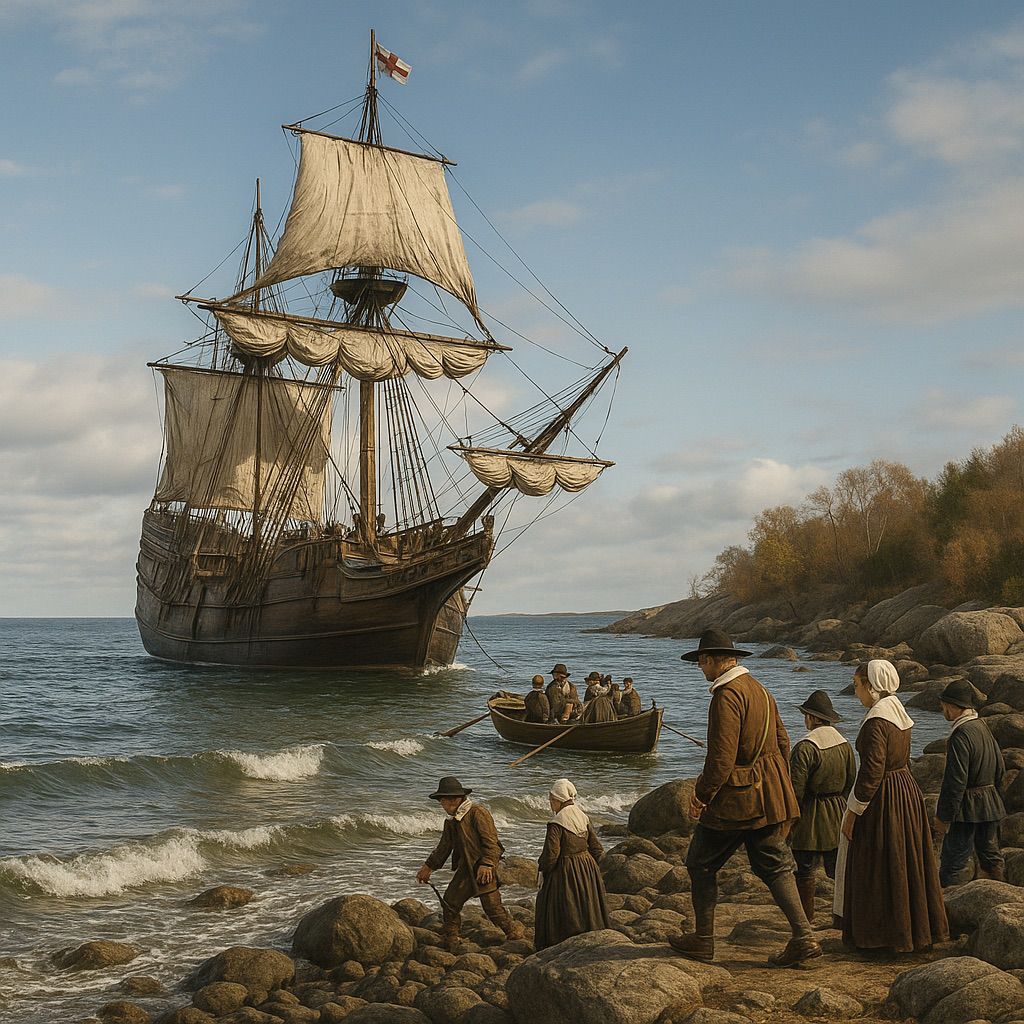
In the early seventeenth century, a single wooden ship crossing the Atlantic carried far more than passengers and cargo. The Mayflower carried fear, hope, desperation, faith, and ambition—elements that would collide on the shores of North America and help shape the future of an entire continent. When the ship finally dropped anchor off the coast of Cape Cod in November 1620, the people aboard were exhausted, uncertain, and unprepared for what lay ahead. Yet they were united by a shared belief that their survival depended on building something new in a land they barely understood.
The passengers of the Mayflower were not explorers in the traditional sense. They were families, craftsmen, laborers, and religious dissenters fleeing a world that no longer offered them security or freedom. Among them were the Separatists—later known as the Pilgrims—who had broken away from the Church of England in search of a simpler, more democratic form of worship. Their refusal to conform made them targets of persecution, forcing them first into exile and eventually toward the unknown.
Years before the voyage, these Separatists had settled in Leiden, Holland, where they enjoyed religious tolerance but struggled economically and culturally. While they were free to worship as they chose, their children began to lose English identity, and work was scarce. At the same time, political changes in England threatened to close even that fragile refuge. Faced with an uncertain future, the community made a decision that would alter history: they would leave Europe entirely.
The opportunity came through negotiations with English investors and the Virginia Company, which hoped to profit from new colonies in North America. The Pilgrims secured permission to settle in the New World, though their destination was meant to be farther south. On September 6, 1620, the Mayflower departed Plymouth Harbour carrying 102 passengers and a crew accustomed to the dangers of the sea.
The voyage was brutal. Storms battered the ship, forcing passengers below deck for weeks at a time. Food spoiled, illness spread, and morale wavered. Yet the travelers endured, bound together by necessity and belief. When land was finally sighted after more than two months at sea, relief quickly gave way to uncertainty. They had arrived far north of their intended destination, beyond the reach of their charter.
Before anyone set foot on land, the settlers faced a critical problem: authority. Without a valid charter, no one technically held legal power. In response, the adult men aboard drafted and signed the Mayflower Compact, an agreement that bound them to govern themselves through collective decision-making. This simple document became one of the earliest expressions of self-governance in American history.
On December 11, 1620, the settlers landed at what would become Plymouth. The land was cold, forested, and unforgiving. There were no towns, no fields, no supplies waiting. Winter came quickly, bringing hunger, disease, and death. Nearly half of the settlers would not survive their first year.
It was during this desperate period that the story of Plymouth Colony became inseparable from the story of the Wampanoag people. Long before the English arrived, Native communities had lived on this land, adapting to its rhythms and dangers. Among them was Tisquantum—known as Squanto—a man whose life had already been shaped by European intrusion. Kidnapped years earlier and taken to England, Squanto returned to find his village destroyed by disease.
Squanto’s knowledge of English and his understanding of both cultures placed him in a unique position. Despite personal loss and mistrust on all sides, he chose to help the settlers. He taught them how to plant corn using fish as fertilizer, how to hunt and fish, and how to survive the harsh New England environment. Without his guidance, the colony likely would have failed.
Relations between the Pilgrims and the Wampanoag were complex and fragile. An alliance formed with the Wampanoag leader Massasoit, driven as much by mutual survival as goodwill. For the English, Native knowledge meant survival. For the Wampanoag, an alliance offered protection against rival tribes and a chance to manage European expansion—though few could foresee the consequences that would follow.
As the seasons passed, Plymouth Colony slowly stabilized. Crops grew, shelters improved, and trade networks formed. Governance evolved as well, reflecting the Pilgrims’ belief in collective responsibility. Yet beneath these successes lay constant tension—between settlers and Native peoples, between faith and survival, and between ideals and reality.
Disease continued to haunt both communities. European illnesses devastated Native populations, while settlers faced recurring outbreaks that threatened to erase their fragile foothold. Each winter brought new uncertainty, reinforcing the understanding that survival depended on cooperation, adaptability, and resilience.
Over time, the colony expanded, drawing new settlers and reshaping the landscape. What began as a refuge gradually became a foothold for broader colonization. Agreements made in desperation became contested as power shifted, and alliances strained under pressure. The story of Plymouth Colony is therefore not one of simple triumph, but of layered complexity—hope entangled with loss, faith intertwined with conflict.
Squanto’s legacy, often reduced to a footnote, remains central to this story. He was neither villain nor savior, but a human being navigating an impossible position between worlds. His role reminds us that the survival of Plymouth Colony was not solely the result of European determination, but of Native knowledge, sacrifice, and compromise.
The arrival of the Mayflower marked a beginning, not a conclusion. It set into motion forces that would shape American identity for centuries, raising enduring questions about governance, faith, coexistence, and consequence. The Pilgrims sought freedom, but their story is inseparable from the land and people they encountered—a truth that complicates the legacy they left behind.
Plymouth Colony stands as both symbol and warning. It represents resilience in the face of adversity, but also the costs of expansion and misunderstanding. To remember it honestly is to acknowledge both the courage of those who crossed the ocean and the lives forever altered by their arrival.