
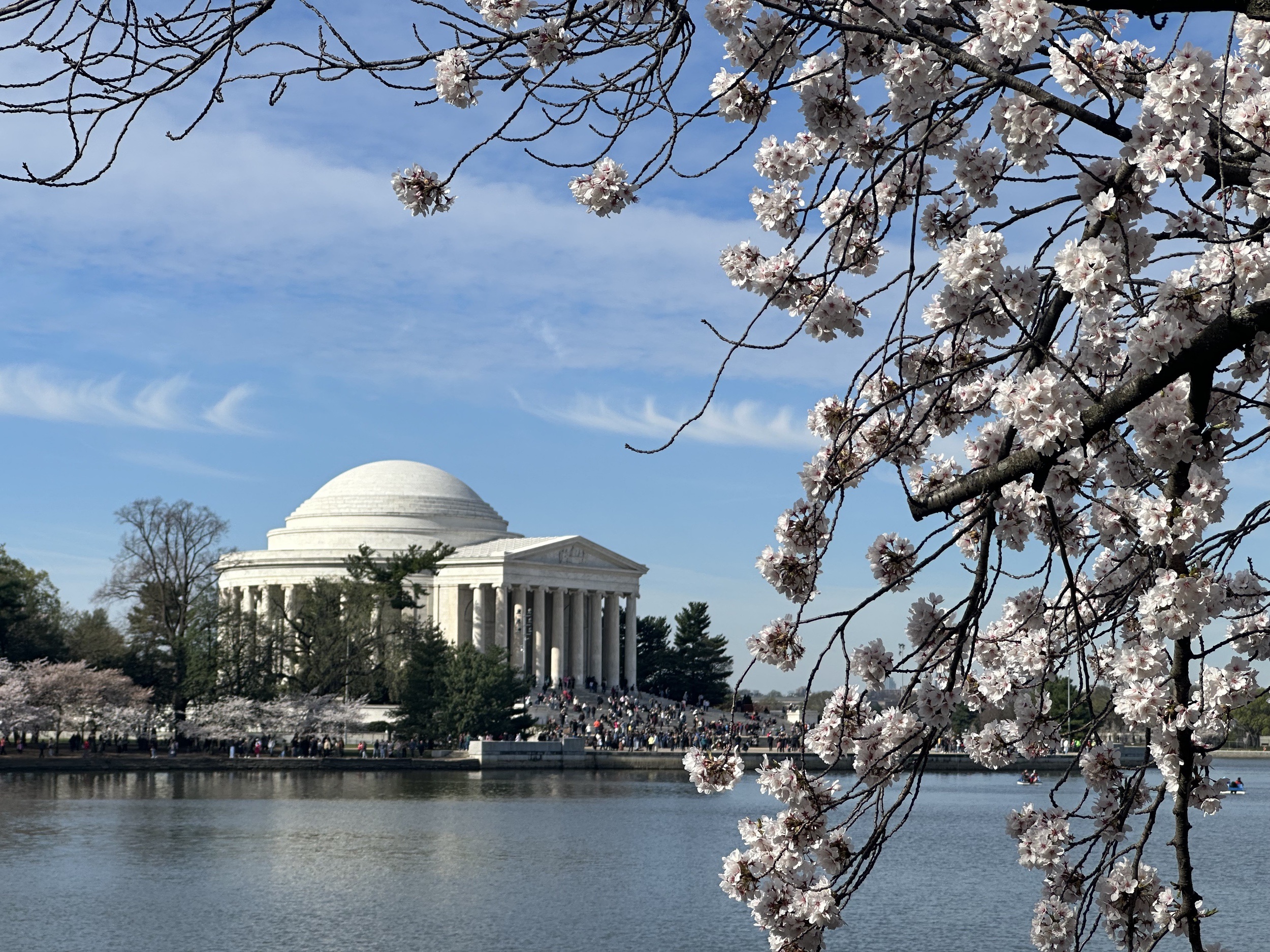
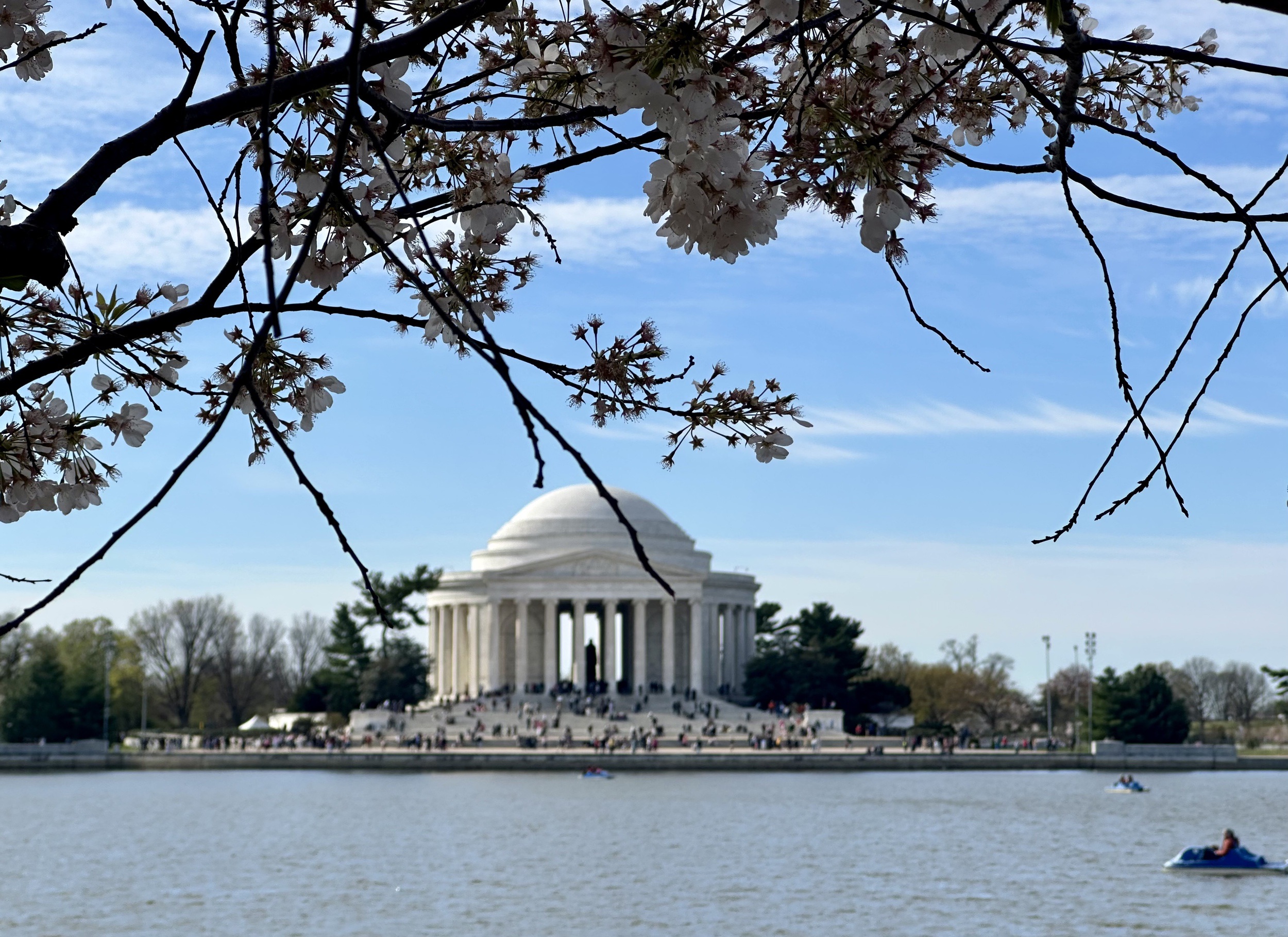
There’s something quietly powerful about standing at the edge of the Tidal Basin in Washington, D.C., watching the white marble dome of the Thomas Jefferson Memorial glow against the sky. It doesn’t shout for attention the way some landmarks do. It doesn’t tower over you with overwhelming scale or intricate ornamentation. Instead, it feels deliberate, almost contemplative—like it’s inviting you to slow down, think, and maybe even question something you thought you understood.
That feeling isn’t accidental. The memorial was designed to reflect the mind of Thomas Jefferson himself—a man who believed deeply in reason, liberty, and the messy, evolving nature of democracy. And like Jefferson, the memorial isn’t simple. It’s layered, full of contradictions, and deeply tied to both the ideals and imperfections of the nation he helped shape.
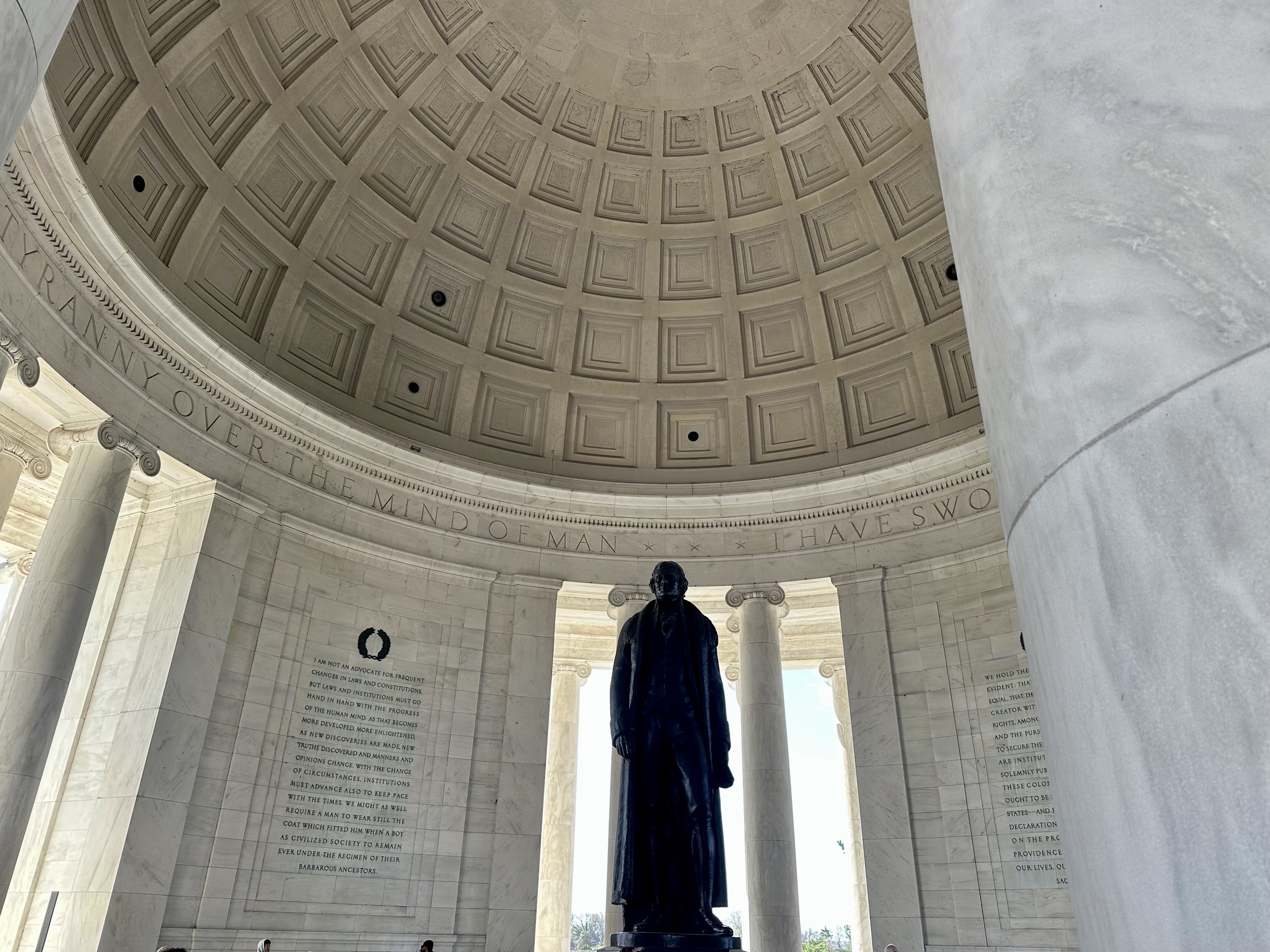
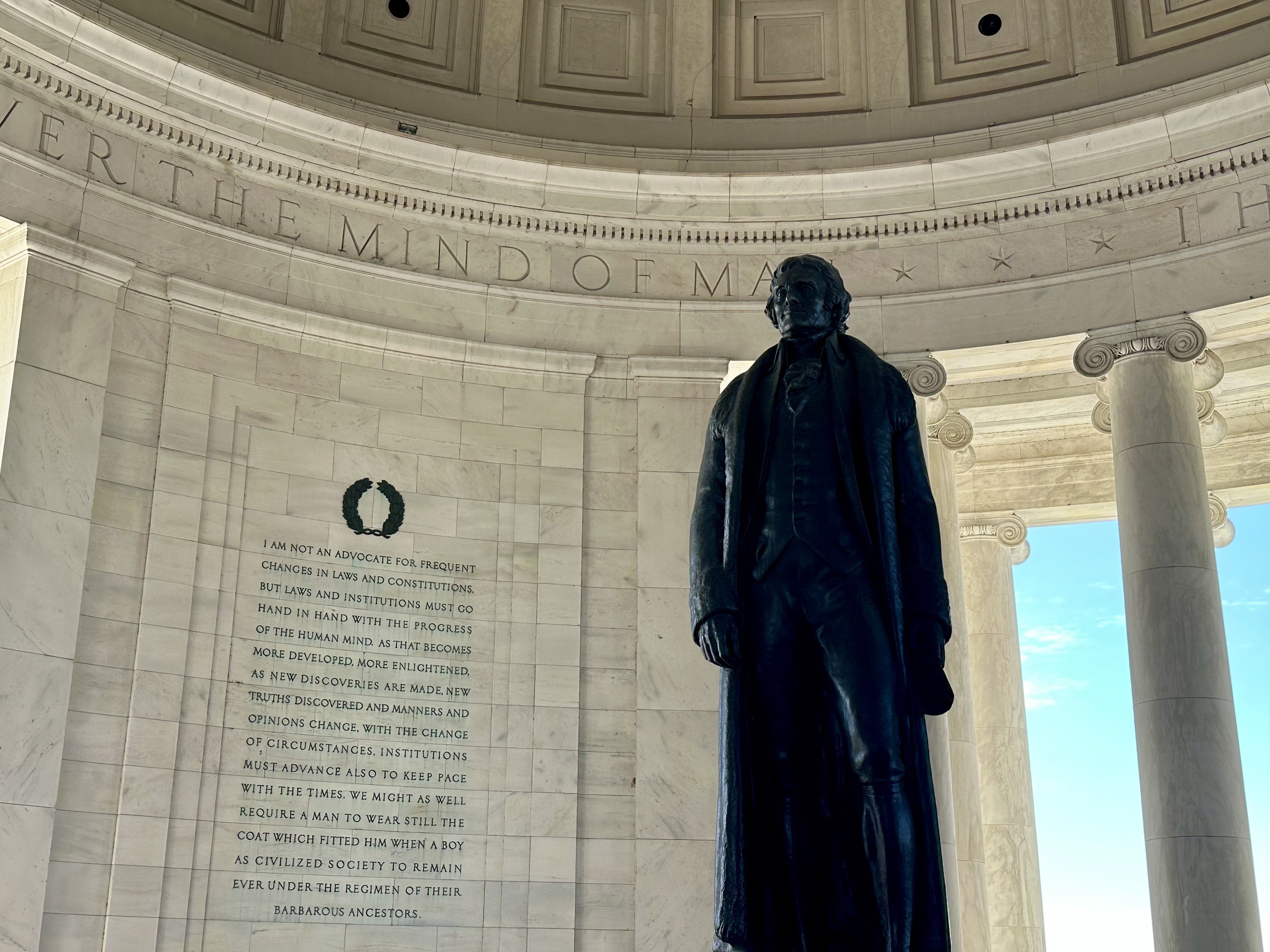
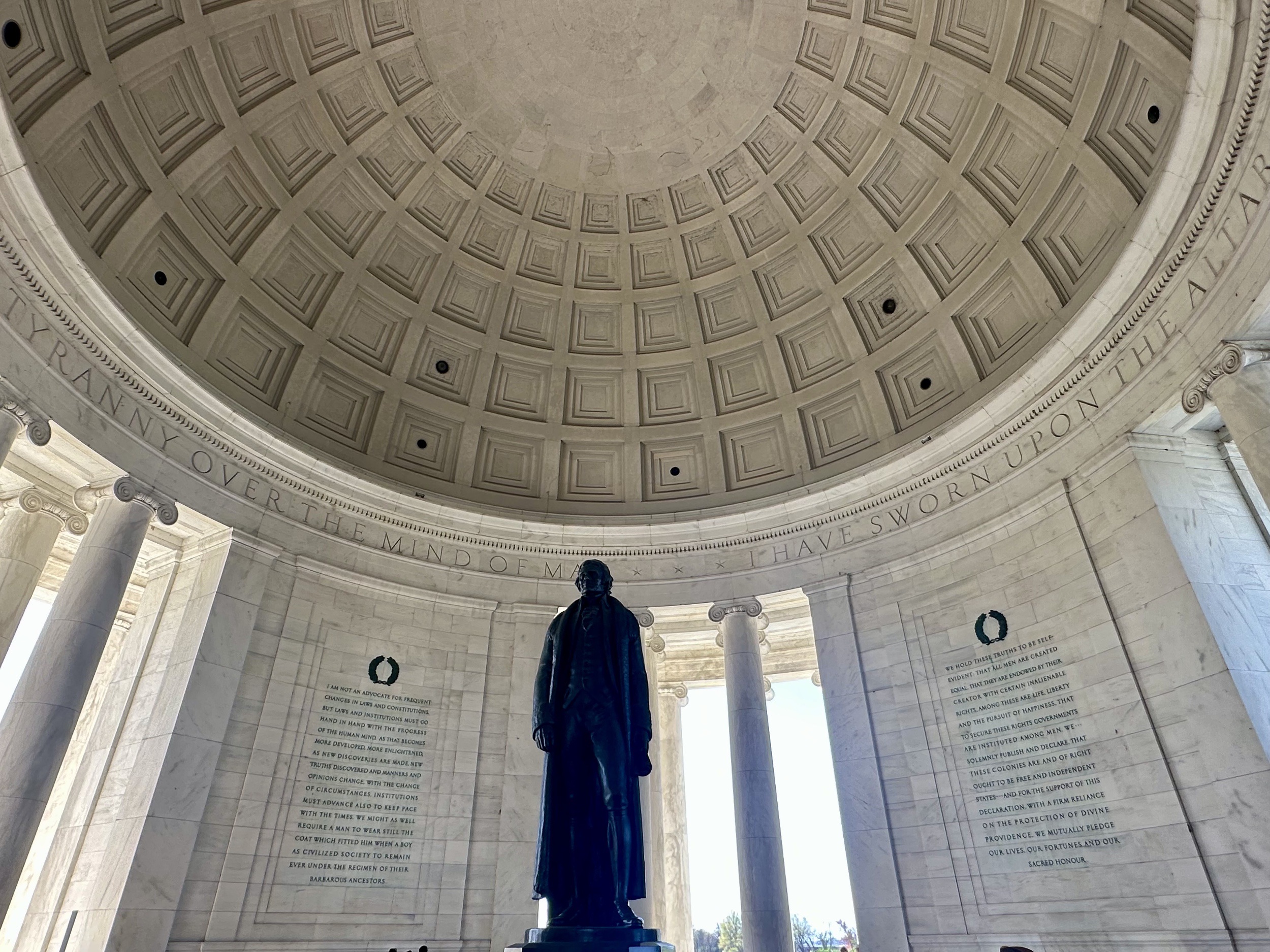
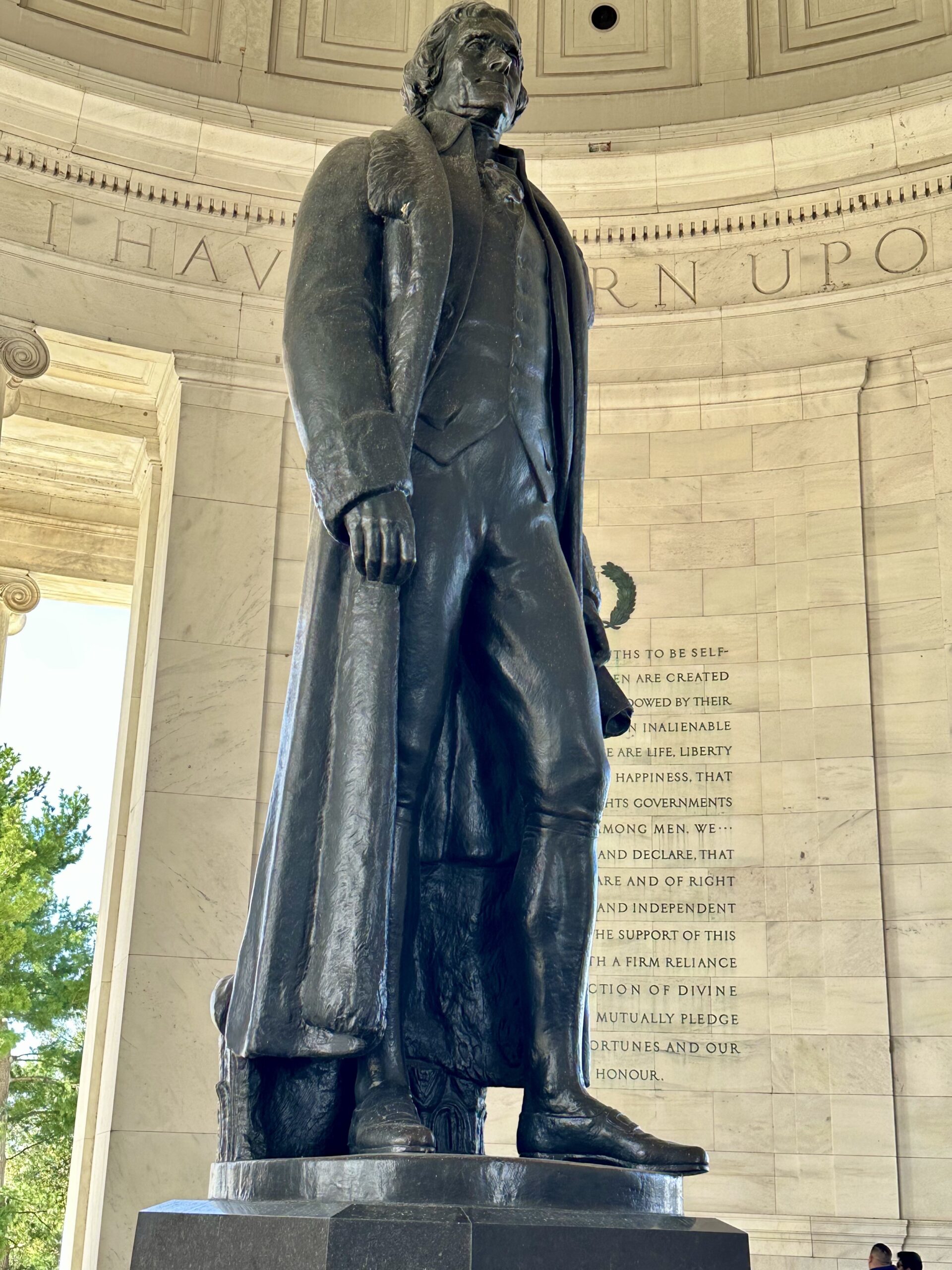
When you approach the memorial, especially during cherry blossom season, the scene feels almost cinematic. Soft pink petals drift across the water, framing the structure in a way that feels too perfect to be real. But then you step closer, climb the steps, and suddenly the beauty gives way to something heavier. Inside, Jefferson stands—towering, bronze, and still—gazing outward as if he’s still watching the country unfold centuries after his time.
The statue itself wasn’t even part of the original unveiling. When the memorial was dedicated in 1943, during the height of World War II, a plaster version stood in its place because metal was being reserved for the war effort. That detail alone tells you something about the moment in which the memorial came to life. The United States was fighting for its survival, and here it was, building a monument to the man who wrote the words that defined its purpose. There’s something poetic about that—almost like a reminder that ideas can outlast even the most uncertain times.
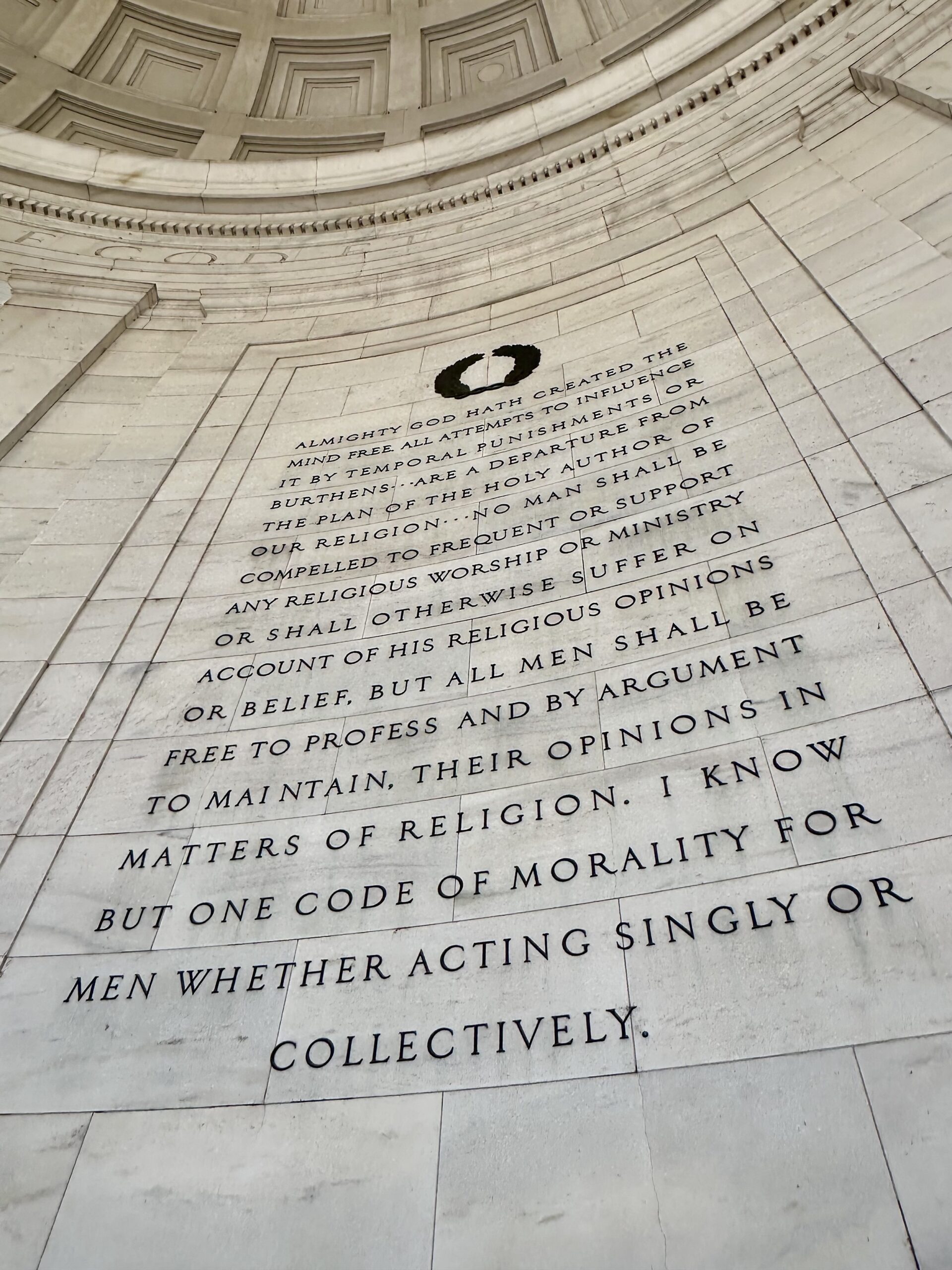
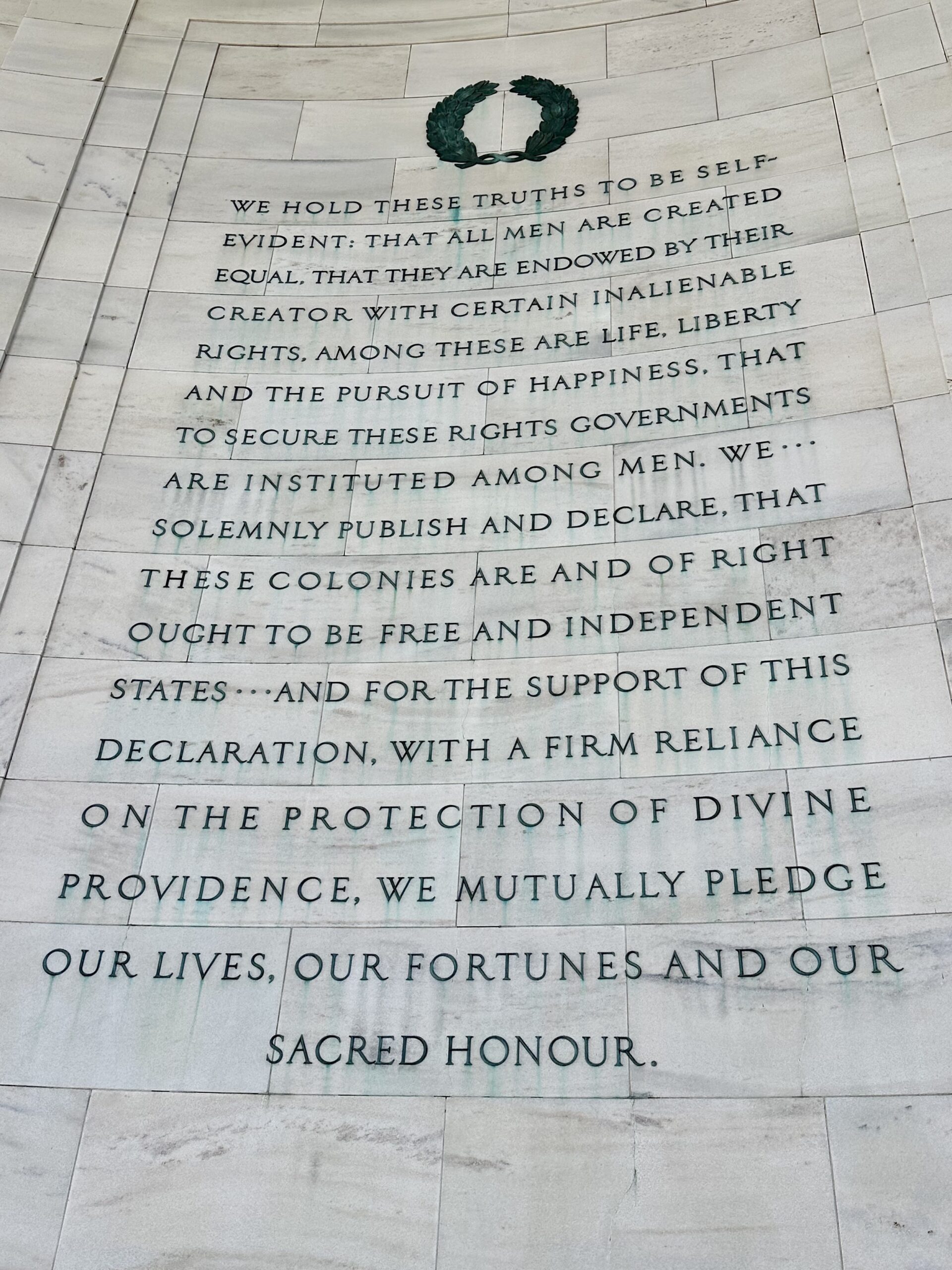
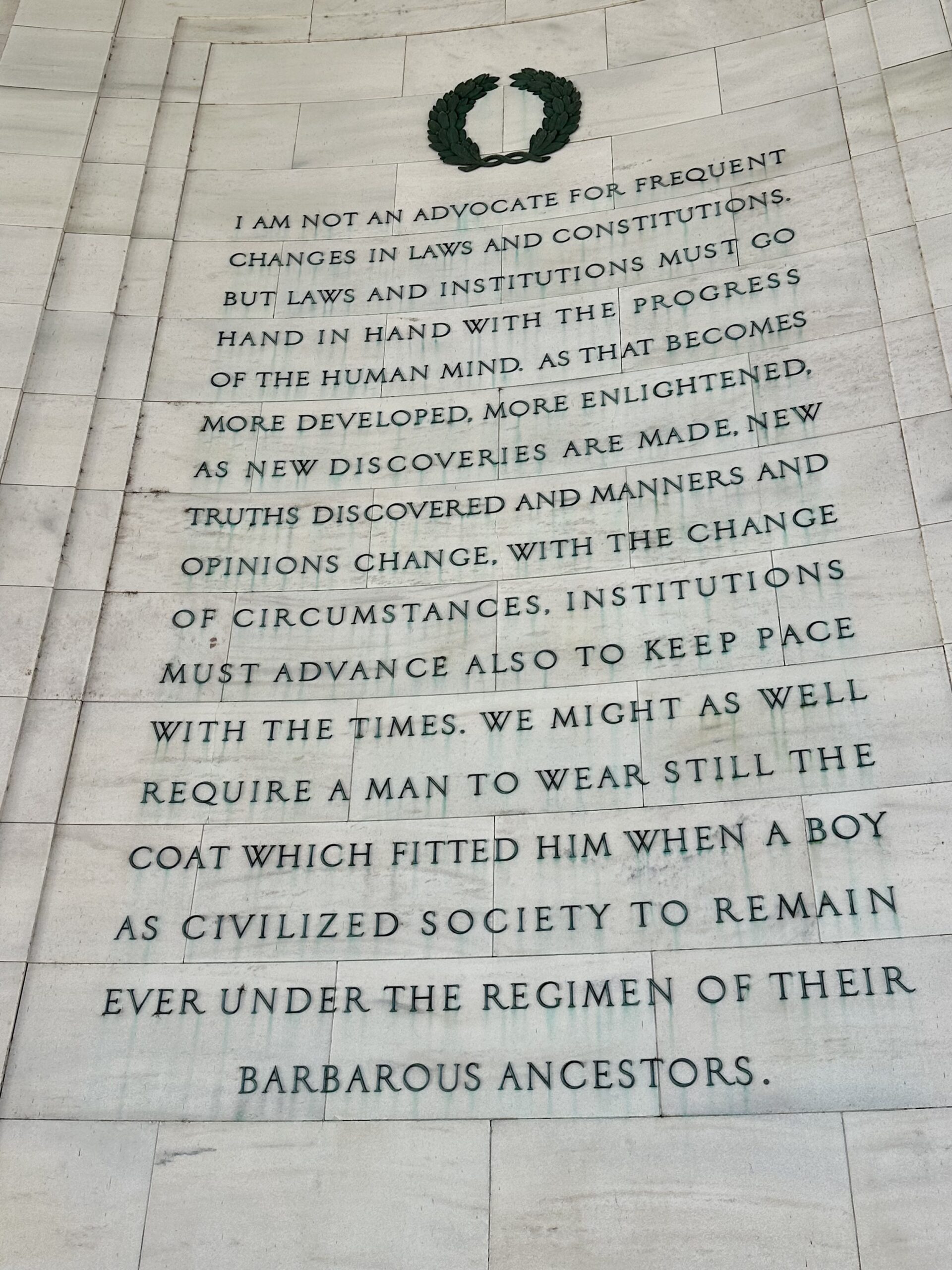
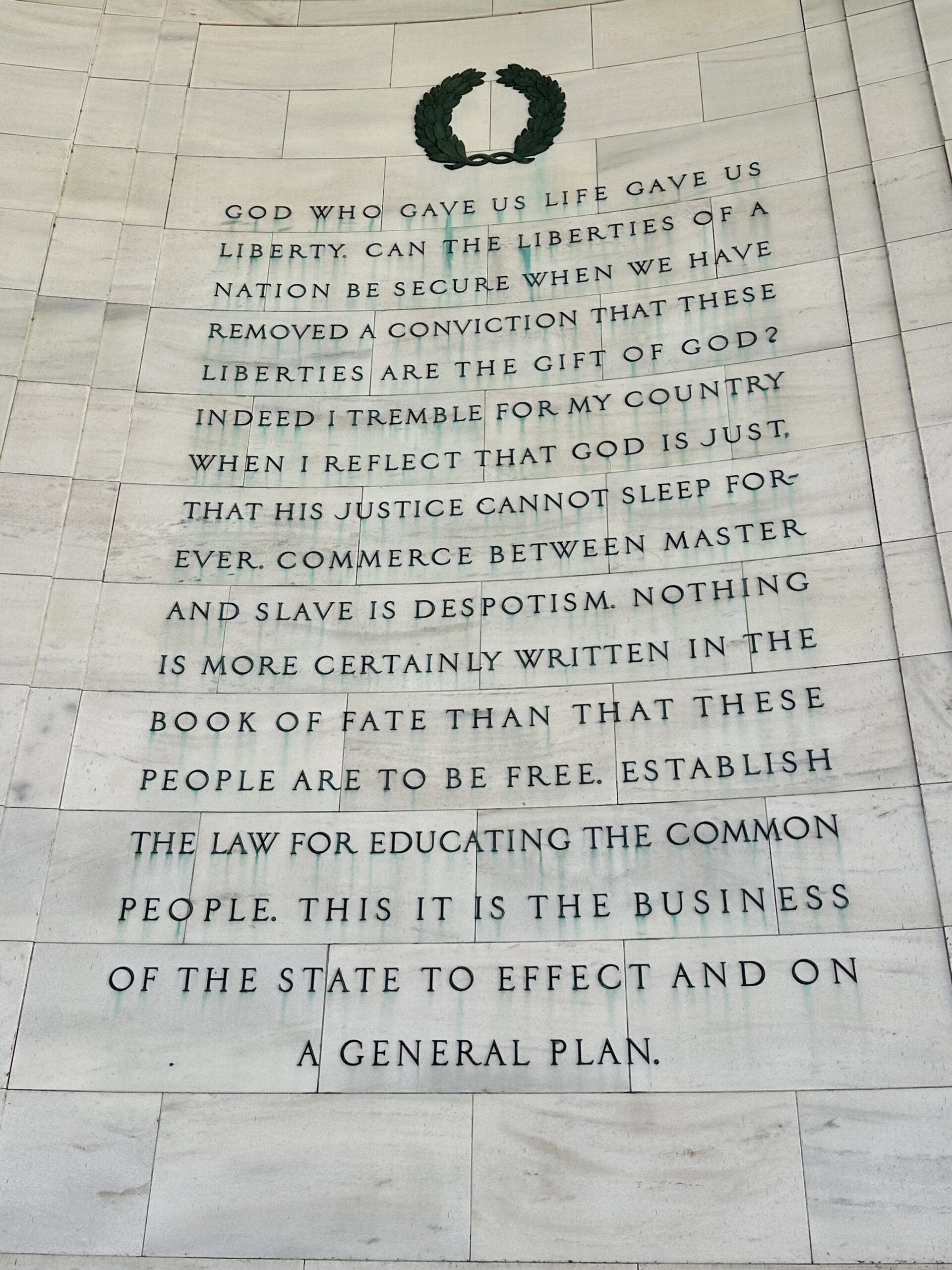
Step inside and you’re surrounded not just by Jefferson’s presence, but by his words. They’re carved into the walls, pulled from documents like the Declaration of Independence and his letters. But what’s striking isn’t just what the words say—it’s how they feel in that space. They don’t come across as distant, historical artifacts. They feel immediate. Alive. Even a little uncomfortable at times.
Jefferson wrote about equality, about liberty, about the rights of individuals to govern themselves. But standing there, it’s impossible not to also think about the contradictions. Jefferson was a slave owner. A man who spoke of freedom while participating in a system that denied it to others. The memorial doesn’t explicitly spell out that tension, but it lingers in the air. And maybe that’s part of its power—it doesn’t resolve the contradiction for you. It leaves you to wrestle with it.
That tension makes the memorial feel less like a celebration and more like a conversation. It’s not just saying, “Here’s a great man.” It’s asking, “What do we do with the legacy of someone who helped build something extraordinary, but was also deeply flawed?” That’s not an easy question, and it’s one the country is still trying to answer.
Architecturally, the memorial draws heavily from classical influences, particularly Roman designs like the Pantheon. The circular structure, the columns, the open interior—they all point back to the ancient world that Jefferson admired so much. He believed that the ideals of democracy and civic responsibility had roots in those earlier civilizations, and the memorial reflects that belief in a very literal way.
But there’s also something distinctly American about it. Unlike the Pantheon, which feels enclosed and inward-looking, the Jefferson Memorial is open to the outside world. There are no doors sealing it off. The wind moves through it. The light changes constantly. It feels connected to its surroundings, almost as if it’s part of the landscape rather than separate from it.
That openness mirrors Jefferson’s own philosophy. He believed that ideas should evolve, that societies should adapt, and that no system of government should be so rigid that it can’t change. Standing in the memorial, you get the sense that it’s not just honoring the past—it’s leaving space for the future.
The location itself is no accident either. Positioned along the Tidal Basin, the memorial sits slightly removed from the more crowded areas of the National Mall. It’s not hidden, but it’s not central either. You have to make a conscious decision to go there. And when you do, the journey becomes part of the experience.
Walking along the water, you start to notice how the memorial reveals itself gradually. First, just a glimpse of white through the trees. Then the full dome. Then the reflection shimmering on the water. By the time you reach it, you’ve already been pulled into its orbit.
At night, the experience changes completely. The crowds thin out, the noise fades, and the memorial takes on a different personality. The lighting casts long shadows across the columns, and Jefferson’s statue feels more introspective, almost like he’s lost in thought. The reflection in the water becomes sharper, clearer, as if the world itself has quieted down just enough to listen.
It’s in those quieter moments that the memorial feels most alive. Not because anything is happening, but because of what it represents. It’s a space dedicated not just to a person, but to an idea—an idea that’s still being tested, debated, and redefined.
And maybe that’s why it resonates so strongly with people, even today. It’s not frozen in time. It doesn’t feel like a relic. It feels relevant. The questions it raises—about freedom, equality, responsibility—are the same ones that continue to shape conversations across the country.
There’s also something deeply human about the way people interact with the memorial. You’ll see tourists snapping photos, of course, but you’ll also see people sitting quietly on the steps, staring out at the water. Couples talking in hushed voices. Individuals reading the inscriptions slowly, as if trying to absorb every word.
It’s not uncommon to see someone stand in front of Jefferson’s statue for a long time, just looking up. Not out of awe, necessarily, but out of curiosity. Maybe even a little uncertainty. As if they’re trying to figure out what to make of him—and by extension, what to make of the country he helped create.
That’s the thing about the Jefferson Memorial. It doesn’t tell you what to think. It doesn’t wrap everything up neatly. It leaves space for interpretation, for reflection, for disagreement. And in a way, that makes it one of the most honest monuments in the city.
Because the story of the United States isn’t simple. It’s not a straight line from past to present. It’s a complicated, often contradictory narrative filled with progress, setbacks, and constant reevaluation. The memorial captures that complexity without trying to simplify it.
Even the decision to build it was controversial. Some people opposed its construction, arguing that it would disrupt the natural beauty of the Tidal Basin. Others questioned whether Jefferson, with all his contradictions, should be honored in such a grand way. Those debates echo the very themes the memorial embodies—who we choose to remember, how we remember them, and why it matters.
In the end, the memorial stands not as a final statement, but as an ongoing dialogue. It invites you to engage with history, not just observe it. To question it. To learn from it. And maybe, to carry those lessons forward in your own way.
As you leave, walking back along the water, the memorial slowly fades behind you. But the feeling doesn’t. It lingers. Not as a clear answer, but as a kind of quiet challenge—one that asks you to think about what freedom really means, and what it takes to live up to it.
And that might be the most powerful thing about the Thomas Jefferson Memorial. It doesn’t just honor the past. It keeps it alive—unfinished, unresolved, and still deeply connected to the present.