
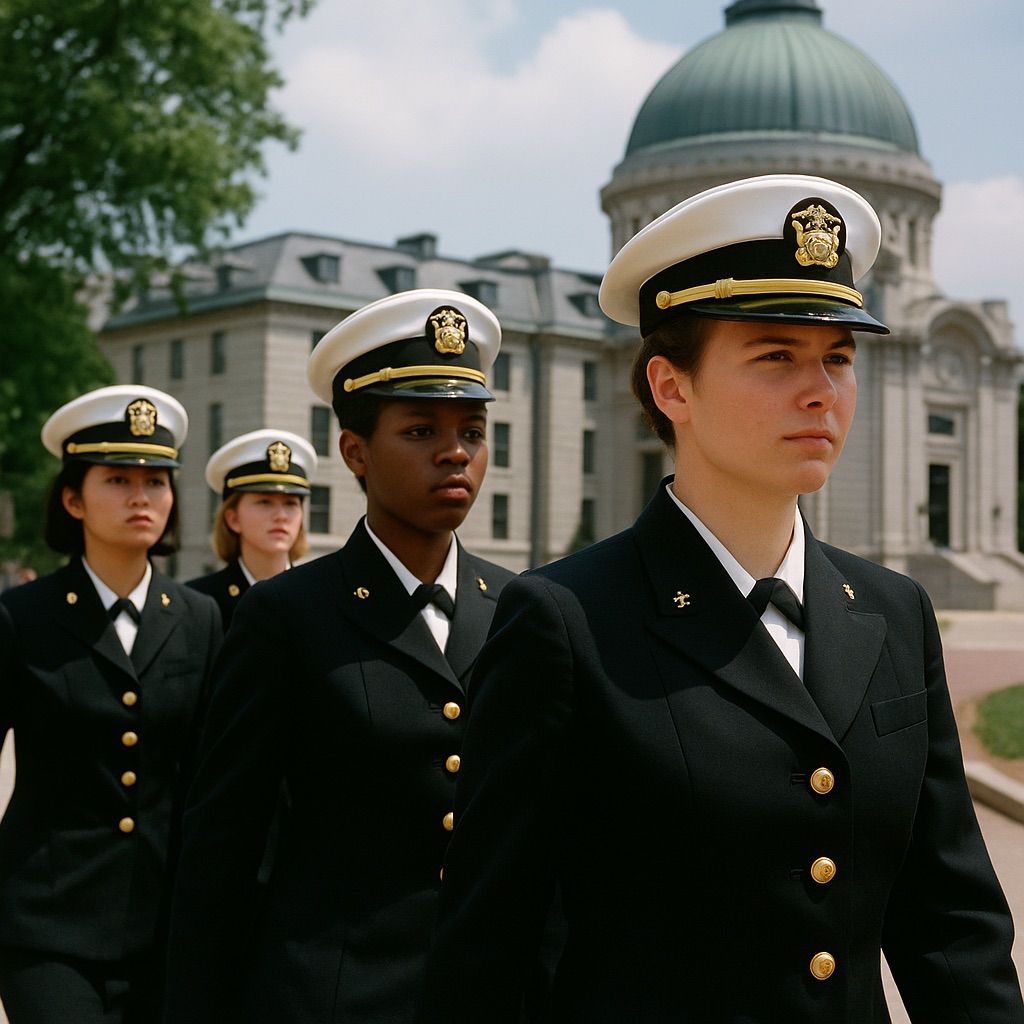
When the gates of the United States Naval Academy swung open on July 6, 1976, and the first class of women stepped onto the Yard in Annapolis, something fundamental in American military history shifted. It wasn’t a loud shift. There were no triumphant parades, no grand declarations, no booming speeches to commemorate the occasion. Instead, a quiet but powerful revolution unfolded as eighty-one young women walked into Bancroft Hall—some nervous, some determined, all painfully aware that every eye in the institution, and many across the nation, were watching them. These women were not only entering the Naval Academy; they were entering spaces and traditions that, for more than a century, had been reserved for men alone. And whether they intended to or not, they would become symbols of possibility, grit, and the relentless push toward equality in America’s armed forces.
It is easy from today’s vantage point to forget just how radical the idea was in 1976. The Naval Academy, founded in 1845, had existed for 131 years without a single female midshipman. Generations of officers had marched across its parade fields, studied navigation in its classrooms, braced through Plebe Summer, and served at sea, all without imagining a woman standing beside them wearing the same uniform. Military service for women existed, but it had always been limited—restricted roles, separate corps, invisible ceilings. The idea that women could train as future naval officers at Annapolis seemed, to many, like a disruption of the natural order. To others, like a long-overdue step toward justice. To the women who showed up that summer, it was both a challenge and a calling.
Most of the women who entered that first year had spent months preparing for what they knew would be an ordeal unlike anything they had experienced before. Plebe Summer was legendary for its intensity—yelling, drills, endless physical training, the buzzing pressure of upper-class midshipmen testing every mental seam and emotional joint. The academy didn’t water it down for the women. Why would they? The Navy wasn’t going to water down the fleet. And so those first days were a blur of shouted instructions, quick salutes, early wake-ups, and aching muscles. Some women arrived from military families, already familiar with discipline and hierarchy. Others came from small towns or city high schools where they were top of their class but had never stood face-to-face with a drill instructor. Some were athletes; some had never done a push-up under such scrutiny. But all arrived carrying a weight most male plebes didn’t: the pressure of proving that their entire gender belonged there.
Despite the official welcome, the atmosphere wasn’t always warm. Some male midshipmen resented the change. They said it ruined tradition, diluted the academy’s culture, or threatened the seriousness of naval training. A few expressed their disdain openly. Others showed it silently—in the way they looked past female midshipmen during formation, in the whispered remarks across the mess hall, in the skepticism that shadowed every one of the women’s movements. But there were allies too—upper-classmen who treated the women with professionalism, company officers determined to set the tone, and fellow plebes who realized quickly that the women were facing a tougher road than they were.
Still, the women endured the same rigors: the obstacle courses, the seamanship tests, the relentless memorization of Navy history, the forced marches, the midnight watches. And in meeting those demands, something remarkable happened. The academy, long famous for shaping men into officers, began shaping women into officers too—just as effectively, just as rigorously, and ultimately, just as proudly.
Behind every woman who made it through those first months was a private story. Some were driven by patriotism. Some were pushing against expectations from their own families. Some wanted to fly jets, command ships, or serve in submarines—dreams that were still decades away from being fully realized but already burning inside them. Others simply wanted to prove that they were capable of thriving in a place everyone said wasn’t built for them.
The public watched closely. Newspapers argued over whether women belonged in military academies. Editorial pages speculated about the academy’s future. Politicians made their speeches. But none of that captured the emotional reality of those women who were struggling every day simply to survive Plebe Year. They were exhausted, blistered, sleep-deprived, and constantly judged—not just on their performance, but on what their performance meant for every woman who might follow.
Some didn’t make it. Attrition hit the women’s ranks hard, just as it did the men. But those who remained grew tougher—physically, mentally, emotionally. They learned to bark commands with authority, to handle weapons with confidence, to navigate ships with precision, to stand firm when challenged. They learned to push through doubt, to drown out dismissive voices, to trust themselves even when others didn’t.
By the time they reached their second year, the academy began to change around them. The shock had faded. The skepticism dulled. And the women—through their competence and resilience—proved that they belonged. Their presence became less of an anomaly and more of a reality. They joined company leadership roles, excelled academically, earned respect from classmates who had once doubted them, and began laying the foundation for a future in which young women would walk through the academy gates without wondering whether they were intruding on forbidden ground.
Their graduation in 1980 marked a milestone not only for Annapolis but for the entire U.S. Navy. For the first time in American history, women were crossing the stage at the Naval Academy as fully trained officers—leaders ready to take on roles once thought impossible for them. They would eventually serve on combat ships, command naval units, become admirals, and even lead the academy itself. Every one of these achievements traces its roots back to the courage and persistence of those eighty-one trailblazers in 1976.
But the story of the first women at Annapolis is not a story of instant acceptance. It is a story of friction, of constant proving, of quiet strength under immense pressure. It is a story of individuals learning to exist in a system that wasn’t built for them, and then slowly reshaping that system through their presence, their discipline, and their performance. It is the story of a moment when the Navy, and the nation, began to recognize that leadership, intelligence, courage, and dedication are not bound by gender.
Today, more than forty years later, women make up a significant percentage of each incoming class. They lead companies, run drills, serve as brigade commanders. They stand in the same uniforms, march across the same parade fields, and sleep in the same dorms as the men—all without the shock, scrutiny, or suspicion their predecessors endured. But the legacy of the first women remains, woven into the academy’s culture and strengthened with every new class that arrives.
Those first eighty-one midshipmen didn’t just enter the Naval Academy—they cracked it open. They redefined who could serve, who could lead, and who could wear the uniform. They showed the nation what was possible when barriers fall, when courage overrides tradition, and when those who have been excluded are finally allowed to participate fully.
Their story is one of discipline and sweat, yes—but also of hope. Hope that institutions can change. Hope that opportunity can expand. Hope that equality can become real, even in places where it once seemed impossible. Their march through the gates in 1976 was more than the beginning of a class; it was the beginning of a transformation that continues to shape the U.S. Navy today.
And it all started because, on a hot July morning, a small group of determined young women straightened their shoulders, tightened their laces, and took the first steps into a future they would forever change.