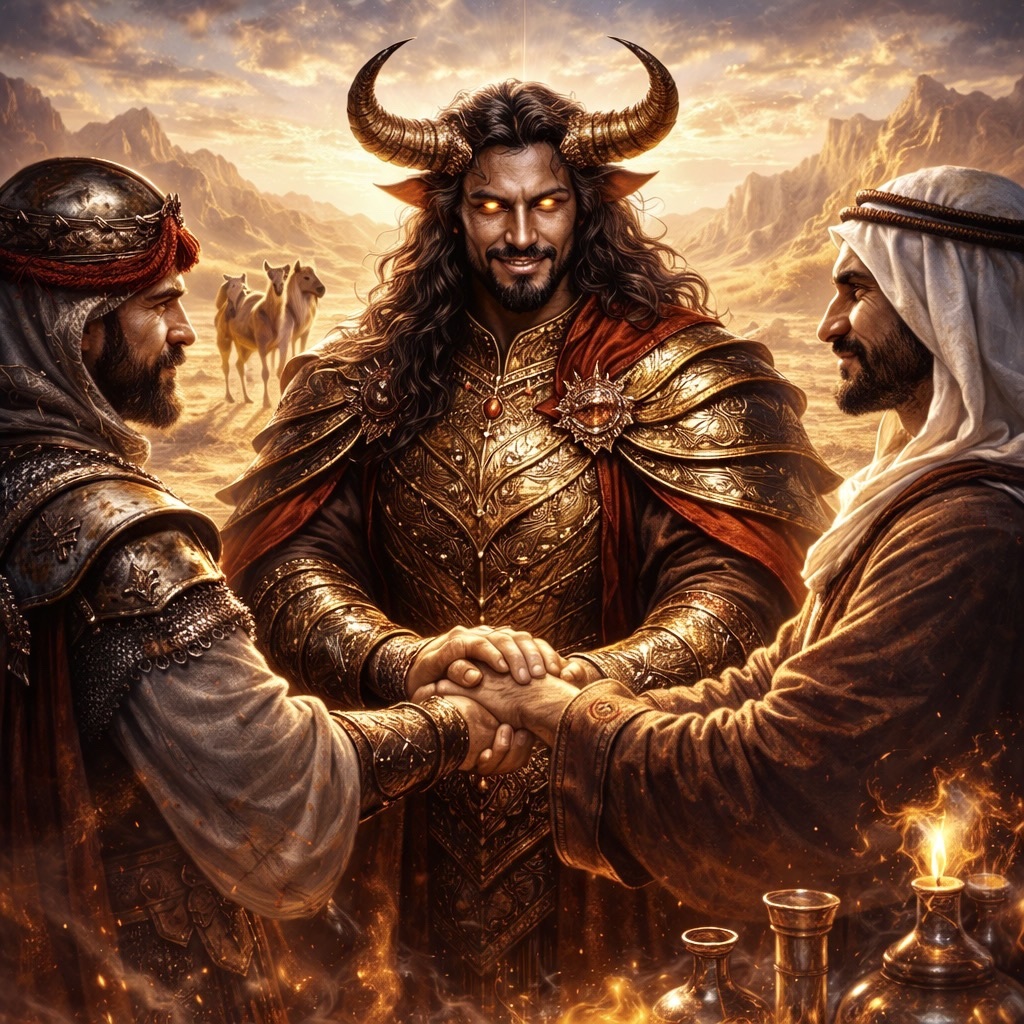
Uvall, also known as Vual, is not a demon of violence, spectacle, or terror. He is far more dangerous than that. He is a demon of agreement. In the Ars Goetia, Uvall is named as a Great Duke of Hell, commanding legions and appearing first as a mighty dromedary before assuming human form. This is not an intimidating image in the conventional sense, and that is precisely the point. Uvall does not conquer through fear. He conquers through conversation.
The camel form attributed to Uvall is deeply symbolic. Camels are creatures of endurance, trade, and long-distance survival. They move slowly but relentlessly, carrying valuable goods across hostile terrain. Uvall embodies this same principle in social and political space. He governs negotiation, persuasion, and the slow reshaping of relationships over time. His power is not immediate, but it is persistent.
Uvall is best known for his ability to procure the love and friendship of both allies and enemies. This ability is often misunderstood as charm or manipulation, but it is something subtler. Uvall does not overwrite free will. He redirects it. He understands what people want to hear, what they fear losing, and what they hope to gain. He speaks to incentives rather than emotions.
In demonology, Uvall is said to reveal the thoughts of enemies and bring about reconciliation, even between opposing sides. This makes him one of the most politically potent demons in the Goetia. He does not need to destroy an enemy if he can neutralize them through understanding or alliance. Under Uvall, conflict becomes conversation, and conversation becomes leverage.
When Uvall takes human form, he is described as persuasive, articulate, and socially adept. There is nothing monstrous about him. That normality is part of his threat. Uvall does not stand out in a room. He blends in, listens carefully, and speaks at exactly the right moment. His influence often goes unnoticed until outcomes are already decided.
Psychologically, Uvall represents the power of social intelligence. He is the demon of reading the room, of sensing shifts in tone, of understanding when to press and when to yield. He does not dominate discussions. He guides them. This makes him especially effective in environments where open force would fail.
Uvall’s domain over friendship is not sentimental. Friendship under Uvall is strategic. It is alliance. It is mutual benefit disguised as goodwill. This does not mean it is false. It means it is conditional. Uvall understands that most human relationships are transactional at some level, whether acknowledged or not.
One of Uvall’s most unsettling attributes is his ability to make enemies friendly without erasing their memory of conflict. He does not rewrite history. He reframes it. Under Uvall, former enemies do not forget why they opposed each other. They simply decide that cooperation is now more advantageous than hostility.
In occult warnings, Uvall is not described as treacherous, but he is described as influential. This distinction matters. He does not betray agreements lightly. He constructs them carefully. Once bonds are formed under Uvall, breaking them carries consequences, not because of punishment, but because of exposure. Uvall knows what everyone promised.
The dromedary symbolism also reinforces patience. Uvall is not the demon of quick deals or impulsive alliances. He understands that trust takes time to build and moments to destroy. His influence grows slowly, often invisibly, until it becomes structural.
In modern symbolic terms, Uvall feels strikingly contemporary. He resembles diplomats, negotiators, lobbyists, and power brokers who shape outcomes without appearing on the battlefield. He is the demon of soft power, of influence exercised through relationships rather than force.
Uvall’s rank as a Duke suggests authority over regions rather than empires. He governs zones of interaction: borders, trade routes, alliances, and negotiations. He does not rule absolutely. He coordinates.
Unlike demons associated with deception, Uvall does not rely on lies. He relies on selective truth. He knows which facts to emphasize and which to leave unsaid. This is not dishonesty in the crude sense. It is framing. And framing is often more powerful than falsehood.
Uvall also understands reputation. He knows how individuals are perceived and how those perceptions can be adjusted subtly. A rumor softened here, a compliment placed there, a concession remembered at the right moment. Under Uvall, social capital becomes currency.
There is a quiet danger in Uvall’s gifts. When conflicts are smoothed over too efficiently, underlying issues can remain unresolved. Uvall does not guarantee harmony. He guarantees cooperation. These are not the same thing.
Psychologically, Uvall represents the human desire to avoid open conflict, even when conflict might be necessary. He is the voice that says, “Let’s find common ground,” sometimes wisely, sometimes at the cost of truth. Uvall does not judge which outcome occurs.
Uvall endures in demonology because societies depend on agreement to function. Laws, alliances, and institutions all rest on negotiated consent. Uvall personifies the force that keeps those negotiations moving.
To engage with Uvall symbolically is to accept that power often flows through relationships rather than weapons. He teaches that influence does not need to be loud to be effective.
Uvall is not the demon of peace. He is the demon of accord. And accord, once achieved, can reshape the world without ever drawing blood.