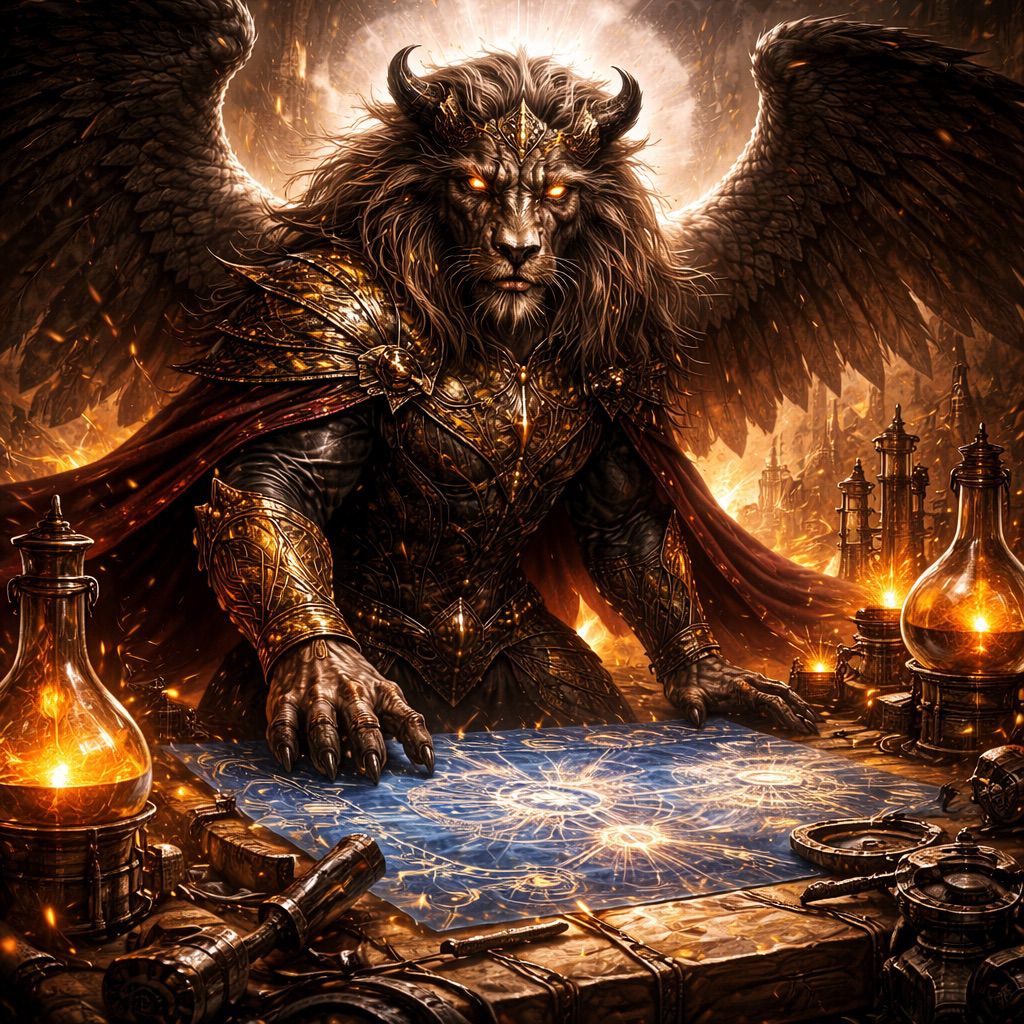
Vapula is not a demon of chaos, temptation, or raw destruction. He is something far more unsettling because he does not feel ancient in the way other infernal figures do. Vapula feels modern. He feels engineered. In the Ars Goetia, Vapula is described as a Great Duke of Hell who appears as a lion with the wings of a griffin. He commands legions and specializes in teaching philosophy, science, mechanics, and craftsmanship. Unlike demons who promise power through dominance or pleasure, Vapula offers something far more seductive: understanding.
Understanding is Vapula’s true domain. Not wisdom, not enlightenment, but functional knowledge. He teaches how things are built, how systems operate, how materials interact, and how ideas can be transformed into machines, structures, and tools. Vapula is the demon of applied intelligence. He does not ask why something should be done. He teaches how it can be done.
The lion-griffin form attributed to Vapula is deeply symbolic. The lion represents authority, confidence, and command. The griffin, a hybrid of lion and eagle, represents mastery over both the grounded and the elevated, the practical and the theoretical. Vapula’s form declares that knowledge is not passive. Knowledge rules.
Unlike demons who obscure truth, Vapula clarifies it. He strips away mysticism and replaces it with process. If something can be built, Vapula knows how. If something can be refined, Vapula understands the method. This makes him incredibly appealing to engineers, inventors, thinkers, and those dissatisfied with abstract answers.
In occult texts, Vapula is said to teach all handicrafts, philosophy, and sciences. This is not limited to intellectual pursuits. Craft implies hands-on skill, the ability to manipulate materials, tools, and systems. Vapula bridges the gap between theory and execution. He is the moment when an idea stops being imagined and starts being assembled.
What makes Vapula dangerous is not deception, but neutrality. He does not guide moral outcomes. He does not caution restraint. He teaches capacity. Once you know how to build something, what you choose to build is no longer his concern. Vapula’s indifference is where the threat lies.
In symbolic terms, Vapula represents technological acceleration without ethical brakes. He is the demon of innovation divorced from responsibility. Every age that has embraced rapid advancement without reflection has encountered Vapula’s shadow, whether they named it or not.
The sciences Vapula governs are not speculative. They are operational. He teaches mechanics, engineering, architecture, metallurgy, and the logic that binds systems together. Vapula understands cause and effect with ruthless clarity. If A leads to B, then B will occur regardless of who is harmed in the process.
This places Vapula in stark contrast to demons associated with illusion or manipulation. Vapula does not lie. He demonstrates. He does not promise results; he explains mechanisms. Once something is understood, it becomes inevitable. Vapula’s knowledge turns possibility into certainty.
Psychologically, Vapula represents the part of the human mind that values efficiency over empathy. The voice that says, “It works,” as justification enough. Vapula is not evil in the dramatic sense. He is amoral. And that makes him terrifyingly realistic.
In modern society, Vapula’s influence is everywhere. In automation. In weapons development. In surveillance systems. In infrastructure that functions flawlessly while quietly reshaping human behavior. Vapula is not the spark of innovation. He is the systematization of it.
The winged lion imagery reinforces this. Vapula is not confined to earthbound craft alone. He understands abstraction, mathematics, and theory, but always with the intent of application. Ideas under Vapula are not meant to remain ideas. They are meant to be used.
Unlike demons who are said to corrupt souls, Vapula corrupts priorities. He makes capability more important than consequence. He teaches that if something can be done, that is reason enough to do it. This mindset has driven both humanity’s greatest achievements and its most devastating mistakes.
In alchemical terms, Vapula is not about transformation of substances, but transformation of function. Raw material becomes tool. Tool becomes system. System becomes infrastructure. Infrastructure becomes dependence. Vapula governs that progression.
Occult warnings about Vapula are subtle but telling. He is not described as hostile or treacherous. He is described as effective. That is the warning. Knowledge gained through Vapula does not come with built-in restraint. It empowers, then steps aside.
Vapula’s rank as a Duke suggests command over disciplined legions. This mirrors how technology scales. One blueprint becomes thousands of machines. One process becomes an industry. Vapula does not work in isolation. He works in replication.
In narrative and symbolic interpretation, Vapula is the demon of “how,” not “why.” And in a world increasingly driven by optimization, speed, and efficiency, that distinction matters more than ever. Vapula does not ask whether a system should exist. He ensures that it functions.
What makes Vapula enduring in demonology is that he does not belong to the past. He belongs to every future humans build without fully understanding the cost. He is the quiet confidence behind systems that work perfectly and consequences that arrive later.
To engage with Vapula symbolically is to accept that knowledge is power, but power is not wisdom. He offers mastery without guidance, capability without conscience. What you build with that mastery is your responsibility alone.
Vapula is the demon of engineers who never ask who will be hurt, of thinkers who value elegance over humanity, of systems that function flawlessly while eroding the people inside them. He does not destroy civilizations. He equips them to destroy themselves.
And that is why Vapula is one of the most dangerous demons in the Ars Goetia. Not because he lies. Not because he tempts. But because he teaches.