
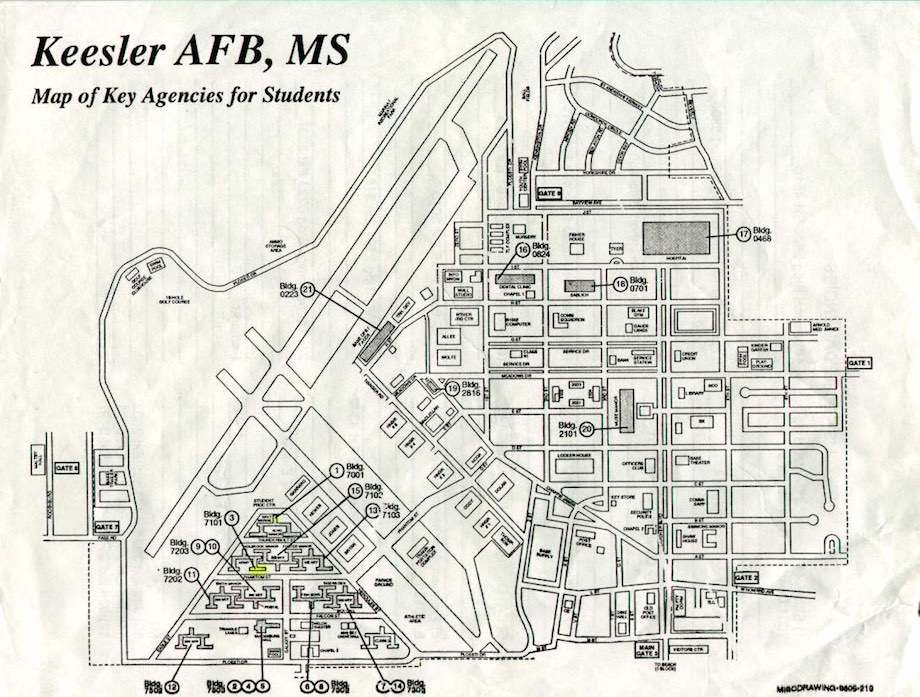
After graduating from Basic Military Training in San Antonio, Texas, I boarded a plane bound for New Orleans, Louisiana. From there, a bus carried me east along the Gulf Coast until we pulled into Biloxi, Mississippi—home of Keesler Air Force Base. The ride was long but filled with the kind of nervous anticipation that only comes with stepping into a completely new world. Clutching my issued duffel and the folded map of the base I’d been handed, I felt the weight of both excitement and nerves. Keesler would be my home for the next sixteen weeks, a place where I would trade the rigid lessons of basic training for the focused challenge of technical school. This was where the Air Force would turn recruits into professionals with real skills, and it was where I would begin to understand the role I had committed to play in serving my country.
The journey from civilian life to military life had already been dramatic at Lackland, but Keesler marked another turning point. Unlike basic training, where every day was a battle against fatigue, inspections, and the relentless push for discipline, technical training carried a different atmosphere. It wasn’t about survival anymore—it was about specialization. Here, we weren’t just Airmen in formation; we were future technicians, controllers, maintainers, and operators. Keesler was where the Air Force took its wide-eyed graduates and funneled them into their career fields, shaping us into the gears that kept the military machine running. For me, it was a chance to finally see the path I had chosen take form.
That map they gave me wasn’t just a folded piece of paper—it was a lifeline. Keesler sprawled out like its own city, with dormitories stacked row by row, classrooms buzzing with instructors, chow halls echoing with hundreds of conversations, PT fields alive with running cadences, and technical facilities where the hum of machines mixed with the scratch of chalkboards. For someone fresh off the bus, it was overwhelming. Every corner of that map represented a place I would come to know intimately: places where I would struggle with lessons, places where I would grow in confidence, and places where I would finally realize that the Air Force wasn’t just a uniform but a calling.
Life at Keesler settled into a rhythm that was both exhausting and exhilarating. Our mornings began with the sharp call of accountability formations, followed by long hours of lectures in classrooms filled with the glow of projectors and the drone of technical jargon. Afternoons were often hands-on, with lab sessions that required patience, precision, and teamwork. Inspections came without warning, and study sessions filled every free block of time. Evenings often blurred into nights, spent balancing between homework and the rare luxury of a few hours of downtime. Yet in the grind, we found friendship. My fellow Airmen became more than classmates—they became family. We shared laughter during long study nights, pushed each other through physical training, and swapped stories of home during rare quiet moments. Alone, Keesler could break you; together, it gave us strength.
The Gulf Coast setting added its own character to the experience. Humidity clung to the air, wrapping around us like a heavy blanket during outdoor drills, and sudden summer storms would sweep across the base, drenching us one moment and leaving clear skies the next. On weekends, if we earned the privilege, we could venture off base and taste a bit of southern life—seafood gumbo, jazz drifting from bars, and the sight of the Gulf of Mexico stretching into the horizon. These escapes reminded us that there was still a world beyond the gates, even if our time within them was tightly controlled.
Looking back, my arrival at Keesler marked the moment when the Air Force stopped being an abstract idea and became real. The base map I clutched that first day symbolized more than just directions—it was a guide into a new identity, one rooted in service, discipline, and purpose. By the time sixteen weeks had passed, I no longer looked at that map as a stranger. I could walk its halls and roads without thinking, every building tied to a memory of struggle, triumph, or growth. When I finally marched away from Keesler with my technical training complete, I realized I had transformed. I was no longer just a nervous newcomer clutching a piece of paper; I was an Airman with a skill set, a mission, and the confidence to meet whatever came next.